

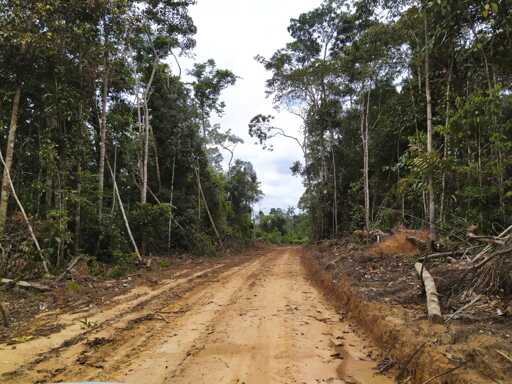
Along a freshly repaved stretch of the BR-317 highway in Acre, a Brazilian state bordering Bolivia and Peru in the Western Amazon, pasture stretches out as far as the eye can see. Solitary Brazil nut trees (Bertholletia excelsa), a protected species, are the only reminder of the tropical forest that once stood there. The road is part of the Interoceanic Highway, inaugurated in 2011 as the first paved road in South America connecting the Atlantic and Pacific oceans. Built through the Brazilian and Peruvian Amazon to help increase trade to Asia as well as between neighboring countries, the highway has been associated with deforestation on both sides of the border. “Roads are the main vector for deforestation and irregular [land] occupation,” says Sonaira Souza da Silva, a professor at the Federal University of Acre’s Floresta Campus and co-author of a recent paper on road expansion in Acre. The desolate landscape that now lines the BR-317 could be replicated elsewhere in Acre, environmentalists warn, if plans go ahead to build a second road connection with Peru. This is part of a renewed push to turn the state into a corridor to the Pacific for the export of Brazilian agricultural and mineral goods, following the 2024 inauguration of Chancay, a Chinese-built mega-port just north of Peru’s capital Lima. A new report from the NGO Amazon Conservation argues that expanding road infrastructure is incompatible with Acre’s deforestation commitments and that new corridors could add between 74,700 to 133,800 hectares (around 184,600 to 330,600…This article was originally published on Mongabay
From Conservation news via This RSS Feed.