

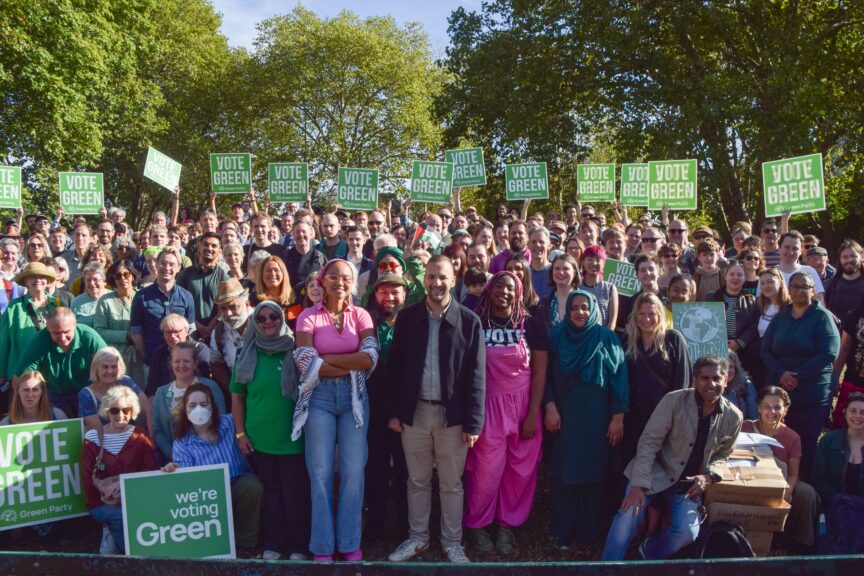
It’s Saturday morning in a Victorian public garden in Camden, north London, and the mood is upbeat. Green leader Zack Polanski is fighting a byelection in suboptimal conditions: in a seat with an 11,000 Labour majority, his approval ratings in a slump, and, unlike when the party won Gorton and Denton in February, a prime minister in Downing Street who not everyone totally hates. But on his side he has a party membership surpassing 230,000, of whom around 200 enthusiastic volunteers are out today. If Green members are apparently “turning on” Polanski for not being anti-Zionist enough, as one recent report in the rightwing press claimed, you can’t feel it here.
But that’s not to say Zionism isn’t being talked about. It is, as much on this sunny morning in Holborn and St Pancras as in the media in recent weeks, because of a controversial motion titled ‘Zionism is Racism’, set to be debated at the party’s conference just days before the 8 October byelection.
The Greens already have strong policies on Israel and Palestine, describing Israeli conduct as apartheid and genocide, backing a full arms embargo, sanctions and an end to occupation and illegal settlements. But the Zionism is Racism motion takes things further. It calls on the party to, among other things, state that it is anti-Zionist, support a single, democratic Palestinian state, demand freedom for Palestinian political prisoners, oppose the Palestine Action ban, affirm Palestinians’ right to resistance, and, as per the title, equate Zionism with racism.
The motion itself isn’t new, and nor is the hoo-ha around it. Submitted to the party’s spring conference but not put to members due to time constraints (or sabotage, depending on who you ask), it was leapt on by the rightwing press as evidence of a Green antisemitism crisis. By avoiding debating the motion back in March, the party just kicked the can down the road, Novara Media reporter Rivkah Brown wrote at the time. But some think that a fight, both with the media and within the party, is exactly what’s needed.
“The whole point of this motion is for us to challenge and confront the establishment,” said Lubna Speitan, a British-Palestinian activist and the proposer of the motion. “It doesn’t matter what the leadership thinks… It’s about us, the members… forcing their hand.”
Speitan’s comments followed an interview in which Polanski, who’s been under pressure to take a stance, said he was undecided about voting for the motion. He did say he believed it needed to better safeguard anti-Zionist Jews from being accused of racism, and it should be up to the people of the region to determine their own political settlement, not the Green party of England and Wales or the British state. Still, on Thursday night, Polanski sat in front of the Board of Deputies of British Jews and declared he was an anti-Zionist – something supporters of the motion claimed as a win.
Ashok Kumar, a Green member who’s backing the motion, told Novara Media: “It’s the right position”.
“[The] politics of the country have shifted quite dramatically since late 2023,” Kumar said. “We’re actually meeting the proportion of the population that really feels strongly about this.
“There is no fence-sitting on this… Some things aren’t nuanced. Slavery, not nuanced. Zionism, not nuanced… The point is to throw down the gauntlet and say, ‘You’re either with the people of Palestine, or you’re with the oppressors’.”
But even anti-Zionist members who don’t find much to disagree with in the content of the motion have raised doubts about whether or not it’s strategic. Some activists are dismissive of the media ire it’s drawing: “Come at us,” said Kumar, “You stand up to the press… and people actually respect that.” But others believe a big debate about Zionism could harm the party’s electoral chances – and without doing anything to make Palestinians’ lives any better.
“It’s quite an abstract debate, it’s quite an academic debate”, said a local party chair, who asked to remain anonymous due to his role. “It’s not particularly relevant for most people in the country at large.”
A Green councillor in south London agreed. “[The motion] traps us at the level of language and definitions… There’s a perception that there’s a dial called ‘anti-Zionism’ and the higher you turn it, the more Palestinian liberation you get. And obviously that’s not true.”
This isn’t an argument for not talking about Palestine. Joe Todd, a writer and Green party member, said he wanted the Greens to have a motion on Palestine that puts pressure on the Labour party in a material way, and that people can understand and relate to. “Trying to talk about Zionism is Racism on the doorstep is just not gonna fly,” he told Novara Media.
There’s a lot of “latent frustration” about the motion, said the local chair. But there’s also an atmosphere in which “people feel like they can’t put their heads above the parapet and say, ‘Actually, no, I don’t think this is right’”, claimed the councillor, who didn’t want to be named for this reason. While many of the motion’s supporters are engaging in collegial debate, others have reportedly heckled dissenting voices. As writer and activist Shanice McBean has noted, some have mobilised the identity of the Palestinian people in defence of their positions, suggesting that the proposed amendments to the motion are a reflection of the Israel lobby.
Jo Dowbor is a co-founder of Greens for Palestine and co-chair of the Young Greens. She supports the motion, but said she believed that some of the toxicity around it, which isn’t the norm within Green party culture, is to do with “how we’ve seen a livestreamed genocide, and how that has affected us all emotionally”.
Kumar doesn’t buy the strategic concerns. He argued that no one is not going to vote for Green because of the Zionism is Racism motion, and it’s precisely through motions like this that the party can shape wider politics and “shift the paradigm”.
“Zack may have never called himself an anti-Zionist and said that Zionism as it’s practiced today is racism without this motion,” he said. “The question may not have even been asked.”
Ultimately, some of the debate comes down to a broader disagreement over how the party will transform the political landscape. Kumar said he doesn’t care if the Greens don’t win as many seats as they otherwise might. “I’d much rather us be a party with strong politics, a democratic tradition, polling between 10-14%. That’s far more effective at shifting the gears of politics in Britain.”
Todd wants to see the Greens become an ecosocialist party that someday aims to form a government. This means “obsessing over getting to 30%” by being “principled but flexible”, following the Belgian Workers’ Party – starting with political principles but shaping how they’re communicated depending on where people are at, he explained.
“The thing that would push forward the Palestinian cause,” Todd said, “is having a genuinely anti-Zionist and pro-Palestinian party in government and in control of the British state.”
From Novara Media via This RSS Feed.