

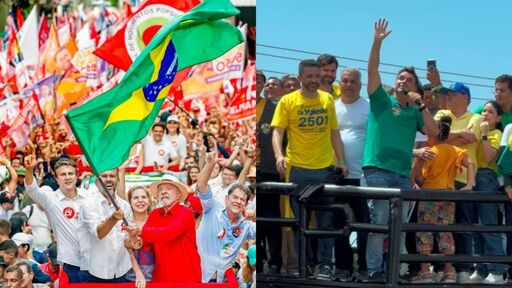

The election campaign in Brazil is at its peak. Candidates are stepping up their speeches, campaign ads are airing more frequently, and attacks on opponents are the order of the day. Brazilian political life has found its focal point, and that is the contest – as it is being portrayed – between two titans.
On one side is the country’s current president, the legendary labor union leader and head of the Workers’ Party, Luiz Inácio Lula da Silva – a representative of progressivism and Brazil’s center-left – who has stated that he has chosen to run for reelection to prevent the far right from conquering one of the last countries to have resisted the new wave of far-right politics in South America.
Leading the charge is Flávio Bolsonaro, a senator from São Paulo who has stepped into the long shadow of his father, the neoliberal and ultra-conservative former president Jair Bolsonaro (a close friend of Trump’s) who is currently in custody, according to Brazilian authorities, for his role in an attempted coup d’état aimed at preventing the swearing-in of the current president, Lula.
The latest polls
For now, polls predict a potential runoff election (October 25) to determine the president, as neither candidate is expected to reach the 50% needed to win in a single round.
According to the polling firm Quaest, Lula continues to hold a slight 5% lead over Bolsonaro. Thus, the center-left candidate would reach 39% and Bolsonaro 34%. Meanwhile, the polling firm BTG Pactual/Nexus reports that Lula has 42% and Bolsonaro 37%.
The remaining candidates would not receive more than 4%, while undecided voters account for 5%. About 10% of those surveyed said they would cast a blank or invalid vote.
In a potential runoff, the race is much closer. Quaest reports that Lula and Bolsonaro would be tied in a future runoff, each with 42%. Nexus, on the other hand, gives Lula a lead in the runoff with 46%, compared to Bolsonaro’s 44%.
Two models, one possible path
From a media and strategic perspective, portraying the South American giant’s current situation as a crossroads can sometimes be a bit misleading. Both candidates advocate capitalism as the only viable economic system, and both are open to international cooperation with necessary trading partners.
However, the major differences – and the significant possibilities that accompany them – undoubtedly point to two distinct paths the country could take. Bolsonaro advocates for a radical reduction of the state and the full opening of the country to international capital, which has once again turned its attention with great interest to South America’s immense natural resources. Minerals, gold, oil, and Brazil’s enormous hydroelectric potential are fundamental to the new material distribution of the imperialist economy.
And while Lula is by no means an isolationist (in fact, he promotes investment) he is not a politician willing to hand over those resources at any cost without a significant state presence and without promoting the economic interests of Brazilian capital. Furthermore, Lula has based his campaign, among other things, on the country’s sovereignist rhetoric.
This issue is probably the most important in geopolitical terms. Lula is not part of Trump’s political-military coalition known as the Shield of the Americas, the true operational arm of Washington’s hemispheric strategy – namely, securing Latin America as its zone of control and influence.
Flávio Bolsonaro, on the other hand, asserts that during his potential presidency, the United States will be not only his main political partner but also his security partner (a relationship that has historically held over the past few decades).
And Trump, of course, has not been a bystander in this dispute – even from a personal standpoint. When he learned of Jair Bolsonaro’s conviction for an alleged coup attempt, he stated that he would impose sanctions on the Brazilian economy for having imprisoned the man he called “his friend.”
In response, Lula has played a game that carries high economic costs but maintains a firm diplomatic stance. Whenever tariffs have been raised, Lula has ordered a similar response, which has put him in direct conflict with the Trump administration.
This issue is likely of much greater significance than it appears, given that Brazil alone accounts for nearly 50% of the region’s total GDP. Therefore, what is at stake in Brazil’s upcoming elections is more than just a presidential election; it is also the continuation of a right-wing wave in the region or a halt to it – one that, given Brazil’s economic and territorial importance, could mean more than just a statistical anomaly.
From BT News via This RSS Feed.