

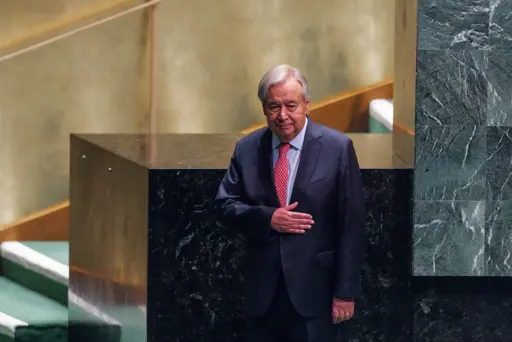
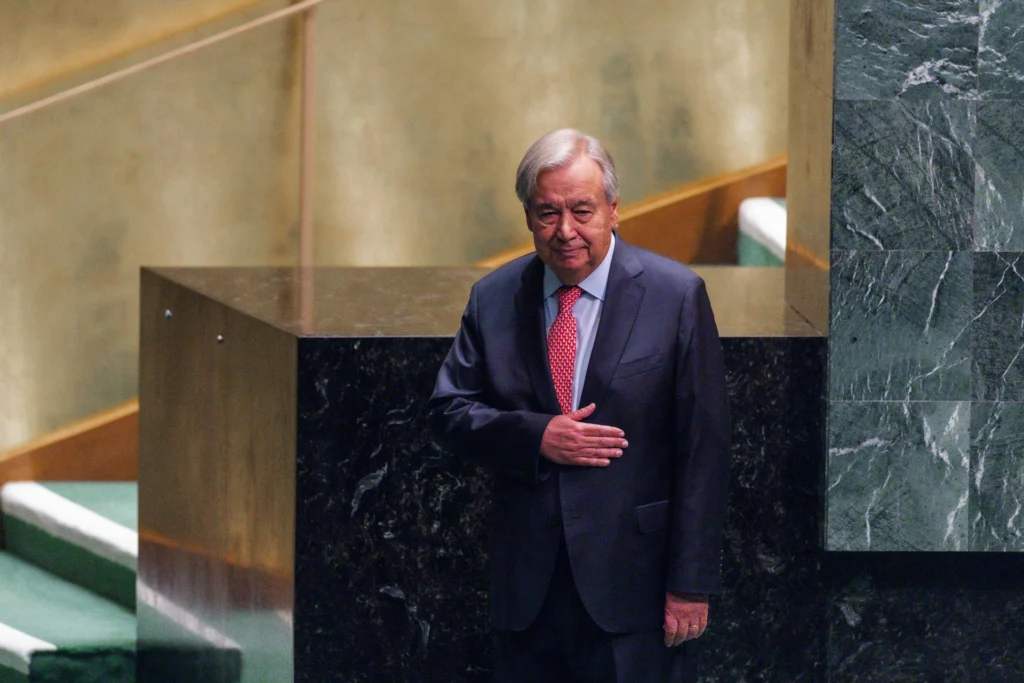
UN Secretary-General Antonio Guterres called on the United States and Russia on Tuesday to establish a successor framework to the New START treaty, after the last remaining bilateral nuclear arms agreement between the two countries expired in February.
This appeal comes at a critical juncture, as the last bilateral nuclear arms control agreement between the two superpowers lapsed in February.
The diplomat warned that, following the treaty’s expiration, there are now no binding limits on strategic nuclear arsenals “for the first time in more than half a century.” He cautioned that “rising risks and the erosion of safeguards are a one-way ticket to disaster.”
RELATED: Zakharova Denounces Efforts to Move Nuclear Weapons Closer to Russian Borders
Antonio Guterres called on all nuclear-armed states to reduce the role these weapons play in their security policies through confidence-building and transparency measures. He also argued that nuclear disarmament “is not a favor,” but a “legal obligation” enshrined in international treaty law.
“For more than eight decades, humanity has lived under the nuclear threat,” Guterres said, recalling the devastating impact of the atomic bombs dropped on Hiroshima and Nagasaki. “The shadow is darkening,” he added. The UN chief urged Washington and Moscow to avoid a renewed nuclear arms race and instead choose “a future without nuclear weapons.”
The threat of nuclear catastrophe is back.
But we cannot allow setbacks to weaken our resolve.
It’s time to choose dialogue over division, diplomacy over confrontation & disarmament over destruction.
Let’s build a safer, more peaceful world for all.
— António Guterres (@antonioguterres) September 26, 2026
Guterres’ remarks come amid growing international concern over the collapse of the last major arms control framework between the world’s two largest nuclear powers.
The New START treaty, which had capped the number of deployed strategic nuclear warheads and delivery systems held by both countries, expired in February without a replacement agreement in place, leaving both nations free to expand their arsenals without formal verification mechanisms or binding numerical limits for the first time since the Cold War era.
Data compiled by the Federation of U.S. Scientists and the Stockholm International Peace Research Institute (SIPRI) between 2025 and 2026 indicate that Russia and the United States together hold roughly 90 percent of the world’s nuclear arsenal, with China, France and the United Kingdom following at a significant distance. The concentration of nuclear capability in just two countries has long made bilateral arms control agreements between Washington and Moscow central to global nonproliferation efforts, making the current absence of any binding framework particularly alarming to disarmament advocates.
Guterres’ call for renewed negotiations comes at a moment of broader geopolitical tension between the two nuclear powers, with relations between Washington and Moscow having remained strained over multiple ongoing conflicts and diplomatic disputes in recent years.
Arms control experts have repeatedly warned that the absence of a successor treaty removes both the verification mechanisms and communication channels that previously helped reduce the risk of miscalculation between the two nuclear superpowers, a concern Guterres directly echoed in his address marking the international day dedicated to nuclear disarmament.
From teleSUR English via This RSS Feed.