

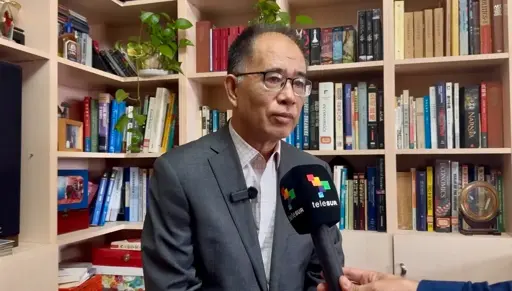
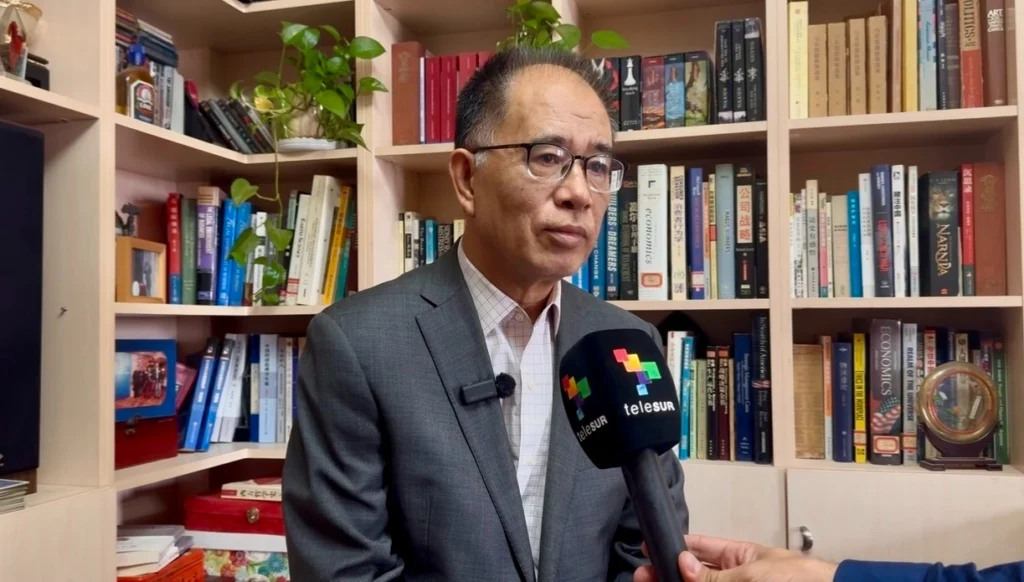
Liu Baocheng, professor at the University of International Business and Economics of China, spoke to teleSUR in Beijing.
The meeting between Chinese President Xi Jinping and U.S. President Donald Trump on September 24 in Washington produced new agreements and dialogue mechanisms, but did not eliminate the structural differences between the world’s two largest economies.
RELATED: China and the U.S. Must Compete While Avoiding Conflict: President Xi
For Liu Baocheng, professor at the University of International Business and Economics (UIBE), the main challenge now is to turn the commitments reached into a more predictable and stable relationship.
“Cooperation as the mainstay. Competition, I think, can be healthy for both sides, but it needs to be properly guarded against possible confrontation,” Liu said.
The two countries reaffirmed their commitment to building a “constructive relationship of strategic stability” and reached new understandings on trade, counter-narcotics, artificial intelligence and military communication. They also reaffirmed mutual support for hosting APEC and the G20, while discussing issues including Iran, Ukraine and the Korean Peninsula.
In the trade area, China and the United States endorsed the results of consultations between their economic and trade teams, including a reciprocal tariff reduction arrangement worth $30 billion. The two countries also continued work on rare earths and critical minerals and on bilateral trade and investment mechanisms.
Ver esta publicación en Instagram
Una publicación compartida de teleSUR English (@telesurenglish)
Stability, Trade and Trust
According to Liu, negotiations leading up to the Washington meeting intensified after Trump announced his tariffs in April 2025. Since then, five rounds of talks have been held in different parts of the world, expanding consensus around what he described as more realistic and feasible outcomes.
Among the objectives were consolidating tariff reductions, expanding market access and ensuring greater stability in the supply of rare earths and critical minerals. For Liu, however, the central challenge goes beyond trade measures.
“Fundamentally, it is about repairing some of the trust that has been missing.”
Liu argues that businesses can absorb some of the costs associated with tariffs and other restrictions, but that unpredictability represents a much greater problem.
“Businesses can bear some of the costs associated with tariffs or other types of restrictions, but what they are most afraid of is volatility and frequent reversals of policies.”
According to the professor, a lack of predictability affects business decisions, investment, global production chains, finance, monetary policy, academic and cultural exchanges, visas and the movement of people.
“Stable means transparent rules, with differences put on the table for dialogue and negotiation.”
Liu therefore argues for permanent mechanisms that can manage differences before they turn into new retaliatory measures.
“It is very important whether the two sides can really establish an institutional framework to prevent firefighting—from restrictions to retaliation—and instead create more preemptive measures for regular dialogue, with a fixed agenda.”
The professor sees the new bilateral trade and investment mechanisms as potential instruments for establishing such institutional guardrails.
“Those mechanisms used to be more effective, but they really cooled down. Now, there is a need for a new set of institutional guardrails.”
For Liu, both China and the United States have legitimate national security concerns. However, he warns that when such concerns exceed their proper scope, they can reduce the potential gains from cooperation.
He also emphasizes that the relationship between the two powers has consequences far beyond their bilateral ties.
“Global issues require understanding between the two superpowers to prevent the escalation of regional situations and geopolitical confrontation.”
In this context, Liu identifies two key concepts for the bilateral relationship: stability and continuity. The two governments had already agreed during Trump’s visit to China in May 2026 to build a relationship of strategic stability.
“Continued strategic engagement benefits U.S. farmers, businesspeople and consumers.”
For the professor, abrupt changes in tariffs and other restrictions can affect the broader economy. Maintaining dialogue would therefore require political commitment from both sides and a long-term vision.
Ver esta publicación en Instagram
Una publicación compartida de teleSUR English (@telesurenglish)
Competition and Artificial Intelligence
Artificial intelligence also played an important role in the discussions between Xi and Trump. The two countries agreed to establish an AI dialogue and a bilateral communication channel for AI-related incidents.
For Liu, artificial intelligence represents a profound transformation, but also creates risks that require international cooperation and rules.
“AI is really a game changer, and it is there to usher in a whole lot of transformative prospects for all people on this planet.”
“But the issue is that there are certain worries that whether AI is going to be misused for any type of technological breakthroughs, and there are realistic and also understandable worries over that.”
According to the professor, China and the United States occupy leading positions in AI development, although they have different strengths.
“Both sides are really in a leadership role, although they have different advantages at the frontier.”
Liu argues that the United States has advantages in basic scientific research and frontier breakthroughs, while China has a strong capacity to rapidly adopt innovations and deploy them on a large scale.
For the professor, that complementarity provides a basis for cooperation.
“There is therefore a good reason for the two sides to work together by combining their respective advantages.”
Liu also sees potential benefits in technological competition, provided that it does not develop into confrontation.
He argues that cooperation should include rules to prevent destructive military uses of AI and to avoid allowing a technology with enormous power to become concentrated in the hands of a small number of countries or actors.
According to Liu, expanding access to open-source technology alone is not enough. Countries also need to develop their own capabilities through cooperation and assistance programs, particularly across the Global South.
The professor warns that unequal development of AI capabilities could create a new technological divide between countries.
“If only a few nations control such powerful technologies, it would be unfair and could create problems in the future.”
His concern is summarized in a broader principle: “Human civilization needs to be shared by all humanity.”
Liu also identifies trust as one of the major challenges facing technological cooperation. He points to concerns surrounding Chinese technologies and products in the United States, including suspicions about potential security risks, while U.S. companies operating in China can also face concerns over data collection and protection.
For Liu, these cases demonstrate the need to combine technological development with transparency and accountability.
RELATED: China and Us Reach Agreement on Coal and Establish Channel of Dialogue on AI
Differences That Remain
Despite the new dialogue mechanisms, differences between Washington and Beijing continue to extend beyond trade and technology.
During the meeting, Xi urged the United States to oppose “Taiwan independence” and handle the Taiwan question cautiously. The two presidents also discussed the Middle East, Ukraine and the Korean Peninsula.
For Liu, precisely because disagreements will not disappear, channels are needed to prevent each new dispute from triggering an escalation.
“The key is stability and continuity, which can help prevent the relationship from escalating into confrontation.”
The professor views the Washington meeting as part of a broader process of managing differences between the world’s two largest economies and major powers.
“I hope this meeting sets a cornerstone for navigating the complexity, both domestically and globally.”
From teleSUR English via This RSS Feed.