


If you scroll down on the list of “Carbon Majors,” the 178 producers that are responsible for most of the world’s fossil fuel emissions, you will eventually get to a company called Continental Resources. This firm is ranked around 150, well after giants like Saudi Aramco and ExxonMobil, but it has still produced almost 600 million tons of carbon dioxide since 2005 alone, equivalent to the combined carbon footprint of around 2 million Americans over that same time. The founder of this company is a man named Harold Hamm, the spitting image of an American oil executive — he grew up dirt-poor in Oklahoma, worked his way into fracking riches, but he still speaks with a Southern drawl. He now uses his wealth to bend the government to his will, raising millions of dollars for Republican candidates and funding crusades against green energy.
If you squint, the protagonist of Alejandro González Iñárritu’s new film Digger could pass for Hamm, or for the Hamm-like archetype that has bled into the American psyche. The film centers around an oil executive named Digger Rockwell, a Texas-accented plutocrat who has built his father’s wildcat oil company into a global concern with offshore rigs in Greenland and Alaska. As depicted by Tom Cruise, he is the ideal of the Southern businessman-ideologue, partial to monogrammed private jet seats and roaring rants about his own genitalia. Other than making money, his sole concern seems to be the welfare of his white cat Maggie, whom he is trying to keep alive against veterinary advice even as she decomposes in his arms.
Digger examines two questions. First, how much responsibility does such an individual bear for the deaths and displacements caused by global climate change? Second, what is the right way for an artist to consider the first question? If you think you already know the answers to these questions, this may be the movie for you, though I can’t promise you’ll enjoy watching it. In trying to construct a fable about the hubris of oil titans like Hamm, Iñárritu has produced a film that says nothing except what the viewer already knows. He is all too aware that political parables about corporate greed are of limited artistic value, but he can’t manage to escape the confines of parable. The result is a mess of shrieking and spittle that will leave even the most climate-conscious viewers reaching for an Advil.
After an opening scene in which the audience is given the chance to marvel at Cruise’s physical metamorphosis into a flabby oil executive, the plot arrives with the delicacy of a tornado siren. A technician on Digger’s rig in Greenland calls to tell him that a methane leak has opened up a large crack that threatens the stability of the island’s enormous ice sheet. Before Digger can even finish a monologue about how he’s not going to shut down a billion-dollar platform because of a tiny crack, another group of company officials arrives on his doorstep to tell him that the rig has blown up and the Greenland ice sheet has already collapsed. Now a massive iceberg is headed straight for Europe, with the potential to flood the continent and kill hundreds of thousands of people. Digger confers with the president (John Goodman) to figure out what to do, and they quickly decide to keep drilling.
This opening act achieves a level of heavy-handedness that remained out of reach even for Adam McKay’s Don’t Look Up, the last major film to satirize those responsible for global warming, which likened climate change to a comet about to hit the earth. Digger’s proposed response to the crisis is to deploy a digital tool called the “firewall” to censor all mentions of “methane,” “iceberg,” and “climate change” from the Internet, while the president and his conservative cronies make predictable suggestions about bombing the iceberg or praying to God for deliverance. Whereas McKay opted for CNN-toned realism, Iñárritu’s aesthetics are a more interesting mix between Wes Anderson and Thomas Hart Benton — Digger’s boardroom is full of Art Deco murals depicting oil discoveries, and above the table hangs an obvious sculpture of a snake eating its own tail.
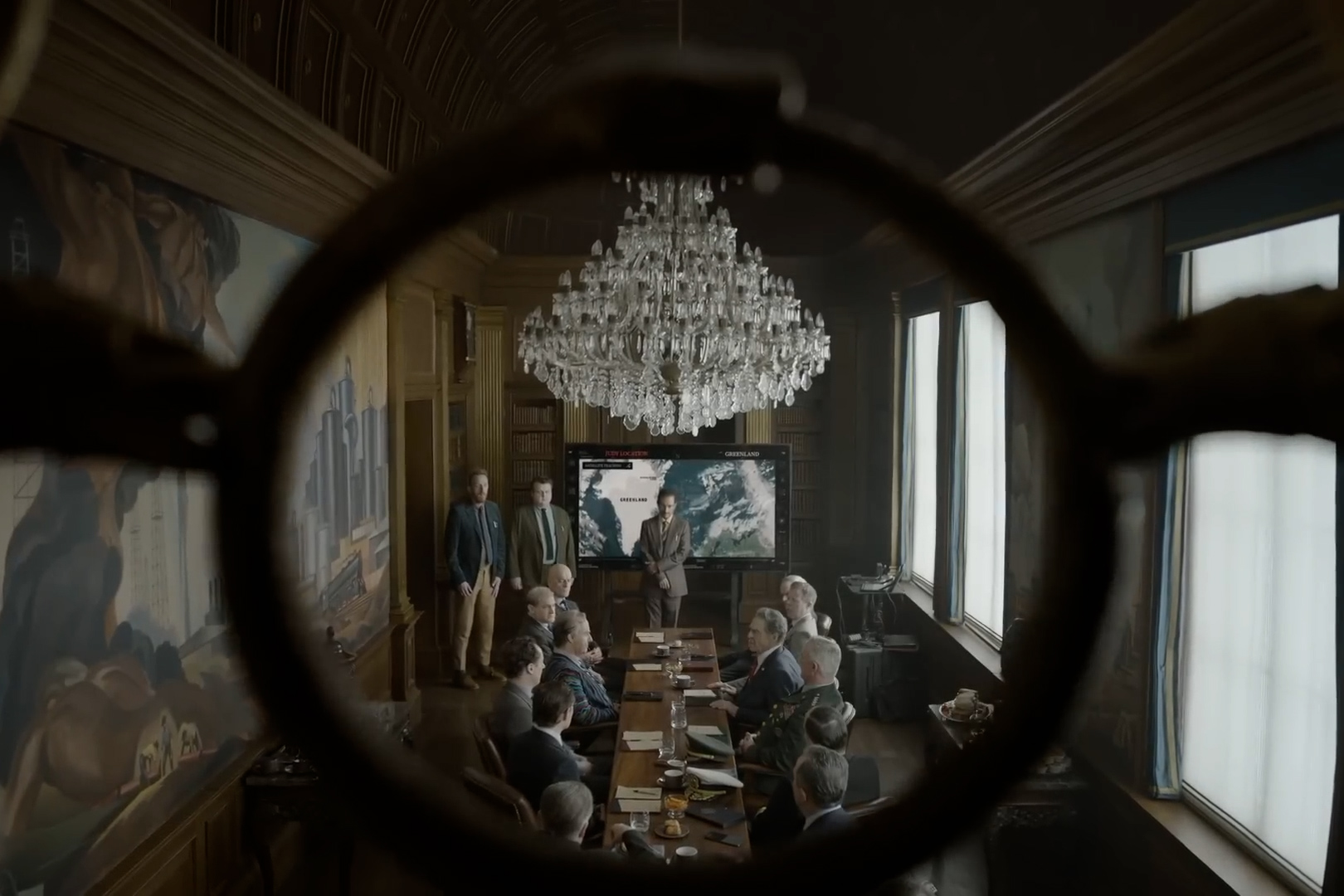
Digger Rockwell (Tom Cruise) meets the president in a boardroom to discuss the iceberg approaching Europe. Courtesy of Warner Bros. Pictures
The dialogue is full of jokes about climate change that will likely be catnip for the small minority of viewers who already spend most of their days thinking about it. There are references to the outsize global warming potential of methane and to a supposed “COP30 fiasco” at which the U.S. alienated its allies by withdrawing from the Paris Agreement. (In reality, they were almost happy to see us go.) There’s even a reference to thawing Arctic permafrost that will be familiar to devoted Grist readers. The vehicle for these revelations is a series of dialogues between Digger and his in-house scientist Ganesh (Riz Ahmed), each of which devolves into a fusillade of worn-out culture war tropes. Ganesh rejects Digger’s offer of delectable sashimi on the grounds that the bluefin tuna population has declined by 97 percent, “even though this administration won’t label them endangered.” He then tries the sashimi and loves it.
Whether or not this satire provides an accurate picture of the world economy, it does not make for enjoyable moviegoing. Well over half the movie consists of people screaming their lungs out about methane or the stock market, culminating in an unbearable scene in which Digger berates the European parliament, calling them hypocrites for using his product while condemning his company. The Danish and German legislators howl at him from the benches, accusing him of genocide for allowing the iceberg to hit Europe, and Digger screams back for several minutes about how the world needs his crude. “You want me to keep producing,” he says. “You demand, and I supply!” If you’ve ever worked in climate change, participated in climate politics, or gotten into a debate about climate change on social media, the whole exchange will feel familiar, and not in a good way.
If I hadn’t been assigned to review the film, I might have walked out after the European parliament scene — not because of what Digger was saying, but just because it was ugly, loud, and unpleasant. Regardless of whether you agree with Digger or with the Europeans, who wants to listen to all that? In a Cruise-appropriate twist, the most pleasant moment of the entire film is when the U.S. Air Force scrambles a squadron of fighter jets to carpet bomb the iceberg. It’s almost the only moment in the movie where everyone shuts up.
The movie includes a twist, or perhaps better to say a reveal, that is intended to show that Iñárritu is up to more than McKay was in Don’t Look Up. At the risk of giving too much away, this isn’t just a parable about climate change, it’s a parable about a parable about climate change. The apparent intention of this narrative complication is to ask what might be achieved by subjecting a viewer to a ham-fisted metaphor like the one the audience has just endured.
McKay’s obvious hope in Don’t Look Up was that such fables might spur people to action, and we can see how well that worked out a few years later — Donald Trump, a climate denier, received almost 80 million votes and triggered a global trend of “climate hushing,” or refusing to look up. Watching a movie about a tyrannical oil executive isn’t likely to make anyone buy an electric vehicle any more than reading the list of the largest emitters would.
So why bother? Iñárritu seems to want to make the case for the value of chronicling our state of affairs, even if that chronicle drifts into caricature. A few guys really have gotten rich selling a product that has enabled global welfare while also threatening the continuity of that welfare. Those guys are much more inclined to continue selling their product than to stop. Isn’t there some value in preserving that truth for our descendants? During a scene whose context I won’t reveal, one character says the following: “It’s ridiculous, and it’s scary, and it’s funny, and it’s stupid. It makes no goddamn sense, but it’s what happened.”
Be that as it may, a film still needs a heart, and Digger doesn’t have one any more than Digger himself does. Despite the shots of Cruise looking longingly at his disintegrating cat or at an oil rig sunset, it doesn’t even achieve the level of emotional resonance of a Marvel movie. It has about as much human warmth as a Twitter debate about permitting reform, and its final suggestion that stories can provide solace in times of great calamity is a classic instance of an artist telling where he should be showing.
If Iñárritu’s point is to show through metaphor that corporate greed has abetted the climate crisis, well, he has made that point only too well. If the point is that this kind of metaphor is simplistic and of dubious political utility, he has also made that point. Even so, viewers looking for stories about the sins of big business may wish they had spent their hard-earned wages on a showing of Coyote vs. Acme, the acclaimed recent Looney Tunes revival. At least there, when the TNT crate drops, you don’t have to think before you laugh.
This story was originally published by Grist with the headline ‘Digger’ is the year’s big climate movie. This climate reporter hated it. on Sep 29, 2026.
From Grist via This RSS Feed.