


By YAYA MARIAH
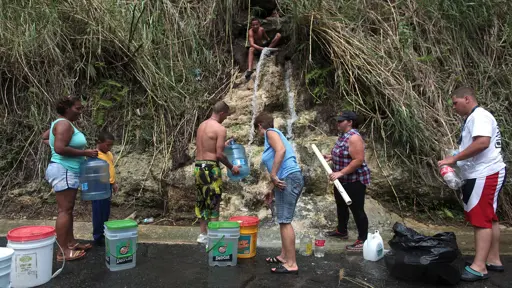
Buckets. Trash bins. Barrels. Any form of container, big or small, is a necessity for island life in the archipelago of Borikén. Surfacing on the news for the past month has been Puerto Rico’s water crisis. On Aug. 7, 2026, the governor of Puerto Rico, Jennifer Gonzalez-Colon, declared a state of emergency and forced a 48-hour rotating water shut-off period for municipalities served by the Carraízo reservoir (including San Juan, Carolina, Loíza, Trujillo Alto, Canóvanas, Gurabo, and Juncos) during the hottest, driest season of the year, affecting more than 180,000 homes.
The current crisis began in mid-June, when Puerto Rico’s Aqueduct and Sewer Authority (known as PRASA, locally known as AAA) detected a rupture in the 72-inch Superaqueduct pipeline in Bayamón, one of the island’s most important water distribution arteries, with breaks at three separate points. A few days later, two additional outages emerged elsewhere in the system.
What the governor and federal government would have you believe is that the crisis is an unfortunate natural disaster that is strictly out of the hands of the people. Gonzalez-Colon said in a statement: “This situation is beyond our control. It is the result of the weather conditions we have been facing.”
Of course, the climate crisis has a part to play. On Aug. 26, Puerto Rico joined other Caribbean islands in a U.S. government drought disaster declaration. More than 33% of Puerto Rico is under extreme drought, and another 30% under a severe drought. July was the driest month on record for San Juan in more than 100 years and the second hottest for the island’s capital. In July, the island experienced over 300 brush fires, too. Meteorologists say the ongoing drought is the result of a natural warming cycle known as El Niño, but this is not the cause to the water crisis, merely an aspect that exacerbates it.
So, what is the reason for this crisis if not the drought (because, of course, the drought is what made the rupture, right)? Why, according to the media, has Puerto Rico been going without water for a month?
Well, firstly, this water crisis isn’t new, and it hasn’t just been going on for a month.
For example, Rosa Flores, a single mother of three, lived in el campo—the countryside—in the municipality of Aguas Buenas. Her oldest child was12, and her youngest was a newborn with the most severe form of spina bifida. Growing up in el campo, Flores’s children understood that seeing buckets, trash bins, and containers throughout the community was not only a normalcy but a necessity.
The area’s plumbing was inconsistent, so they relied on rainwater harvesting. Collected rainwater was used to flush toilets, wash dishes, bathe and, when necessary, drink. The cleanest containers were reserved for drinking water. Water used for showers was saved and reused whenever possible.
Flores’s oldest child became so accustomed to the unreliable plumbing that they developed an intuitive routine: when the water pressure began to weaken, they knew the water would soon be shut off and rushed to complete their essential tasks.
When their household went several days without running water—when there were droughts—the family traveled to the closest creek to bathe. This practice was not only common but also dangerous because public bathing was illegal. Is illegal. Yet in el campo, bathing in the creek became an accepted part of daily life. Many families washed themselves in that same creek, and even at the same time.
Rosa Flores is my maternal grandmother. She was born in 1958 and didn’t immigrate to the States until my mom, her oldest child (who was born in 1976), was 13 years old. I mention this to emphasize that the current water crisis is not, unfortunately, an abnormality but a function of our colonial status.
PRASA serves roughly 3.2 million residents through a network of reservoirs, rivers, treatment plants, pipelines, and aquifers, but much of it dates back to the 1940s and ’50s and is already well past its useful operational life. Approximately 59% of all treated water on the island is lost before it ever reaches a resident because of leaky, aging pipes or simply swallowed by the crumbling infrastructure.
PRASA doesn’t control the electrical grid for its pumping (which, by the way, is also unreliable. The average Puerto Rican suffers through 27 hours a year without power, compared with two hours for the average mainlander. And that’s without counting the effects of natural disasters in which Los Boricuas have spent many more hours without electricity).
PRASA also doesn’t control the treatment systems and only holds jurisdiction over only eight of the island’s 36 reservoirs. Two of its key reservoirs, Dos Bocas and Guayabal, have lost 70% and 50% of their storage capacity respectively due to accumulated sediment that was never dredged. Sedimentation has slashed the capacity of San Juan’s biggest water source, the Carraizo Reservoir, by 45%.
Puerto Rico’s utility is managed by the Financial Oversight and Management Board, created under a 2016 law known as PROMESA, and established after years of debt accumulation where PR filed for bankruptcy with a total of $74 billion, the largest filing in United States history.
With the establishment of PROMESA, a board of members appointed by the president from a candidate list provided by Congress, has been widely rejected from Puerto Ricans since its inception. The focus of the oversight board, La Junta, was reportedly to achieve a “balanced budget” and to “restructure public finances” but really has, and always has been, prioritizing bondholder repayment.
Over the past decade, La Junta has implemented budget cuts that have weakened PRASA’s ability to maintain and modernize its infrastructure. Just this year, $30 million was cut from its equipment renewal and replacement program, a budget item used to replace pumps, pipes, and other essential components of the water distribution system. In 2025, of 291 active capital PRASA projects, only 4 percent had been completed and another 20 percent were under construction. An August 2025 government assessment identified roughly $1.66 billion in capital projects, but only $15.7 million, about 1 percent, had been completed. Other actions that compounded PRASA’s deterioration are bill increases, staff reductions, and privatization projects.
Separately, of more than $5.1 billion in federal funds assigned to the utility for reconstruction after Hurricane Maria, only about $196 million had actually been disbursed. Over the past decade, out of all of the money allocated to fix Puerto Rico’s electrical grid, only 25% of the funds has been put to use.
While resources allocated to AAA infrastructure are being reduced, there is money in the General Fund to make over $300 million in extra annual payments to bondholders. But do you know what money can go into? The $2 billion neocolonial luxury project development in Cabo Rojo, Esencia! This project would be built on 2000 acres, including 500 luxury hotel rooms, 1200 residences, two golf courses, and an equestrian center, among other things.
Additionally, while residents are asked to ration and sacrifice the limited water they receive, this project would require more than 1.5 million gallons of potable water daily, even as the town’s existing system faces shortages. Although PRASA has already established that it does not have the capacity to supply water to the project, some politicians are attempting to allow for these kinds of commercial development with the House Bill 1079 to loosen the restrictions established under Law 292-1999, which protects and conserves the island’s karst landscape—a natural filtration system that supplies fresh water to 500,000 Puerto Ricans—potentially allowing construction in areas currently protected under the law.
The companies behind the Esencia project, such as Three Rules Capital and Reuben Brothers, have a global trail of damage including reports of environmental degradation, appropriation of archaeological sites, and the obstruction of public beach access, and more. In several of the affected communities from these companies, residents confirmed that developers showed little willingness to address concerns or implement mitigation measures.
The U.S. colonial administration of Puerto Rico, just like any other colonial government, demands resource colonization—that is, control over the colony’s natural resources. This is not lost among the Puerto Rican people as they deal with water rationing from a crumbling infrastructure, the consequences of a paralyzing amount of national debt, and prioritization of bondholders and privatization projects, gentrification, a housing crisis, low wages, and forced displacement.
Puerto Rico has lost 600,000 people in the past 20 years (a 15% drop). The island is now on a demographic death spiral, with one of the oldest populations and lowest birth rates in the world, and 40% of the population live below the federal poverty line.
On March 28, thousands of Boricuas marched, demanding: “Esencia No Va!” Boricuas grouped under “We Demand Water” Coalition to demand solutions to the water crisis, including other leftist and feminists groups. On Aug. 11, Puerto Rico’s AAA workers staged a 24-hour strike. On Aug. 12, Nuyoricans joined the fight against Esencia, protesting. On Aug. 13, Boricuas protested the water crisis with signs capturing their exhaustion like: “sin agua no hay vida” and “hacen la Casita pa’ privatizar.”
On Aug. 15, there was a protest outside the entrance of the Fairmont Hotel in San Juan, where Gov. Jenniffer González-Colón hosted the first of two events to celebrate her 50th birthday and raise campaign funds. Protesters chanted and held signs to express their opposition to several pressing issues on the island, including the water rationing, the recurring power outages, and the Esencia development. Protests continue, the most recent being on Labor Day.
On Saturday, Aug. 22, Bad Bunny had a concert in San Juan. He said: “This chaos, this disaster is created on purpose to try to play with our emotions, to try to give up, to leave, so they can continue to sell this island part by part and fulfill its mission of a Puerto Rico without Puerto Ricans.”
Los Boricuas are mad. And Los Boricuas are fighting back, in the islands and across the diaspora. But some criticism may be in order. Many of the actions—mass actions and protests—lack a real strategy to fight back. I often see people in the streets but no calls to action. Instead, I hear chants like “J Go out.” And yes, González and the rest of the PNP along with the PPD (the two bourgeois parties on the island) are a threat to Puerto Rico. However, calling for her to go out but not the foreign capitalists and not the imperialists she serves is just calling for another face, another puppet, to take her place. This would do nothing to change the status quo.
Rather than seeing strategies or solutions to the Esencia threat, I’m seeing reformist policies led by parties like the MVC. Proposal calls on the government to reconsider the plans for the project and remedy its construction plans which are going to destroy the ecosystem and displace Boricuas.
These policies are just asking a government that can only function and operate within the colonial constraints of Puerto Rico’s status as , a government that’s tied to imperialism and foreign capital to act in the interest of Puerto Ricans.
The government and developers will not make the project better for Boricuas because Esencia is not for Boricuas. It is for the rich, colonial master wanting another land grab at the expense of the Boricua masses. And advising the government on how to make Esencia better is a distraction and a waste of time. Esencia doesn’t need to be made better. It needs to be stopped.
Puerto Rico is of financial and military importance as a colony to the U.S. imperial core. There is an immensely tight grip around the archipelago because it is an outpost for the Caribbean, giving the U.S. greater ability to pursue its imperialist domination in the rest of Latin America and the globe. Just as reformist policies will do nothing for Boricuas against Esencia, the U.S. will not grant or negotiate the freedom of its subjects unless a counterforce is mobilized to seize what is needed and break Borikén’s colonial chains.
Puerto Rico needs a movement for independence from the U.S. colonial regime. This must be a mass movement led by workers, students and farmers, in industry, agriculture, and tourism that fights for our autonomy, putting our money, our labour, and our land in our hands, throwing out the imperialist bosses, starting with the U.S.
The struggle has not been easy. Despite militant attempts by workers to fight for their rights the unions in Puerto Rico have been systematically dismantled through backroom deals made between sellout labor leaders, the U.S., and local bosses. This has led to high unemployment, which has forced many to flee the island. With the absence of a fighting working-class, this has allowed for the privatization of education, energy, and ports, as well as cuts to pensions—making the corrupt politicians, local capitalists, and imperialists rich.
With this in mind, we must link the struggles of the Boricua masses, on the island and in the disaspora to those of the working class in the U.S., where workers, especially immigrant workers, are also under threat. Other examples include slashing federal employment and their unions decimated. This has disproportionately affected the Black community. Freedom of speech and academic freedom under attack, ICE terror, and more part of our collective current reality.
The Boricua working class also shares a common enemy in U.S. imperialism with the rest of the working masses of Latin America. It’s essential to ally with the rest of Latin America while fighting within the belly of the beast. The anti-imperialist struggle can be a vehicle for revolution and collaboration with comrades across Latin America allows us to have a deeper understanding of how those processes are unfolding and how they’re affected by the Latino diaspora in the U.S.
Fuera Yanquis!
Photo: Alvin Baez / Reuters
The post Why are Puerto Ricans forced to ration water? first appeared on Workers’ Voice/La Voz de los Trabajadores.
From Workers’ Voice/La Voz de los Trabajadores via This RSS Feed.
You must log in or # to comment.