

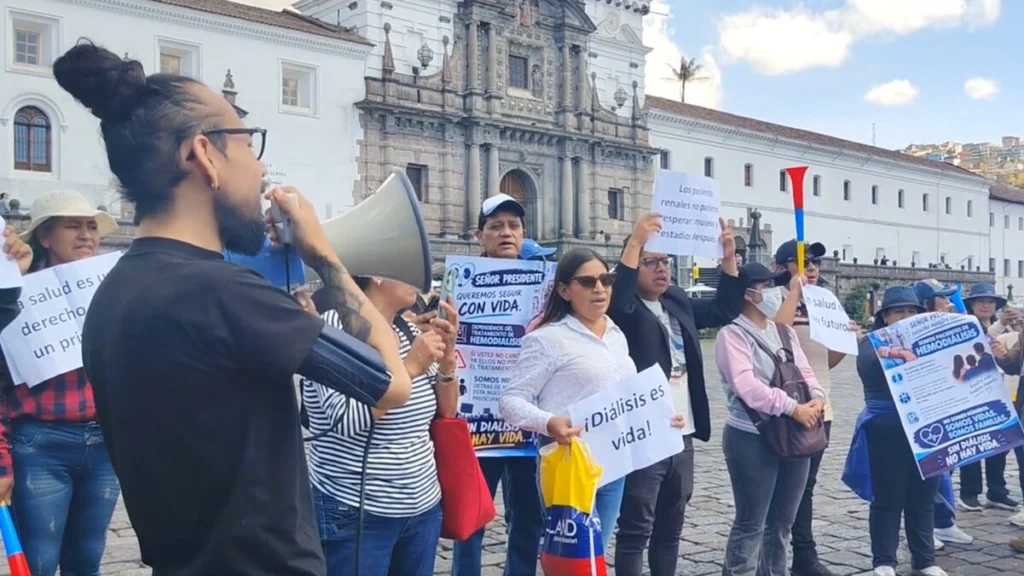
Private clinics plan to suspend dialysis services on Oct. 1 over 26 months of unpaid government bills.
On Tuesday, the Ecuadorian Renal Patients’ Front (FPRE) called for a sit-in at the San Francisco Square in Quito to demand that President Daniel Noboa guarantee the continuity of their medical treatments.
RELATED:
Ecuador Allows U.S. Military Personnel To Stay 180 Days
The protest came after several private clinics announced they will suspend dialysis services starting Oct. 1 because the national government has not made the corresponding payments for providing the service for 26 months.
“Dialysis is life, we want to live,” the protesters shouted, reminding the Noboa administration that the medical procedure is essential to their survival.
In Ecuador, about 10,800 people depend on dialysis to survive on a daily basis. Over the past two years, about 5,000 kidney patients have died as a result of budget cuts to public health services.
Angelito Cifuentes lleva 15 años conectado a una máquina de diálisis para seguir viviendo. Hoy, ante la falta de garantías del Gobierno sobre la continuidad de su tratamiento, tuvo que salir en silla de ruedas a reclamar su derecho a la salud y a la vida. Él, con la voz… pic.twitter.com/iUOitMGRiQ
— Elena Rodríguez Yánez (@ElenaDeQuito) September 29, 2026
The text reads, “Angelito Cifuentes has been connected to a dialysis machine for 15 years to stay alive. Today, faced with the government’s failure to guarantee the continuation of his treatment, he had to go out in a wheelchair to demand his right to health and life. With a faltering voice, he speaks of watching his fellow patients slowly die.”
On Tuesday, teleSUR correspondent Elena Rodriguez reported that the areas surrounding the government headquarters remain heavily guarded to prevent citizens from approaching to protest.
“As soon as kidney patients announce a protest, authorities surround the Carondelet Palace with metal barriers… When people demand medical care and medicines, the palace is barricaded again,” she reported.
Currently, hospitals run by the Ecuadorian Social Security Institute and the Health Ministry are experiencing shortages of medicines and medical supplies that prevent treatments for people with catastrophic, rare or chronic diseases.
“We have no solution. As kidney patients, we feel sentenced to death,” said Alejandro Solano, a kidney patient who denounced the lack of immunosuppressive medications for transplant recipients, forced referrals, and the arbitrary suspension of dialysis.
“It is inhumane to silence those who are caught between life and death,” said FPRE spokeswoman Gabriela Alvaro, who rejected the “attempts at intimidation” and the requirement for “permits to protest.”
teleSUR/ JF
Sources: teleSUR – FPRE
From teleSUR English via This RSS Feed.