

On Monday, the Health Directorate of the Cuban province of Holguín received a donation from the non-governmental organization Solidarity Luxembourg-Cuba, aimed at strengthening comprehensive care for children and adolescents with Autism Spectrum Disorder (ASD) and other neurodevelopmental disorders.
RELATED:
Cuba and Grenada Sign Education Agreements for Special Education and Literacy Program
The contribution includes medical equipment, clinical supplies, and specialized therapeutic resources for patient treatment and monitoring. These resources will be utilized at the Octavio de la Concepción de la Pedraja Provincial Pediatric Hospital, home to the Comprehensive Neurodevelopmental Disorders Care Service (SAINT).
SAINT comprises a multidisciplinary team dedicated to the early diagnosis and intervention of patients up to 18 years of age. Their work involves identifying developmental abnormalities and implementing therapeutic and educational strategies designed to improve the children’s communication, social skills, and autonomy.
During the handover of the donation, Sandro Rinaldis, a representative of Solidarity Luxembourg-Cuba, reaffirmed the commitment to maintaining such international cooperation projects. Initiatives of this kind have a direct impact on the quality of life for families in the region.
Holguín is part of a national network supporting child neurodevelopment, alongside Havana, Matanzas, Villa Clara, and Santiago de Cuba. This effort is also backed by the NGO mediCuba Switzerland and aims to consolidate free public care models for children and adolescents with neurodevelopmental needs.
Esta semana en el @Europarl_EN: “Cuba sí, bloqueo no”, un foro para abordar el impacto de más de seis décadas de sanciones de EE.UU. 🆚️Cuba y sus consecuencias para el pueblo cubano.
📍 Parlamento Europeo, Bruselas
🗓 30/09 y 1/10/2026#CubaNoEsUnaAmenaza, el bloqueo sí. pic.twitter.com/f7bz2fMxhH— Beatriz Lauzarique (@LauzariqueCuba) September 28, 2026
The text reads, “This week at the @Europarl_EN: “Cuba yes, blockade no”—a forum addressing the impact of over six decades of U.S. sanctions on Cuba and their consequences for the Cuban people. European Parliament, Brussels. September 30 & October 1, 2026. #CubaIsNotAThreat; the blockade is.”
The donation takes place against the backdrop of the 38th anniversary of the establishment of diplomatic relations between Cuba and the European Union. The island’s Ministry of Foreign Affairs reaffirmed its commitment to maintaining political dialogue and cooperation with the organization and its member states, based on the principles of equality, reciprocity, and mutual respect.
These principles are set out in the Political Dialogue and Cooperation Agreement (PDCA), in force since 2017. This instrument enabled expanded collaboration and exchanges in areas such as human rights, unilateral coercive measures, and sustainable development.
The PDCA replaced the 1996 Common Position—championed by Spain—which made European Union relations with Cuba conditional upon the implementation of unilateral reforms. The current agreement promotes an approach based on direct dialogue, reciprocity, and mutual respect between the parties.
Diagnosis and educational inclusion in Cuba
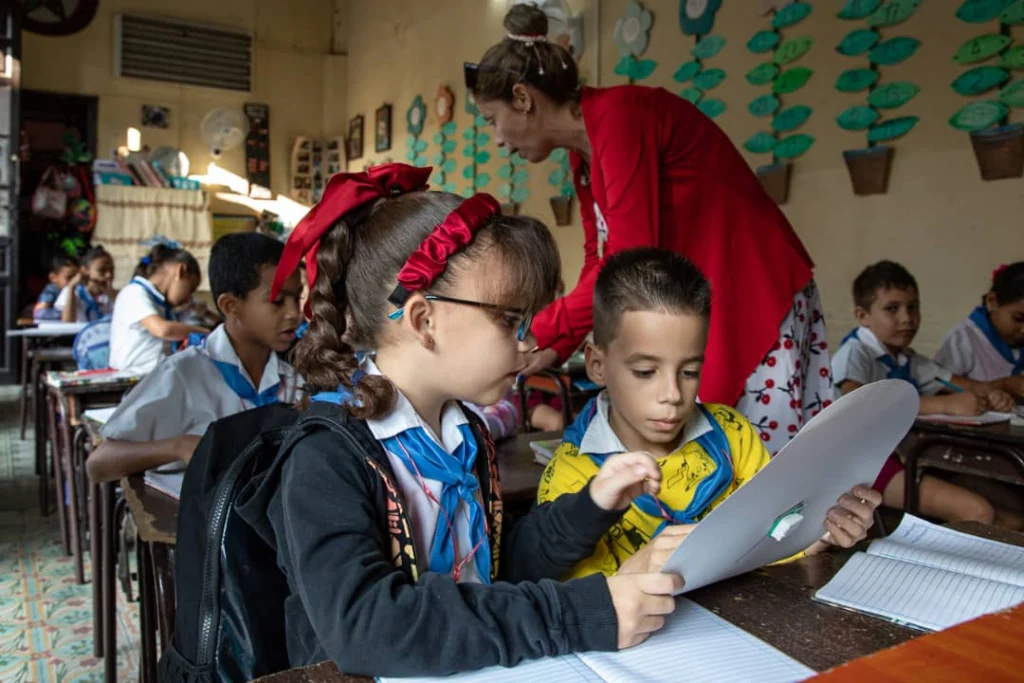
Autism care in Cuba encompasses both health and educational measures. The Dora Alonso special school, located within the Ciudad Escolar Libertad complex in Havana, exemplifies this strategy. As part of the treatment, its students interact with pupils from nearby primary schools.
In 2007, the United Nations General Assembly adopted a resolution declaring April 2 as World Autism Awareness Day. This date aims to raise awareness about this neurodevelopmental condition and highlight its prevalence across different regions of the world.
Early diagnosis allows for the identification of signs related to communication, social interaction, and motor coordination. Indicators described in the text include a lack of pointing or shared attention at 18 months of age, as well as a lack of responsiveness to other people during the first years of life.
Education from an early age is considered a means to foster the development of children identified with ASD. Consequently, the Cuban system prioritizes early detection, early intervention, and educational inclusion.
Children with autism attend general education schools and daycare centers, supported by specialized educators. In addition, special education teachers update their knowledge alongside medical geneticists, neuroscience specialists, and child psychiatrists, with the aim of providing comprehensive care to children and adolescents with autism.
From teleSUR English via This RSS Feed.