

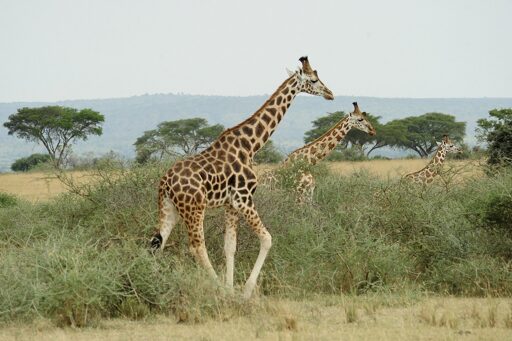
Giraffes living in the South Sudan’s war-torn savannas are genetically healthy and connected to nearby giraffe populations by gene flow, despite decades of conflict, recent research suggests. These findings show that “regions of the world that have been affected by conflict can maintain a lot of biodiversity and should therefore not be overlooked by genetic studies and conservation efforts,” Sam van Giessen, study lead author and a conservation genomics researcher from the University of Amsterdam, Netherlands, told Mongabay by email. The IUCN, the global wildlife conservation authority, currently recognizes four species and seven subspecies of giraffes. South Sudan is home to two subspecies of the critically endangered northern giraffe (Giraffa camelopardalis): the Nubian giraffe (G. c. camelopardalis) and the Kordofan giraffe (G. c. antiquorum). Between the conflict years of 1985 and 2025, Nubian giraffes in Ethiopia and South Sudan declined by 95%. By 2025, researchers estimated roughly 235 Nubian giraffe survived across South Sudan in isolated pockets, down from an estimate of 15,000 individuals in 1995. To find out the genetic health of these giraffe populations, researchers from the South Sudan government, the Giraffe Conservation Foundation (GCF), and conservation NGO African Parks analyzed DNA from skin biopsies collected from 30 Nubian giraffes in Boma and Badingilo national parks, run by African Parks. As the giraffe population in the region is small, there was some concern that inbreeding could be a problem for the subspecies’ long-term conservation. However, their analysis showed the South Sudan Nubian giraffe population has relatively high levels…This article was originally published on Mongabay
From Conservation news via This RSS Feed.