

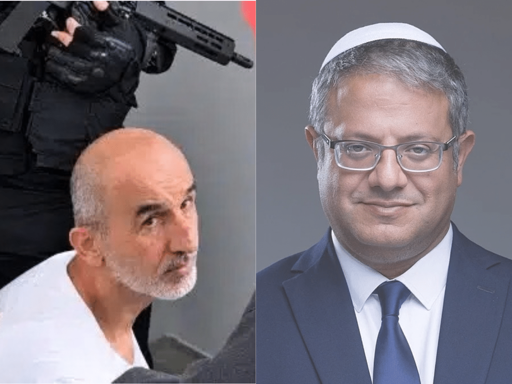

‘Israel’s’ national security minister has filmed himself threatening to kill a Palestinian prisoner and saying he wants to execute him.
Itamar Ben-Gvir published the footage on Sunday, which shows himself, accompanied by armed, masked guards, raiding the prison cell of Palestinian political leader and prisoner, Hassan Salameh, who was handcuffed at the time.
Ben-Gvir tells Salameh, who has been imprisoned by the Israeli occupation since 1996:
I want to kill you. I want to execute you.
He also tells Salameh that the prison conditions imposed on him are the result of his own policies.
https://www.thecanary.co/wp-content/uploads/2026/09/hassan-vid.mp4
Ben-Gvir added that the prison visit gave him a sense of “closure”, and referred to the attacks in Jerusalem in 1996. He claimed he had protested against them as a teenager and now had the power to make Salameh’s life in prison “hell”.
In a statement, the Palestinian Commission of Detainees and Ex-Detainees Affairs, said:
The footage published by Ben-Gvir shows that degradation and depravity have reached their highest levels.
Ben-Gvir’s actions ‘cowardly act of bullying’
The video was recorded and released exactly a month before ‘Israel’s’ 27 October elections. It also follows years of public demands for the execution of Palestinian prisoners.
In the video, Ben-Gvir directs that threat at Salameh, one of the most prominent Palestinian prisoners.
The Palestinian Prisoners’ Media Office says Israeli occupation authorities are fully responsible for Salameh, claiming that Ben-Gvir’s actions were “a cheap political and electoral stunt” and “a cowardly act of bullying against a defenceless and handcuffed prisoner”.
Since the start of ‘Israel’s’ genocide in Gaza, policies such as solitary confinement, physical assaults, starvation, medical neglect, and repeated transfers, have become commonplace for Palestinian prisoners.
The Palestinian Prisoner’s Society (PPS) said in a statement:
What is happening today is more dangerous than anything that has passed, with the shift toward direct threats of killing and execution, and the public display of operations of repression against prisoners inside the prisons…
Ben-Gvir’s threats and repeated displays inside the prisons cannot be separated from the system of repression under which prisoners live. And its continuation in the absence of international accountability constitutes an increasing danger to their lives.
Hamas said it remains committed to securing the release of individuals held in ‘Israel’s’ prisons. It also claimed that the occupation has “turned prisons into arenas for direct physical liquidation, in flagrant violation of all international laws”.
Salameh received third longest prison sentence
Hassan Salameh, a leading figure in Hamas’ al-Qassam Brigades, was born in Khan Younis refugee camp in southern Gaza in 1971. He was arrested several times during the First Intifada after becoming involved in the Palestinian struggle for liberation.
In 1996, he was shot and arrested by Israeli Occupation Forces (IOF) in Hebron. The PPS reported that Salameh was interrogated and tortured for about four months.
That same year he was convicted for his involvement in Hamas attacks in ‘Israel’, including bombings on buses in Jerusalem. Salameh said these were in response to the Israeli occupation’s killing of Yahya Ayyash, one of the main operational leaders of Hamas.
Salameh was sentenced in 1997 to a prison term of 48 life sentences. This is the highest sentence among Palestinian prisoners after Abdullah Barghouti and Ibrahim Hamed.

More than 10 years in solitary confinement
Salameh has been kept in solitary confinement for about 13 of his 30 years in detention, including the last three years, since the start of the genocide. His family has been allowed to visit him only twice in 30 years.
Ben-Gvir has spent years campaigning for tougher treatment of Palestinian prisoners.
Since becoming national security minister, he has made severe prison conditions part of his political brand. He has repeatedly presented inhumane and degrading conditions, medical neglect and the torture of Palestinian prisoners as evidence that he is delivering on his promises.
Repeated videos of him harassing and abusing prisoners are posted online.
His threat to execute Salameh comes after the Knesset passed a law, which came into force in May of this year. Pushed by his Jewish Power party, the law makes death by hanging the default punishment for Palestinians convicted in military courts of lethal attacks on Israelis.
But, as expected from the genocidal apartheid state, the death sentence only applies to Palestinians who carry out lethal attacks, not to the Jewish-Israeli terrorists who regularly attack and kill Palestinians.
Ben-Gvir wants to ethnically cleanse Palestine
Ben-Gvir is looking to strengthen his position in the next government and he clearly thinks that threatening resistance fighters with execution in prison will work in his favour. His Jewish Power party has said it will seek the defence and justice ministries, with Ben-Gvir wanting defence and Tally Gotliv lined up for justice.
According to the Times of Israel, Gotliv’s recent move from Likud to join Jewish Power is closely tied to her attempt to retain parliamentary immunity while facing a criminal case for the disclosure of a Shin Bet officer’s identity.
Ben-Gvir has said he would use the defence post to push changes to the military’s rules of engagement and advance his policy of “voluntary migration” of Palestinians from the occupied territory. This would speed up ‘Israel’s’ long planned ethnic cleansing of Gaza and the West Bank.
Gotliv has called for changes to ‘Israel’s’ legal system that would reduce the power of the courts.
Salameh’s treatment has prompted calls for guarantees of his safety and a “serious investigation into these threats”, from the Palestinian Centre for Prisoner’s Advocacy.
The Palestinian Commission of Detainees and Ex-Detainees Affairs warned of a real danger to Palestinian prisoners, particularly leaders of the prisoner movement. The organisation has called on international and human rights organisations to intervene.
The case raises questions beyond Ben-Gvir’s actions towards one prisoner. ‘Israel’ is a signatory to the Geneva Conventions, which set out protections for people held in detention during armed conflict, including from violence, intimidation and degrading treatment.
Palestinian prisoner advocacy groups have called for those protections to be enforced and for those in ‘Israel’ responsible for violations to be held accountable.
How many Palestinians have been imprisoned?
As of September of this year, there are:
- About 9,350 Palestinians being detained by the Israeli occupation
- More than 3,100 being held under administrative detention with no trial or charge
- Almost 1,400 of these are Palestinians who have been abducted in Gaza, also without charge or trial, under the Unlawful Combatants Law
- More than 350 of these prisoners are children
- Nearly 90 are women
Israel’s use of the Unlawful Combatants Law has also resulted in the mass incommunicado detention and enforced disappearance of thousands of Palestinians from Gaza since 7 October 2023.
Featured image via X/ Wikipedia
By Charlie Jaay
From Canary via This RSS Feed.
You must log in or # to comment.