

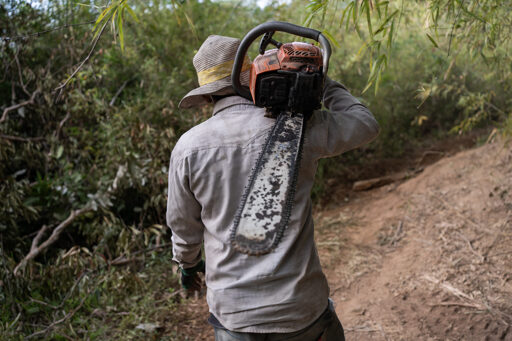
BANGKOK — Over the course of 2025, the Mekong countries of Cambodia, Laos, Myanmar, Thailand and Vietnam lost a combined 746,168 hectares (1.8 million acres) of tree cover, an area roughly equivalent to the size of the Bangkok Metropolitan Area, according to Mongabay’s analysis*. Data published by the Global Land Analysis and Discovery (GLAD) laboratory at the University of Maryland, in partnership with Global Nature Watch (GNW) — formerly Global Forest Watch — shows that of the total 746,168 hectares of tree cover lost, more than 154,000 hectares (380,000 acres) was primary forest. Mongabay’s analysis found that just shy of 200,000 hectares (494,000 acres) of the total were lost from the region’s protected areas. While these numbers may paint a bleak picture for the Mekong’s forests, the rate of regional deforestation has dropped by almost 25% from that recorded by GNW in 2024, continuing a decline that, according to the data, began in 2023. Fewer wildfires, higher rainfall, stricter law enforcement and lower market rates for commodities could all factor into a drop in the Mekong’s deforestation rate for 2025 when compared to 2024. However, experts warn that short-term drops do not always represent a broader trend in deforestation. Every country in the Mekong saw a fall in deforestation rates from 2024 to 2025, but each still grapples with a range of challenges to protecting the region’s remaining forests. Data from 2025 shows a drop in deforestation recorded across Mekong nations, but much of the tree cover lost last year was lost inside…This article was originally published on Mongabay
From Conservation news via This RSS Feed.