

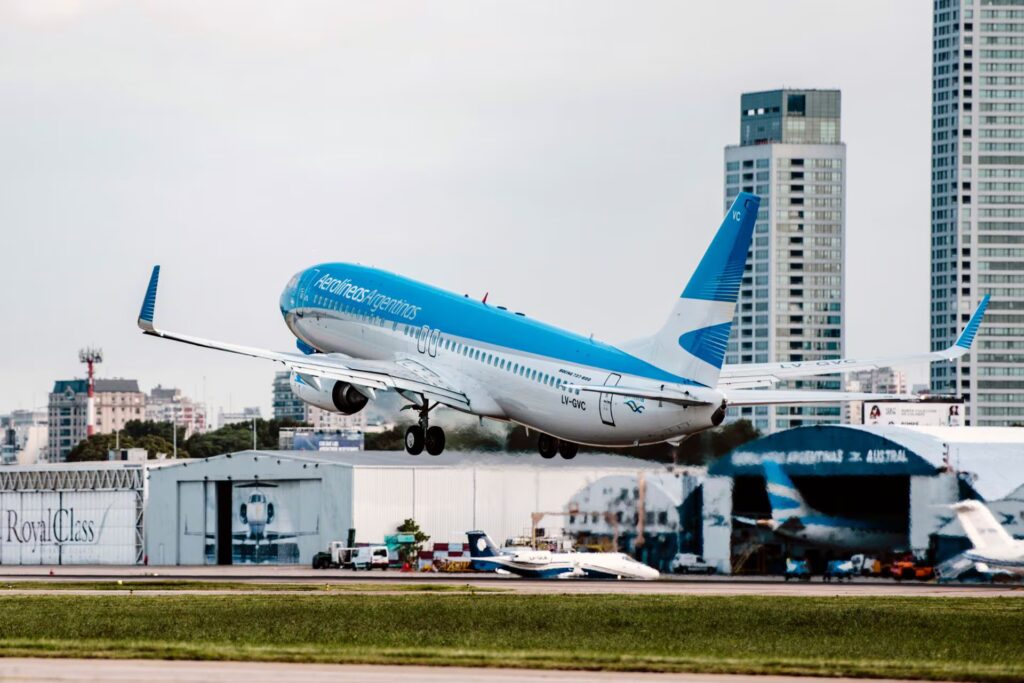
A U.S. judge has authorized a hedge fund to seek the seizure of Argentine assets abroad, reviving concerns about the country’s financial vulnerability amid economic instability.
A U.S. judge has authorized investment fund Titan Consortium to begin seizure proceedings against Argentine assets abroad over the 2008 expropriation of Argentina’s Airlines, the country’s flag carrier, in a ruling that rejected Argentina’s argument that the claim had expired under the statute of limitations.
The decision dismissed Argentina’s arguments of prescription, which claimed that over 12 years had passed since the original ruling, exceeding the three-year statutory period for such claims.
RELATED: Argentina Country Risk: Alarming Signals Behind the 600-Point Surge
Argentina had requested the nullification of the measure, asserting that the time elapsed since the original judgment surpassed the legal limit. However, the U.S. court rejected this argument and upheld the obligation to pay as demanded by private creditors.
The original claim arose from a ruling by the International Centre for Settlement of Investment Disputes (ICSID), which ordered compensation in favor of the Spanish firms that were expropriated from the Argentine Airlines. After years of internal litigation between the original beneficiaries and the financial entities that acquired the rights to the lawsuit, the current claim amounts to 390 million dollars.
[AHORA] En los Estados Unidos, la jueza Jia Cobb autorizó al fondo “Titan Consortum” a pedir embargos de activos argentinos por la expropiación de Aerolíneas Argentinas: sería por un monto superior a los US$390 millones. https://t.co/kkVixqgIwm pic.twitter.com/eMc6Lo5MiF
— ElCanciller.com (@elcancillercom) September 27, 2026
Text reads: “In United States, Judge Jia Cobb authorized the “Titan Consortum” fund to seek embargoes on Argentine assets for the expropriation of Argentinean Airlines: it would amount to more than $390 million.”
The ruling was issued by Judge Jia Cobb of the D.C. Court of Appeals, who dismissed the arguments presented by the South American country’s legal defense. Argentina had sought to have the measure annulled, arguing that more than 12 years had passed since the original ruling, far exceeding the three-year statutory period established for this type of claim. Despite that legal argument, the U.S. court rejected the challenge filed in 2025 and upheld the payment obligation demanded by the private creditors.
As a result, the plaintiff firm is now authorized to seek the precautionary seizure of aircraft or other state assets entering the judicial jurisdictions of New York or Washington.
A Contrasting YPF Ruling
The unfavorable ruling stands in contrast to a separate decision issued around the same time by the U.S. Court of Appeals for the Second Circuit in New York regarding the renationalization of oil company YPF. In that case, the court agreed to maintain a temporary stay on the transfer of oil company shares to the plaintiff funds, backing the sovereign defense doctrine put forward by Argentina’s central government.
The publication of the Argentine Airlines ruling renews concerns over the country’s financial vulnerability in international courts, coming amid a period of significant economic instability domestically.
Government legal representatives are currently evaluating operational alternatives to protect public assets deployed across international routes and markets, given the risk that aircraft or other state property could be subject to seizure while operating abroad.
The case adds to a broader pattern of legal exposure Argentina has faced in U.S. courts in recent years over asset disputes tied to state expropriations, with creditors increasingly turning to U.S. jurisdictions to enforce international arbitration awards against the South American nation.
From teleSUR English via This RSS Feed.