

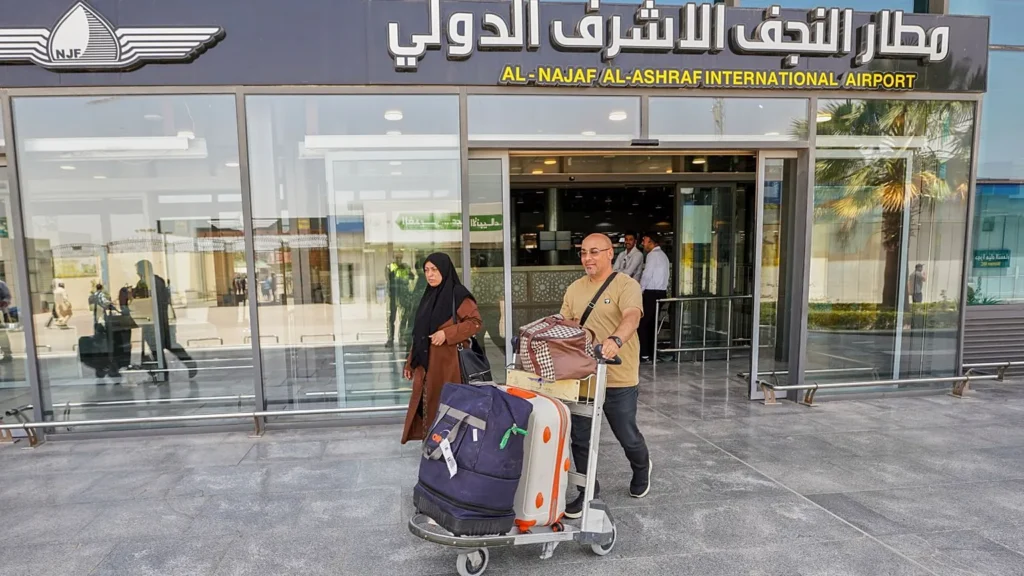
Iraq’s Najaf International Airport will resume flights to and from Iran within 24 hours, the country’s ambassador to Tehran announced this Monday, following a suspension that began Friday, due to threats of U.S. sanctions against entities linked to Iran’s aviation sector.
The Najaf International Airport in Iraq is set to resume flights to and from Iran within the next 24 hours, following a temporary suspension that began on September 25 due to U.S. threats of sanctions against Iranian aviation entities.
The Iraqi government, led by Prime Minister Ali al-Zaidi, is actively working to restore air traffic between the two neighboring countries.
RELATED: Iraq Extends Resistance Disarmament Deadline to 2027
The Embassy of Iraq in Iran, represented by Ambassador Yaser Abdelzahrá Al Hayach, announced the resumption and clarified that the suspension was not a decision by the Iraqi government but rather a result of foreign service companies abstaining from providing ground services due to fears of U.S. penalties.
The resumption of operations comes after Iraq’s government indicated on Saturday, September 26, that it remains in contact with United States to secure exemptions for certain airports, allowing Iranian citizens to travel for humanitarian, medical, educational and religious pilgrimage purposes to Najaf, one of the holiest cities in Shia Islam and home to the shrine of Imam Ali.
🔴 BREAKING: Iraq’s envoy to Iran says Najaf airport will allow Iranian flights within 24 hours. pic.twitter.com/ncyT9yYXrc
— Al Arabiya English (@AlArabiya_Eng) September 28, 2026
Political Backlash Grows
The suspension sparked political backlash in both Iran and Iraq. Ali Akbar Velayati, international affairs adviser to Iran’s supreme leader, criticized the flight halt, describing it as an attempt to sow internal divisions within the so-called Axis of Resistance. He directed a pointed message to Iraq’s Prime Minister, asserting that legitimacy stems from Najaf, not from Washington.
In Iraq, former Prime Minister Adel Abdul-Mahdi called the suspension a serious mistake, while parliamentarian Falah Al Khazali rejected what he characterized as external impositions on national sovereignty. Reflecting that same opposition, dozens of Iraqi citizens gathered Monday outside the airport terminal to protest the route’s suspension, voicing frustration over the disruption to travelers and pilgrims who regularly use the connection between the two countries.
🇮🇶🇮🇷 BREAKING: Protesters storm the entrance to Najaf International Airport
Large crowds of protesters in Najaf have pushed into the entrance of Najaf International Airport amid demonstrations against Iraq’s suspension of flights with Iran.
The restrictions followed U.S.… pic.twitter.com/o58v82t6wc
— DD Geopolitics (@DD_Geopolitics) September 28, 2026
Iran’s Civil Aviation Organization, for its part, formally lodged a protest with the International Civil Aviation Organization (ICAO) against sanctions imposed by U.S. Treasury Department. The measures, announced by Treasury Secretary Scott Bessent and in effect since September 23, target 27 Iranian airlines and have triggered operational restrictions across several countries in the region. Other nations, including China, have publicly rejected the unilateral measures and continue to accept Iranian flights.
The episode highlights the broader ripple effects of Washington’s sanctions campaign against Iran’s aviation sector, with regional governments now navigating pressure to comply with U.S. restrictions while facing domestic backlash over disruptions to religious pilgrimage, medical travel and everyday air connectivity between neighboring countries. Iraq’s efforts to secure targeted exemptions suggest Baghdad is seeking a middle path that avoids direct confrontation with Washington while still accommodating the significant volume of Iranian pilgrims who travel to Najaf each year.
From teleSUR English via This RSS Feed.