

By Manal Samhat – Sep 28, 2026
A bond shaped by sacrifice, grief, hope, and belonging, from the people, for the people. Two years after his martyrdom, Sayyed Hassan Nasrallah’s words and memory continue to resonate among his people.
To understand the bond between Sayyed Hassan Nasrallah and his people is to look beyond the formal language of political leadership and into something far more intimate: a relationship shaped by trust, shared hardship, grief, sacrifice, and an enduring sense of belonging.
Over decades, his voice became woven into his people’s lives, accompanying them through wars and victories, funerals and moments of fear, and uncertainty and hope. They waited for his speeches, gathered to hear his words, hung his pictures everywhere, and looked to him not only for political direction but for reassurance and strength.
For many, he came to occupy a deeply personal place: as their Sayyed, their protector, their teacher, and a father figure. His speeches reveal this relationship in his own words: he spoke to their tears, their wounds, their families, their martyrs, and their hopes, while repeatedly placing himself and his own family within the same circle of sacrifice.
Even after his martyrdom, the relationship has not simply disappeared with his physical absence. His voice continues to echo through recordings, commemorations, photographs, and the memories of those who once waited for him to speak. What follows is therefore not simply an examination of a political leader and his audience, but an exploration of a profound emotional bond and of how a voice that once belonged to a living man can, after his martyrdom, become inseparable from the memory of an entire community.
The coffins of Sayyed Hassan #Nasrallah and Sayyed Hashem Safieddine have entered the Camille Shamoun Sporting City Stadium for the funeral procession honoring the two extraordinary leaders.#SayyedHasanNasrallah #Lebanon #AlMayadeen pic.twitter.com/9b6fTcDwam
— Al Mayadeen English (@MayadeenEnglish) February 23, 2025
A voice they followed, a memory they carryThe relationship of the leader of the Resistance, Sayyed Hassan Nasrallah, with his supporters was built over decades of speeches, personal presence, and a political and military career that became closely intertwined with the community he led. For his people, he was not simply the secretary-general of Hezbollah but a figure associated with major turning points in Lebanon’s modern history, including forcing “Israel” out of southern Lebanon in 2000, which was later marked as Resistance and Liberation Day, and its defeat in the July 2006 war.
Reports from his funeral described mourners carrying his photographs, weeping openly, and traveling from across Lebanon and abroad to pay their respects; expressions of a bond that had become deeply personal, as well as political.
On Resistance and Liberation Day, we cannot help but remember the victory speech delivered by martyr Sayyed Hassan Nasrallah at the Bint Jbeil municipality stadium, where he branded “Israel” as being “frailer than a spider’s web”, a phrase that still haunts the occupation to this… pic.twitter.com/Yjsgo14vHJ
— Al Mayadeen English (@MayadeenEnglish) May 25, 2026
His martyrdom in an Israeli airstrike in September 2024 transformed that relationship from one centered on a living leader into one increasingly expressed through memory and symbolism. Nearly five months later, hundreds of thousands gathered in and around Beirut’s Camille Chamoun Sports City Stadium for his public funeral, despite the enormous losses Hezbollah and its supporters had endured during the preceding war.
The stadium was full long before the ceremony began, while millions filled the streets in its vicinity. The scale of the mourning demonstrated that his image and legacy remained a powerful point of identification among his people even after his martyrdom.
On February 23, 2025, Lebanon witnessed one of the largest funeral processions, as millions gathered to bid farewell to martyrs Sayyed Hassan Nasrallah and Sayyed Hashem Safieddine.
Lebanon’s highways filled before dawn, villages and cities emptied, and mourners arrived on foot,… pic.twitter.com/hsPHms5srs
— Al Mayadeen English (@MayadeenEnglish) February 23, 2026
That connection has also continued beyond the funeral. In June 2026, supporters gathered at Sayyed Nasrallah’s shrine in Beirut during Ashoura, weeping, holding his image, and listening to Hezbollah Secretary-General Naim Qassem’s address. Such scenes illustrate how Sayyed Nasrallah has increasingly become a symbol through which supporters remember sacrifice, resistance, and their own collective experience. His physical absence therefore did not erase the emotional bond that had developed during his lifetime; instead, his memory became embedded in commemorations, public rituals, photographs, and the language of those who continue to invoke his legacy.
More than a speech, a safe havenHis relationship with the people was shaped not only by what he represented, but by how he spoke to them. His speeches rarely sounded like distant political addresses; they were often structured as direct conversations with an audience. He combined religious references, historical memory, humor, colloquial Lebanese Arabic, military detail, and moments of deliberate emotion.
That connection became particularly visible in the way the people responded to his addresses during moments of crisis. Sayyed Nasrallah frequently appeared by video rather than before a live audience because of security concerns, yet the physical distance did little to diminish the sense of personal presence. Supporters gathered around television screens in homes, cafés, and public spaces, while major speeches could become collective events marked by chanting, applause, silence, and emotional reactions.
Defying storms and severe weather conditions, people from #SouthLebanon have embarked on their journey to #Beirut to attend the funeral procession of Sayyed Hassan and #SayyedHashem on foot.
Answering the call of Sheikh Naim Qassem, they declared their unwavering loyalty,… pic.twitter.com/MxAXKGsTpf
— Al Mayadeen English (@MayadeenEnglish) February 22, 2025
Honesty even in calamityIn September 2024, following the pager and radio explosions, groups gathered to hear him address an audience experiencing shock and fear; his admission that Hezbollah had suffered an “unprecedented” blow was notable precisely because his people were accustomed to his confident public addresses.
His speeches therefore served a function beyond political messaging: they could give supporters a framework through which to understand frightening events, define what he considered the meaning of those events, and reinforce a shared sense of identity.
A chant, a legacy, a bond that enduresAfter his martyrdom, that relationship acquired another dimension. His voice itself became part of the rituals of remembrance. At his February 2025 funeral, his speeches were played to the enormous crowd as his coffin entered the stadium, while mourners carried his photographs and chanted his name.
Labbayk all the wayThe chant “Labbayk ya Nasrallah” (“At your service, O Nasrallah”) echoed across the stadium and continues to be heard among his supporters at commemorations and gatherings. The words, originally expressing a pledge of loyalty to Sayyed Nasrallah himself, have taken on a broader symbolic meaning after his martyrdom: they represent an enduring attachment to the path, values, and legacy they associate with him. In this sense, the chant transforms personal allegiance to a departed leader into a declaration of continued commitment to what he represented and to the political and resistance movement he led.
The speeches that once accompanied moments of uncertainty had become part of the memory through which those moments were subsequently understood. His words could be replayed, quoted, commemorated, and passed to younger generations, transforming the familiar voice that once addressed his people into an enduring symbol of the relationship they believed they had shared with him.
A year has passed since Sayyed Hassan’s passing.
A year has gone by, yet the wound remains fresh.
It has been a year that felt like both a fleeting moment and a decade. A year marked by the absence of his presence, guidance, and wisdom.
Yet, the memory of Sayyed Hassan is… pic.twitter.com/PP4OZxRl0C
— Al Mayadeen English (@MayadeenEnglish) September 27, 2025
The father figure behind the voiceThe place of Sayyed Hassan Nasrallah in people’s lives extended far beyond that of a political leader. He was often spoken of and remembered as a father figure, protector, teacher, and guide; someone whose presence provided reassurance during periods of war, uncertainty, and loss. This perception was reinforced by the intimate way he addressed his audience, frequently speaking directly to families, martyrs’ relatives, fighters, and ordinary people rather than limiting his message to political institutions. People did not simply listen to his speeches for political positions; many looked to his words for reassurance, dignity, and a sense of direction.
In a deeply personal moment during his interview with #AlMayadeen, Sheikh Naim Qassem, #Hezbollah Secretary General, recalled emotional moments and reflected on the bond he shared with martyr Sayyed #HassanNasrallah, describing him as a leader who "brought peace to our hearts and… pic.twitter.com/7AurWOp5Tc
— Al Mayadeen English (@MayadeenEnglish) July 8, 2025
His speeches were central to the construction of this relationship. Sayyed Nasrallah could move between the language of a military commander, the authority of a political leader, and the warmth of someone addressing members of a wider family. He spoke about the fallen, their parents and children, and the sacrifices of ordinary supporters, often placing individual grief within a larger collective narrative. His repeated references to martyrs by name and his attention to their families helped cultivate the impression that those who sacrificed were not anonymous figures to the leadership.
One year since Sayyed #HassanNasrallah’s martyrdom, a leader who stood firm when others faltered, a force that redefined resistance, and a legacy that will never be forgotten.#Hezbollah #Lebanon https://t.co/r63K31uSB1
— Al Mayadeen English (@MayadeenEnglish) September 27, 2025
The SayyedAfter his martyrdom, these dimensions of his image became even more pronounced. The enormous crowds at his February 2025 funeral, the repeated invocation of his words, and the continued presence of his photographs and speeches in commemorations demonstrated that his people were mourning not only a secretary-general, but a figure they associated with fatherhood, leadership, protection, sacrifice, and personal reassurance. His martyrdom also changed the meaning of his recorded voice: words once heard from a living leader became part of a legacy repeatedly revisited by those who regarded him as their Sayyed, a title carrying religious and personal significance.
On February 23, Lebanon’s capital #Beirut will witness an unprecedented funeral procession as #Lebanon pays its final tribute to martyr Sayyed Hassan #Nasrallah.
From villages, cities, and at least 79 countries, tens of thousands will gather, not just in mourning, but in loyalty… pic.twitter.com/Fk4Nl6xPCk
— Al Mayadeen English (@MayadeenEnglish) February 22, 2025
When the nation held its breath for his voiceWaiting for Sayyed Nasrallah’s speeches became almost a ritual in itself for the people. His appearances were treated as moments when they could finally hear directly from the Sayyed, particularly when events were unfolding rapidly, and uncertainty was at its highest.
In November 2023, amid the war on Gaza and fears that the Lebanon front could widen, large crowds gathered across Lebanon to hear what Sayyed Nasrallah would say.
In an interview with #AlMayadeen, Sayyed Hassan Nasrallah’s daughter shares her personal memories of Ramadan with her father.
She recalls how the month of #Ramadan held a unique significance, with a special iftar dedicated by Sayyed Hassan for his family.
Unlike other times of… pic.twitter.com/zrwiDsCSgf
— Al Mayadeen English (@MayadeenEnglish) February 28, 2025
This habit of waiting for Sayyed Nasrallah before forming an understanding of what was happening became especially striking during moments of danger. His people often wanted to hear the situation from him before reacting to events around them. On August 6, 2024, following the Israeli assassination of Hezbollah commander Fouad Shokor, supporters gathered in Beirut’s Southern Suburb to watch Sayyed Nasrallah’s televised address; the speech was met with cheers when he promised a response.
"The enemy targeted a building full of civilians in Haret Hreik during the assassination of martyr Fouad Shokor. We extend our condolences and congratulations to the families of the martyrs for the loss of their loved ones and for them being awarded the honor of martyrdom, as the… https://t.co/UNJtzDwNjx
— Al Mayadeen English (@MayadeenEnglish) August 1, 2024
Even more revealing was the atmosphere after the pager and radio explosions in September 2024. His address was the first major communication from the leadership after two days of shock and fear. In this sense, his voice had acquired a distinctive role: people did not merely want information about an unfolding event; they wanted to experience the event through his interpretation of it.
A voice heard across the front linesSayyed Nasrallah’s speeches were followed closely even by those on the other side of the war because Israeli analysts and officials understood that his words could carry concrete implications for what Hezbollah would do next. Israeli media repeatedly described the anticipation surrounding his appearances. The Jerusalem Post, for example, wrote that Sayyed Nasrallah’s limited number of interviews created heightened expectations for his speeches “not only among his own public but also among viewers abroad, especially in Israel,” while noting his calm and deliberate presentation.
More strikingly, The Times of Israel commentator David Horovitz wrote in 2019 that, during a period of escalating tensions, “Israel” learned what had actually happened in a Hezbollah-“Israel” exchange through Hezbollah’s footage and Sayyed Nasrallah’s camp, describing Hezbollah as a “key source of credible information” in that episode. Horovitz explicitly contrasted this with information coming from Israeli authorities and wrote that Israelis did not want to have to obtain reliable information from Sayyed Nasrallah, but acknowledged that they had.
When Sayyed Nasrallah spoke, his adversaries listenedThe Israeli attention to Sayyed Nasrallah was therefore not simply an interest in an adversary’s propaganda; it reflected recognition of his ability to communicate his position with precision. The Times of Israel analyst Avi Issacharoff wrote that, for many years, Sayyed Nasrallah had been regarded as someone who “spoke the truth”, not only in Lebanon but across much of the Middle East.
A Jerusalem Post analysis noted that Sayyed Nasrallah had cultivated an image of being measured and capable of “speaking the truth, even when it is not in his favor,” arguing that this credibility mattered to both his Lebanese audience and “Israel”. Thus, even amid profoundly hostile Israeli assessments of Hezbollah and Sayyed Nasrallah, Israeli commentators repeatedly recognized something important about his communication: when Sayyed Nasrallah spoke, his adversaries listened.
Two years after the martyrdom of Sayyed Hassan, his legacy remains a subject of focus in “Israel.”
From his role as a central figure in three decades of confrontation to the equations he established, what remains of the Sayyed’s legacy, and how has the Resistance adapted in his… pic.twitter.com/A6bJcRj4cO
— Al Mayadeen English (@MayadeenEnglish) September 23, 2026
The bond, in his own wordsThe nature of that bond comes through most clearly in Sayyed Nasrallah’s own words. Across different moments of war, loss, and celebration, his language reveals how he addressed his people, not as a distant audience, but with a striking sense of closeness and shared experience.
The following excerpts, drawn from different moments of his public life, illuminate the language through which he expressed that bond and help explain why his voice came to occupy such a deeply personal place in the memories of those who followed him.
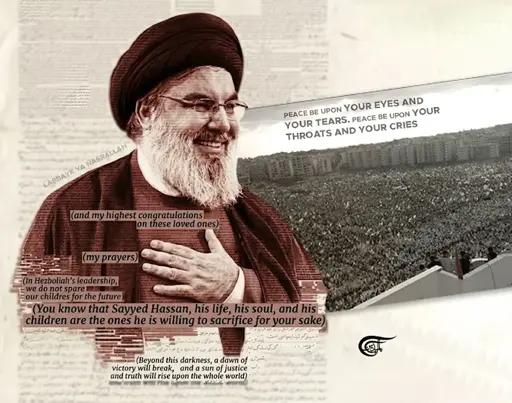
To the pager attack victims: ‘Peace be upon your eyes and your tears’
Peace be upon your eyes and your tears.
Peace be upon your throats and your cries.
Peace be upon your faithful hearts.
Peace be upon your longing and your loyalty.
The phrase “Peace upon your eyes” captures perhaps more vividly than any political slogan the intimate relationship Sayyed Nasrallah sought to establish with his people. In his address after the September 2024 pager and radio attacks, he did not speak of the wounded simply as casualties or members of an organization; he addressed the human beings behind the injuries.
The words carried an almost familial tenderness: rather than speaking about the victims, he spoke to them, offering recognition at a moment when many had been blinded, maimed, or permanently scarred. Contemporary accounts describe the pager operation as having caused thousands of casualties across Lebanon, making his address an important moment of communication with a community confronting sudden and unprecedented shock.
“Peace be upon your eyes and your tears… Peace be upon your longing and your loyalty…” — Ummah’s Martyr Sayyed Hassan Nasrallah, addressing those wounded in the pager attacks two years ago.#Lebanon #SouthLebanon #SayyedNasrallah #PagersAttck pic.twitter.com/Ysr8cCbczN
— Al Mayadeen English (@MayadeenEnglish) September 17, 2026
That choice of language also illuminates why many supporters perceived Sayyed Nasrallah as something closer to a father and personal guardian than a conventional political leader. His speeches frequently transformed political events into intensely personal encounters: he named the suffering, addressed families, mourned the dead, and spoke directly to those who had endured injury or loss. “Peace upon your eyes” is powerful precisely because the eyes are deeply personal; they are not an institution, a battalion, or a statistic. By greeting their eyes, he was symbolically acknowledging the people themselves. For supporters accustomed to waiting for his speeches to understand major events, such words reinforced the expectation that when something happened to them, he would see it, speak about it, and speak to them.
Sayyed Hassan Nasrallah: The Martyrdom of a Great International Revolutionary Leader of Our Era
Sharing their tears, carrying their grief
In fact, the progression of the words is significant. “Your eyes and your tears” recognizes suffering; “your throats and your cries” recognizes the anguish that could not remain silent; “your believing hearts” recognizes faith; and “your longing and loyalty” recognizes the emotional bond that supporters felt toward their leader and community. Rather than distancing himself from that pain, Sayyed Nasrallah linguistically placed himself alongside those experiencing it.
That is what makes the passage especially revealing of the image his supporters had of him. He did not merely tell them what had happened; he addressed them on a very personal level. And after his martyrdom, those words acquired an additional layer of poignancy. The relationship was preserved through the very voice that had once spoken directly to them.
To the people: ‘You are not here to give your lives for a person’
You are not here to give your lives for a person. Rather, you know very well, and so do the families of the martyrs, the wounded, and the detainees. as well as those whose homes were destroyed, that Sayyed Hassan, his life, his soul, and his children are the ones he is willing to sacrifice for your sake.
This passage reveals another defining dimension of the relationship between Sayyed Nasrallah and his people: reciprocity. He explicitly rejected the idea that his followers existed to serve or sacrifice themselves for him, insisting instead that he and his family were the ones who belonged to them. With this saying, he placed himself inside the same circle of sacrifice as his supporters, rather than above it. The leader was not presented as someone for whom others were expendable; he portrayed his own life, his children, and ultimately his own fate as bound to the people he led.
“I love you all. I am proud that all these thousands of people consider me one of them.”
Martyr Sayyed Hassan Nasrallah spoke of his people with unparalleled love that went far beyond words. When some would say, “May we be sacrificed for the sake of Sayyed Hassan,” he reminded… pic.twitter.com/G09uyNlIoT
— Al Mayadeen English (@MayadeenEnglish) September 22, 2026
This helps explain the unusually personal attachment his supporters expressed toward him. They did not perceive the relationship solely through the formal structure of leader and follower. His speeches repeatedly positioned him as someone who shared their losses, understood their fears, mourned their dead, and accepted the same risks. That reciprocity was particularly significant for families of fighters and civilians who had lost homes or loved ones. His message was effectively that their sacrifices did not purchase the protection of a distant leader; rather, the leader himself was accountable to them and prepared to pay the same price.
A never-before-seen photo was published by Al Mayadeen showing the martyred leader Sayyed Hassan Nasrallah in the operations room days before his martyrdom.
From this very room, orders were given to support those in Gaza, no matter the consequences.
From this very room, Sayyed… pic.twitter.com/MpmI3aOBEC
— Al Mayadeen English (@MayadeenEnglish) September 27, 2025
His martyrdom subsequently gave that relationship an intensely symbolic dimension. The statement that “Sayyed Hassan, his life, his soul, and his children are the ones he is willing to sacrifice for your sake” could no longer be understood merely as rhetoric about a possible sacrifice: his own martyrdom, preceded by his son’s, had become part of the history he had been describing.
For supporters, this reinforced the perception that he had not asked them to bear a burden from which he himself was exempt. Instead, the relationship they remembered was one in which the leader claimed responsibility for his people while simultaneously placing himself among them; a perception that helps explain why his death was experienced by many not simply as the loss of a political leader, but as the loss of someone they regarded as personally bound to their community.
Remembering martyr Sayyed Hassan Nasrallah: The voice that refused to bow to tyranny. 40 days since his martyrdom, #Lebanon and the region honor not just a leader but a legacy of steadfast resistance.
Born in #Beirut’s impoverished Karantina neighborhood, the leader of the… pic.twitter.com/swd8j5MT1T
— Al Mayadeen English (@MayadeenEnglish) November 8, 2024
Hadi’s martyrdom: ‘We do not spare our children for the future’
Hadi’s martyrdom is a testament that in Hezbollah’s leadership, we do not spare our children for the future. We take pride in our sons when they go to the front lines, and we hold our heads high when they ascend to martyrdom.
Sayyed Hadi Nasrallah, the eldest son of Sayyed Hassan Nasrallah, was 18 years old when he was martyred on the front lines on September 12, 1997, during a heroic confrontation by the Islamic Resistance at Jabal al-Rafi’ in the Iqlim al-Tuffah area of southern Lebanon. He was martyred alongside other Hezbollah fighters and Lebanese Army soldiers, while 4 Israeli soldiers were killed in the same battle. Hadi’s body was subsequently withheld by Israeli forces.
Four years after the September 13, 1993, massacre, in which demonstrators protesting the Oslo Accords were martyred, Sayyed Hassan Nasrallah stood before the families and supporters of the Resistance, carrying a grief that was deeply personal.
His eldest son, Hadi, had himself… pic.twitter.com/OrppIQ2dPX
— Al Mayadeen English (@MayadeenEnglish) September 23, 2026
The loss was profoundly personal for Sayyed Nasrallah, but he chose to publicly frame it within the same experience of sacrifice endured by other Lebanese families. At a Beirut rally, he told the crowd that he was proud of his son and thanked God for “choosing a martyr from my family.” Hadi’s remains were eventually returned to Lebanon in 1998, as part of a prisoner-and-remains exchange.
Hadi’s martyrdom subsequently became an important part of Sayyed Nasrallah’s public identity. It was the origin of the byname “Abu Hadi” (Father of Hadi), by which he was widely known, and his son’s martyrdom was repeatedly invoked by supporters as an example of the fact that Sayyed Nasrallah’s own family had experienced the same loss that he spoke about when addressing other families of fighters.
The loss of Hadi gave particular weight to Sayyed Nasrallah’s later words that he and his family were a sacrifice for his people. When he spoke of the families of martyrs, he was not speaking only from the position of a leader; he was also a father who had experienced the loss of his eldest son. Hadi’s martyrdom therefore made the language of sacrifice deeply personal, placing Sayyed Nasrallah’s own family within the same circle of loss he spoke about to other families.
Over 74,000 Al-Mahdi scouts gathered from all over Lebanon to mark 40 years since the foundation of the Al-Mahdi Scouts Association and commemorate the martyrdom anniversary of Sayyed Hassan Nasrallah and Sayyed Hashem Safieddine.
Under the title of “Sayyed’s Generations,” the… pic.twitter.com/Sn7YpdAhNI
— Al Mayadeen English (@MayadeenEnglish) October 12, 2025
Certainty beyond the darkness: A dawn of victory will breakEven in the darkest moments, Sayyed Nasrallah sought to instill in his people a sense of certainty that suffering would not have the final word, urging them to look beyond the bloodshed toward the dawn of victory and justice.
Amid the pure sacred blood that has been shed, and despite the dark nights creeping over our region, amid the scent of blood and gunpowder, we look ahead with unwavering certainty that beyond this darkness, a dawn of victory will break, and a sun of justice and truth will rise upon the whole world.
This language of certainty was central to the relationship Sayyed Nasrallah cultivated with his people. Even when speaking amid aggression, destruction, and uncertainty, he sought to direct their gaze beyond the immediate pain toward a future he described with absolute confidence. The imagery of darkness giving way to dawn transformed suffering from an endpoint into part of a longer journey, offering his audience reassurance that their sacrifices would not be without meaning.
At a time when Lebanon is once again facing brutal Israeli aggression, when fear, uncertainty, and loss weigh heavily on so many, the words of Martyr Sayyed Hassan Nasrallah are deeply missed and continue to resonate with his people.
He knew what it meant to look into the… pic.twitter.com/hI8ukWvEhe
— Al Mayadeen English (@MayadeenEnglish) September 22, 2026
For those who looked to him in moments of fear and loss, such words could provide a powerful sense of reassurance and continuity. His message was not simply that the present would eventually pass, but that beyond the darkness lay victory, justice, and truth. In this way, hope became an important part of his connection with his people: he presented himself as someone who could stand with them in the darkest moments while continuing to speak with confidence about what he believed awaited them on the other side.
A leader who came to his peopleThere were moments when being physically among his people mattered to Sayyed Nasrallah more than the safety of remaining behind a screen.
Standing before you and among you carries a risk—for you as well as for me. There were other options available. Yet until half an hour ago, we were still discussing those options. But my heart, my mind, and my soul would not allow me to address you from afar, nor through a screen.
The significance of these words from a speech he gave commemorating the August victory, on September 22, 2006, lies in the distinction he draws between speaking to the people and being physically present among them. He acknowledges that appearing before a large crowd exposed both himself and those around him to danger, and that remaining at a distance, or speaking through a screen, would have been the safer course.
Yet the fact that he describes his decision through the language of the “heart,” “mind,” and “soul” presents his appearance not merely as a political calculation, but as a deeply personal act of connection. In the context of a speech commemorating the 2006 war, his physical presence becomes part of the message itself: he was not simply delivering words to an audience, but deliberately placing himself in the same physical space as the people to whom he was speaking.
A presence he refused to replaceThe phrase “before you and among you” is particularly important. “Before you” describes the formal relationship between a leader and an audience; “among you” reduces that distance. Linguistically, it suggests proximity, shared circumstance, and identification. His refusal to speak “from afar” or “through a screen” therefore conveys that there was a boundary he did not want technology or security arrangements to create between himself and his supporters.
There is also a broader meaning in the sequence “my heart, my mind, and my soul.” Rather than saying simply “I decided”, he invokes three dimensions of himself – emotion, reason, and spirit – to explain why he chose to appear in person. That formulation can be read as portraying the relationship with his supporters as one that, in his own understanding, could not be reduced to political communication alone. For supporters, such moments could acquire the character of a shared memory: the leader physically standing among the people despite the danger.
His Quran, his Amama, his glasses, and his rosary; all placed on the same table where Sayyed Hassan Nasrallah delivered his iconic speeches and spoke to millions.
Seeing these familiar belongings once again makes his absence feel so real, yet somewhat close.
They may be… pic.twitter.com/GIuJX2O5Pg
— Al Mayadeen English (@MayadeenEnglish) September 26, 2026
The presence that death could not eraseNearly two decades after that 2006 moment and two years after his martyrdom, the words inevitably carry a different resonance. Sayyed Nasrallah was killed in an Israeli airstrike in Beirut on September 27, 2024, and Hezbollah confirmed his martyrdom the following day.
On September 27 last year, Lebanon stood witness to a moment that shook its soul. Sayyed #HassanNasrallah, the voice of resistance, the guardian of dignity, was martyred under the weight of fire and steel. But from beneath the rubble, his legacy rose stronger.
His silence did… pic.twitter.com/b1EIbFbqxa
— Al Mayadeen English (@MayadeenEnglish) September 27, 2025
The funeral of Sayyed Hassan Nasrallah and Sayyed Hashem Safieddine was held in Beirut on February 23, 2025, nearly five months after their martyrdom, with a massive turnout. Sayyed Nasrallah was buried in Beirut’s Southern Suburb, while Sayyed Safieddine was later buried in his hometown of Deir Qanoun in southern Lebanon.
With heavy hearts, people from Lebanon and across the globe bid farewell to the Ummah’s martyr Sayyed Hassan #Nasrallah and martyr Sayyed Hashem.#Lebanon #Beirut pic.twitter.com/fXkXP4aXAk
— Al Mayadeen English (@MayadeenEnglish) February 23, 2025
Two years after Sayyed Nasrallah’s martyrdom, his words carry an even deeper poignancy. The leader who once refused to address his people from afar is now remembered through the very voice and presence that once brought him so close to them.
His absence has transformed those moments of presence into cherished memories, and the words he once spoke in their midst now evoke a profound sense of longing. Sayyed Hassan, or El-Sayyed, as people like to call him, is missed not simply as a leader, but as a familiar voice, a reassuring presence, and a figure whose connection with his people remains alive in their hearts.
Two years on, the longing for his presence continues, and the memory of the man who chose to stand among his people remains deeply etched in their collective memory.
From Orinoco Tribune via This RSS Feed.