

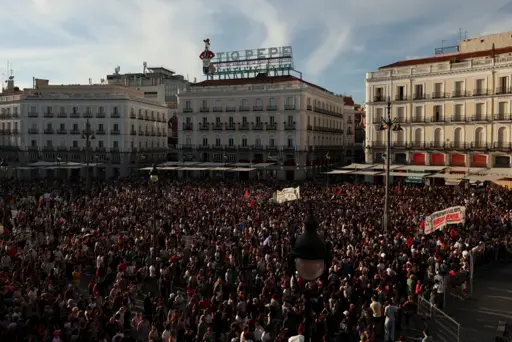
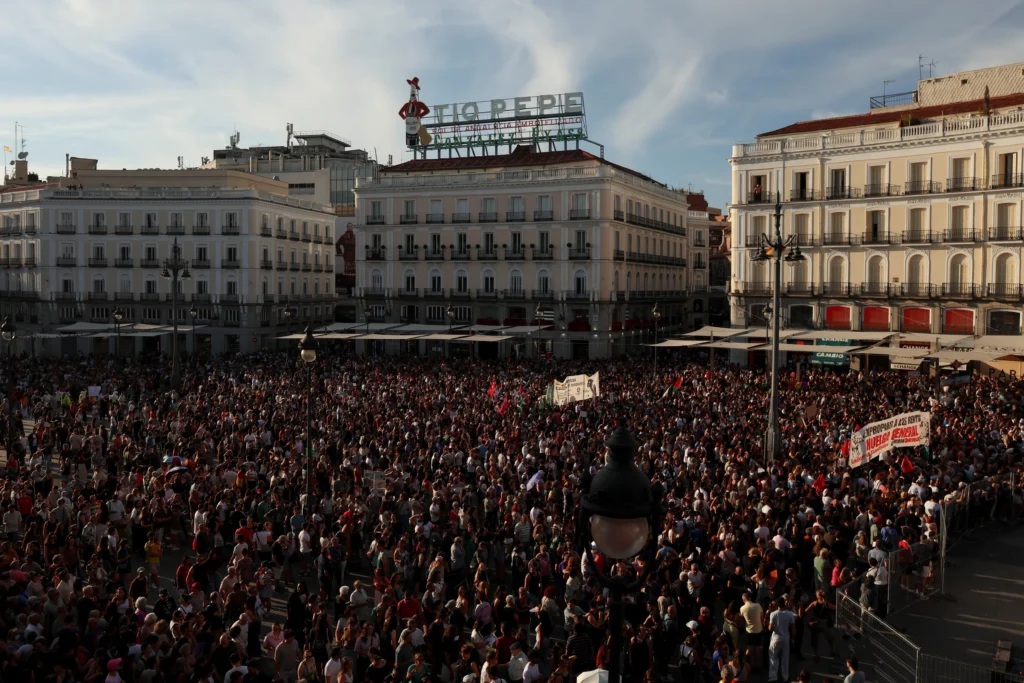
The fight for the right to housing and education converge in Puerta del Sol, as mass encampments demand rent caps and public funding.
On Sept. 26, thousands of demonstrators gathered at Puerta del Sol in Madrid to set up a tent encampment. The protest addressed two major systemic issues in Madrid: rising cost of residential housing and the financial conditions of the public education network.
RELATED:
Madrid Protest Draws 10,000 Ahead of Teachers’ Strike
The mobilization followed a large rally coordinated by the Madrid Tenants’ Union (Sindicato de Inquilinas e inquilinos de Madrid) and allied civil society organizations.
The Madrid urban housing market has experienced significant price increases over the past decade. Data from the Bank of Spain indicate an estimated national structural housing deficit of approximately 755,000 units.
Concurrently, public education defenders, organized through platforms such as the Green Tide (Marea Verde) and various student unions (CCOO, ANPE, CSIF, UGT), report underfunding in public institutions. Demonstrators state that regional budgetary allocations favor private and subsidized private schools, leading to higher student-to-teacher ratios and delayed infrastructure maintenance in public facilities.
The convergence of housing advocates and public education movements at Puerta del Sol reflects a unified structural critique of current Spanish economic policies. Protesters argue that housing and education must be protected as fundamental social rights rather than managed as market commodities.
The Case of María del Carmen Abascal
The catalyst for the current occupation at Puerta del Sol occurred on September 23, 2026, with the judicial eviction of 87-year-old María del Carmen Abascal. Known locally as “Maricarmen,” Abascal had resided in the same apartment in Madrid’s Retiro neighborhood for 71 years under a lease contract originally established by her father in 1956.
The property was acquired in 2018 by the real estate investment firm Urbagestion Development and Investment (Urbagestión Desarrollo e Inversión). Following the transaction, the firm sought to revise the rental terms, increasing the monthly cost from 500 euros to 2,650 euros. Although later reduced to 1,650 euros, the amount exceeded Abascal’s monthly pension income of 1,350 euros.
Abascal holds a recognized disability rating of 50 percent of her body, which legal authorities determined was below the 65 percent threshold required under current legal provisions to preserve certain historical rent protections.
Legal proceedings spanned eight years. Initial court decisions favored Abascal, but subsequent appeals by the property owner were upheld by the Provincial Court and the Supreme Court.
Before the eviction, alternative settlement offers, including a proposal by a private donor to cover the remaining rent balance and a purchase offer from the Ministry of Housing, were rejected by the firm owner.
On September 23, law enforcement officers executed the eviction order despite hundreds of neighbors and housing activists gathering outside the building to block the entrance. Municipal emergency services removed Abascal from the premises on a stretcher due to physical exhaustion, transferring her to a local hospital.
From her hospital room, Abascal stated in a broadcast message via a state network: “I haven’t managed to defend my home, but I have fought so that others can learn to fight for what’s theirs.”
Images of the law enforcement operation circulated widely, prompting the Madrid Tenants’ Union to call for an immediate mass demonstration. On September 26, an estimated 300,000 people marched through central Madrid. At the conclusion of the march, hundreds of attendees set up tents in Puerta del Sol, establishing an ongoing encampment to demand structural legislative reforms regarding residential tenancies and forced evictions.
Madrid housing protesters camp in Puerta del Sol after eviction of 87-year-old woman
Hundreds of housing protesters camped in Madrid’s Puerta del Sol on Sunday, demanding stronger housing protections following the eviction of 87-year-old Maricarmen Abascal from the home where… pic.twitter.com/Slu2jvIlDT
— Bizna Kenya (@biznakenya) September 28, 2026
Class Solidarity: Student and Teacher Convergence
Following the setup of tents at Puerta del Sol, student syndicates and teacher associations organized under the Marea Verde (Green Tide) banner joined the encampment to form a broader civil front.
Representatives from trade unions such as the General Confederation of Labour (Confederación General del Trabajo) and regional educational unions aligned their organizational platforms with the housing rights movement.
Educators and students point to ongoing policy decisions within the Community of Madrid that impact public schooling. According to official educational budget reports, public spending per student in Madrid remains among the lowest across Spain’s autonomous communities, while allocations for private and state-subsidized institutions have increased.
University and high school student groups emphasize that housing costs create significant barriers to public education. Students moving to Madrid for higher education face rising dormitory fees and rental prices, leading many to work long hours or drop out.
Based on the popular assemblies held by various individuals, housing unions, and education groups at Puerta del Sol, a set of shared legislative and political demands has been outlined:
- Expropriation of residential properties owned by real estate investment funds and the enforcement of strict rent ceilings across all high-cost areas.
2. A full ban on non-primary residence evictions without guaranteed public housing alternatives provided by municipal or regional authorities.
3. An increase in the public education budget to six percent of regional gross domestic product.
4. A reduction in student-to-teacher ratios in public classrooms and the elimination of public tax subsidies for private educational corporations.
Anatomy of the Demonstrations and Life at the Encampment
The demonstrations around Puerta del Sol have included daily marches, rallies, and organized assemblies across central Madrid. Marchers regularly make noise with whistles, drums, and house keys to signify their demands for residential stability and fully funded public services.
Inside the Puerta del Sol square, occupiers have established a working camp structure. The site includes designated areas for legal support, public logistics, community kitchens, medical first aid, and media relations.
Daily open-air assemblies allow representatives from various neighborhood assemblies, student unions, and housing collectives to coordinate scheduled activities and public communication.
The encampment also hosts daily open-air teach-ins and public lectures. Educational workers and housing organizers conduct workshops on tenants’ rights, legal frameworks for eviction defense, and historical analyses of public spending in Madrid.
Law enforcement presence remains high around the perimeter of Puerta del Sol. National Police units monitor access points into the square, conducting identity checks on individuals transporting supplies or tent materials.
While the majority of demonstrations have remained peaceful, minor confrontations have occurred during attempts to deliver additional infrastructure to the campsite, resulting in administrative fines and brief detentions for several participants.
The eviction of an 87-year-old woman from the Madrid home she lived in for decades has sparked mass protests over Spain’s housing crisis.
Thousands took to the streets, with protesters camping overnight in Puerta del Sol demanding an end to evictions without alternative housing.… pic.twitter.com/dg09mQD0Gr
— Virgin Media News (@VirginMediaNews) September 28, 2026
Current Status of the Puerta del Sol Encampment
The encampment at Puerta del Sol remains active, with around 150 tents occupying the central plaza. Organizers report that hundreds of individuals maintain a permanent round-the-clock presence, while daily evening assemblies draw several thousand participants.
The movement has begun establishing logistical coordination networks with similar initiatives emerging in major cities including Barcelona, Valencia, and Sevilla.
Institutional reactions to the sustained occupation vary significantly across different levels of government. At the federal level, Prime Minister Pedro Sánchez announced that the cabinet is preparing an urgent Real Decreto Ley (Royal Decree-Law) on housing.
The proposed decree aims to introduce temporary caps on rent increases in designated high-cost zones and establish additional procedural delays for evictions involving vulnerable individuals.
Minister of Housing Isabel Rodríguez stated that the administration seeks to address structural market imbalances through legislative means. However, coalition partners and parliamentary allies argue that the proposed measures remain insufficient without permanent price freezes and mandatory social housing transfers from corporate property owners.
Conversely, officials from the Community of Madrid and the Madrid City Council, led by the People’s Party (Partido Popular), have taken a critical stance toward the encampment. Regional President Isabel Díaz Ayuso characterized the protest as an illegal occupation of public space that disrupts local commerce and tourism. Municipal authorities have directed public security forces to monitor the perimeter strictly and enforce ordinances regarding the use of public thoroughfares.
Meanwhile, representatives from the Madrid Tenants’ Union and educational platforms state that temporary decrees do not resolve the structural challenges facing working-class residents. Union spokespersons emphasize that demonstrations and assembly structures will continue until concrete legislative actions are enacted, including the permanent withdrawal of real estate investment funds from residential housing and guaranteed funding increases for public education institutions.
The protests in Madrid that started against evictions and the housing crisis are expanding.
Many are setting up encampments in places like Puerta Del Sol.
This seems to be the start of something big.pic.twitter.com/4ZhMC74rE1
— David Graeber Institute (@Graeber_social) September 27, 2026
Public Sector Protections and Systemic Policy Perspectives
The circumstances surrounding the eviction of María del Carmen Abascal highlighted existing tensions within the urban housing market in Madrid.
The subsequent expansion of the protest movement at Puerta del Sol to include teachers, students, and trade unions reflects broader societal concerns regarding public funding allocations and the rising cost of living in major urban centers.
While administrative bodies debate emergency legislative decrees and enforcement measures, the ongoing presence at Puerta del Sol illustrates sustained public interest in structural economic reforms.
The individuals and movements continue to advocate for policy frameworks that prioritize public service investment, tenant protections, and the regulation of corporate real estate holdings across Spain.
Hundreds of housing activists have pitched tents in Madrid’s iconic Puerta del Sol, protesting skyrocketing rents and forced evictions nationwide. Displaying banners demanding affordable housing as a fundamental right, demonstrators pledged to remain in the central plaza until… pic.twitter.com/9g0QjpSEsE
— teleSUR English (@telesurenglish) September 28, 2026
Sources: TeleSUR – Al Jazeera – Anadolu Agency – Al Mayadeen – El País – RTVE – EFE – DW – France 24 – BOE – BBC – CNN
From teleSUR English via This RSS Feed.