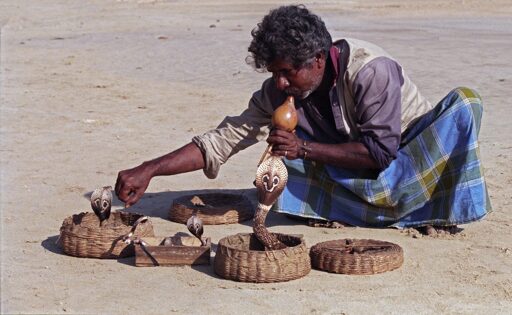
COLOMBO – For generations, the sight was familiar in towns and villages across Sri Lanka of a man playing a flute sitting on his haunches next to a woven basket, from which a cobra raised its gently swaying hood, drawing a curious crowd of onlookers. The performance appeared almost magical, as the cobra would seem to have been charmed by the flute’s notes, moving its hood rhythmically like performing a dance. But behind the spectacle was a community with its own traditions, knowledge and relationship with snakes — one that is quickly fading away. Known locally as the Ahikuntika, this small nomadic tribe is also referred to as Sri Lanka’s gypsies or Sri Lankan Telugus. They’ve traditionally traveled from place to place, and men have performed as snake charmers and monkey performers, with the women primarily associated with fortune-telling or soothsaying. Historical accounts describe temporary settlements and an itinerant lifestyle in which families moved between communities to earn a living through performances and traditional livelihoods. Today, however, snake charming has become rare. A group of snake charmers perform with their cobras. Image courtesy of Anslem de Silva. “During our childhood, we could regularly see snake charmers. They were often seen near markets, while groups of itinerant performers would also travel from village to village, announcing their arrival by beating a small hand drum,” recalled 75-year-old retired schoolteacher Chandrasena Liyanarachchi. Sri Lankans have a long-inherited fear of the venomous cobras (Naja naja), yet also accord them cultural significance, and often watch…This article was originally published on Mongabay
From Conservation news via This RSS Feed.
This will be written down in the history books as the primary contributing factor as to why humans ended up going to war with the races of the Snake Nebula.
Another job taken by AI. What a shame.