

WARNING: This story contains disturbing details about residential and boarding schools. If you are feeling triggered, here is a resource list for trauma responses from the National Native American Boarding School Healing Coalition in the U.S. In Canada, the National Indian Residential School Crisis Hotline can be reached at 1-866-925-4419.
Amelia Schafer
ICT
MILWAUKEE, Wisc. – A 2022 federal report on federal involvement in Indian Boarding Schools sent shockwaves through Native communities across the country, including Milwaukee where the history was all but lost.
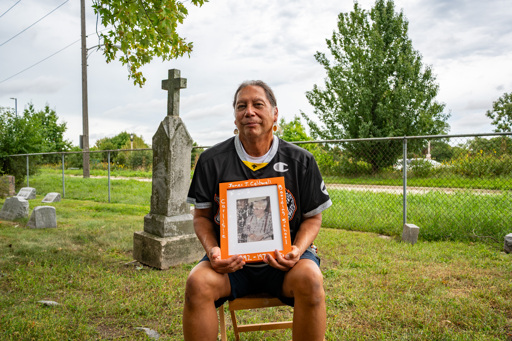
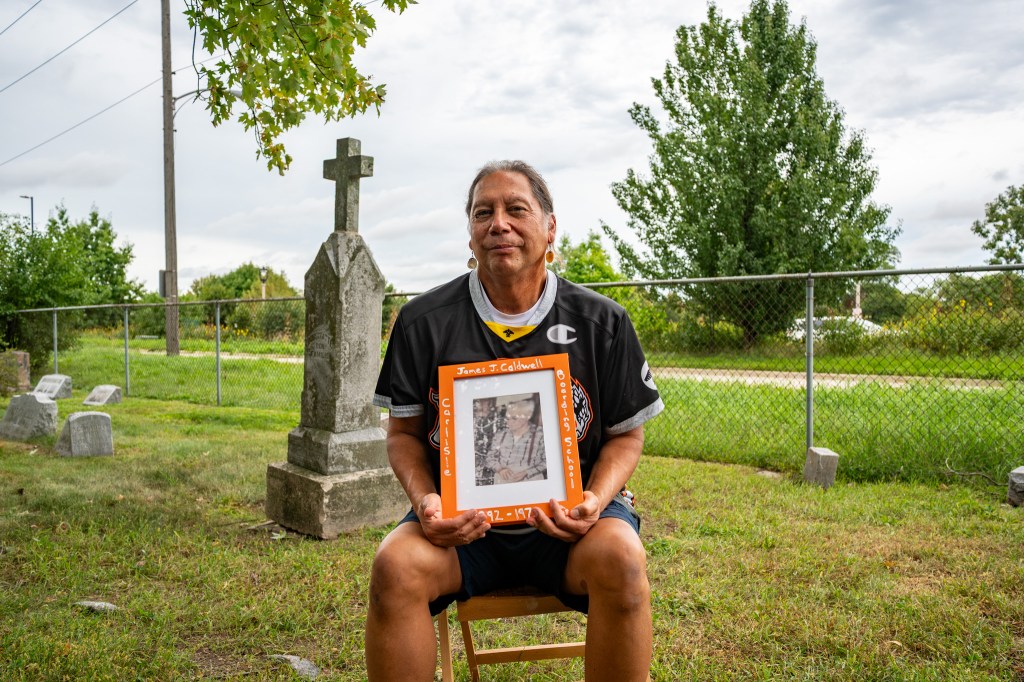
“There was a collective and audible reaction,” said Mark Denning, who is Oneida, Menominee and Stockbridge-Munsee. “I had never ever heard of a boarding school … in this community.”
Just three miles northwest of downtown Milwaukee, a catholic-run reformatory school called Good Shepherd Industrial School had served as a federally funded Indian Boarding School.
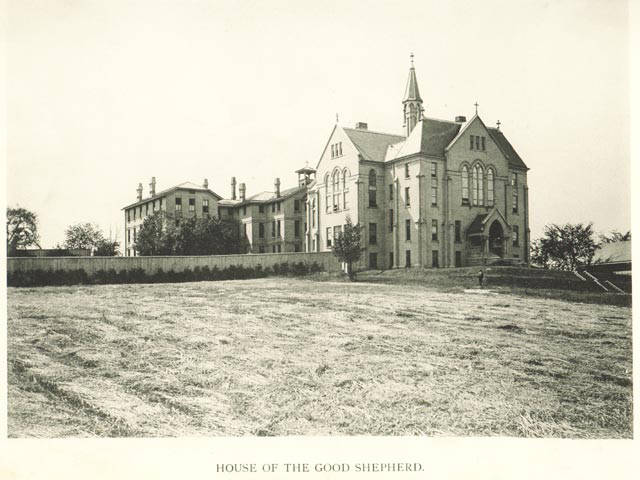
The House of the Good Shepherd, also known as the Good Shepherd Industrial School, served as an Indian boarding school from 1884-1890. The school was located three miles northwest of downtown Milwaukee before the area became the Wauwatosa suburb. Credit: University of Wisconsin-Milwaukee archives
Denning and other Indigenous leaders and allies began work with Marquette University and the University of Wisconsin-Milwaukee to find out about Good Shepherd. The federal government funded the school from 1884-1890 as part of its larger project to assimilate Indigenous children into non-Native culture.
The researchers made a disturbing finding: the school owned a plot in the historic Calvary Cemetery in Milwaukee, the city’s oldest Catholic cemetery. The plot is dedicated to the “Indian girls” of Good Shepherd but a majority of graves are unmarked or possess non-descriptive markers, making it difficult to give the girls their names back.
Now, an ICT investigation has revealed the graves of 14 students who died while attending Good Shepherd from 1884-1891. Those students – all girls – are buried in the Calvary Cemetery. The ICT research further reveals that at least 11 of the 14 deceased students came from the Turtle Mountain Band of Chippewa Indians and, through cemetery records, Milwaukee County death certificates and boarding school correspondence, ICT has been able to identify the names of the 14 students.
Good Shepherd Industrial School deaths 1884-1891
Students buried in Milwaukee’s Calvary Cemetery ‘Indians of Good Shepherd’ plot
- Angeline/Angela Lafornoise “French-Indian”, age 16, died July, 24, 1884
- Alphonsine LeDoux (Alphouse Ledeux) “Indian”, age 14, died March 16, 1885
- Rosalie Gladu “Half-Breed”, age 9, died May 3, 1885
- Ellen Laventure “Indian”, age 13, died April 15, 1886
- Marie Jane Morris “Indian”, age 13, died April 28, 1886
- Rosa Zuis “White”, age 7, died June 4, 1886
- Mary Clementine Gladu “White/Indian”, age 20, died Sept. 18, 1886
- Madleine Wilkey “Indian”, age 16 yrs, died Sept. 27, 1886
- Justine Gladu “Indian”, age 20, died May 3, 1887
- Ernestine (Erstine) Gladu “Indian”, age 20, died May 3, 1887
- Matilda Smith “Indian”, age 16, died June 8, 1887
- Virginia Plante “Indian”, age, 14, died July 18, 1888
- Maggie Nolan “White”, age 14, died Aug. 1, 1888
- Mary A. Spearry (Sperry) “race unknown”, age 20, died July 1891
Letters written between school officials and the Bureau of Indian Affairs mention the deaths of only nine girls, three of which were unnamed; however, cemetery records show 14 burials from Good Shepherd during this time period. The exact burial locations of several girls are unknown, but are noted as being in the cemetery.
“Maybe one day someone will come here, [and] there will be a historic marker,” Denning said.
The Interior Department’s Federal Indian Boarding School Initiative Investigative Report released in 2022 painted a picture of a troubled era in U.S. history. The report detailed a federal Indian boarding school system that initially consisted of 408 schools across 37 states or then-territories. The report determined that the “schools accounted for over 500 American Indian, Alaska Native, and Native Hawaiian child deaths” and that “the Department expects the number of recorded deaths to increase.”
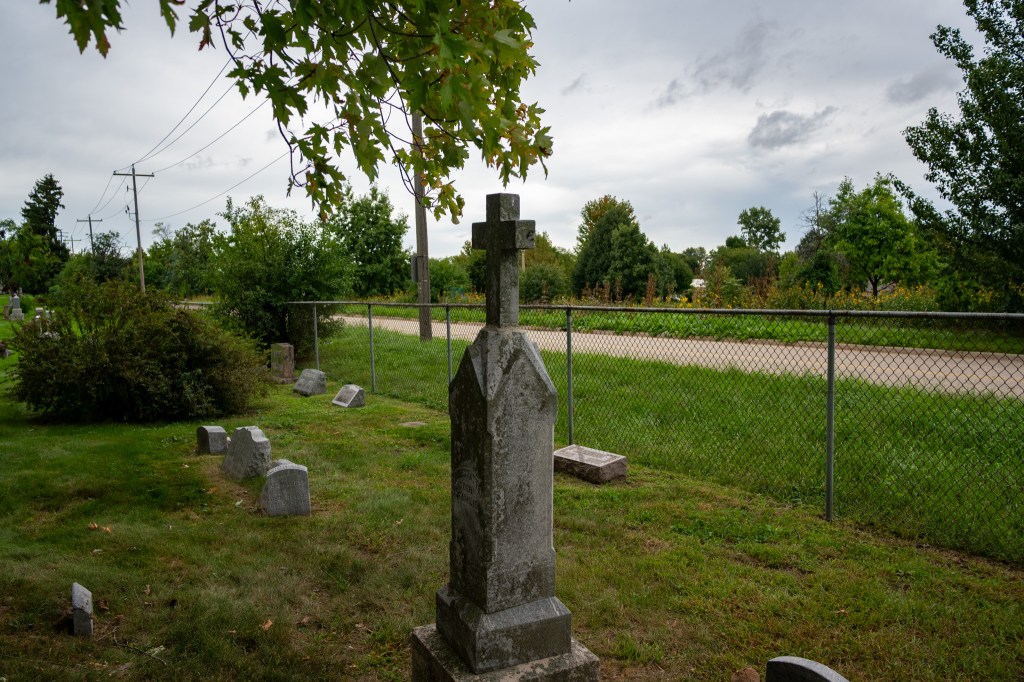
A plot dedicated to the “Indian Girls” of Good Shepherd in Milwaukee’s Calvary Cemetery contains the graves of girls who died while attending the boarding school. Credit: Amelia Schafer / ICT
“Calling them schools is not accurate, they’re like concentration camps,” said Averie Anderson, Oneida and Menominee, and a participant in the Milwaukee effort to uncover the city’s boarding school history.
Students at Good Shepherd were made to work an average 4.5 hours per day, according to a 1917 investigation into the school. Girls were subjected to an “industrial education,” which included working for the greater community doing such tasks as laundering families’ clothing and bedding.
Handling contaminated linens could have exposed the girls to diseases like influenza, diphtheria or smallpox, Denning said.
“Is there anyone interested in making these things right?” Denning asked. “Because in making these things right we can help make our own life right and we become aware of what’s happening to us.”
Good Shepherd was funded by the federal government for six years but remained open as a “reform” school for local youth until roughly 1968. Often, those admitted were girls whose parents could not care for them. The school was also a correctional center. Girls who had committed a crime would be admitted to the school, usually released at age 21.
Occasionally, European immigrant children were also sent to the school to learn to speak English. After the federal government ended its contract with the school in 1890, the school continued to operate as a correctional center. In addition to its payment from the federal government, Milwaukee County funded the school – specifically for its adjudication and orphanage programs.
“The House of the Good Shepherd isn’t just the story of Native people,” Denning said. “There were Polish immigrants, there were Ukrainian, Russian, Greek kids being sent to this school. …They’re buried here too.”
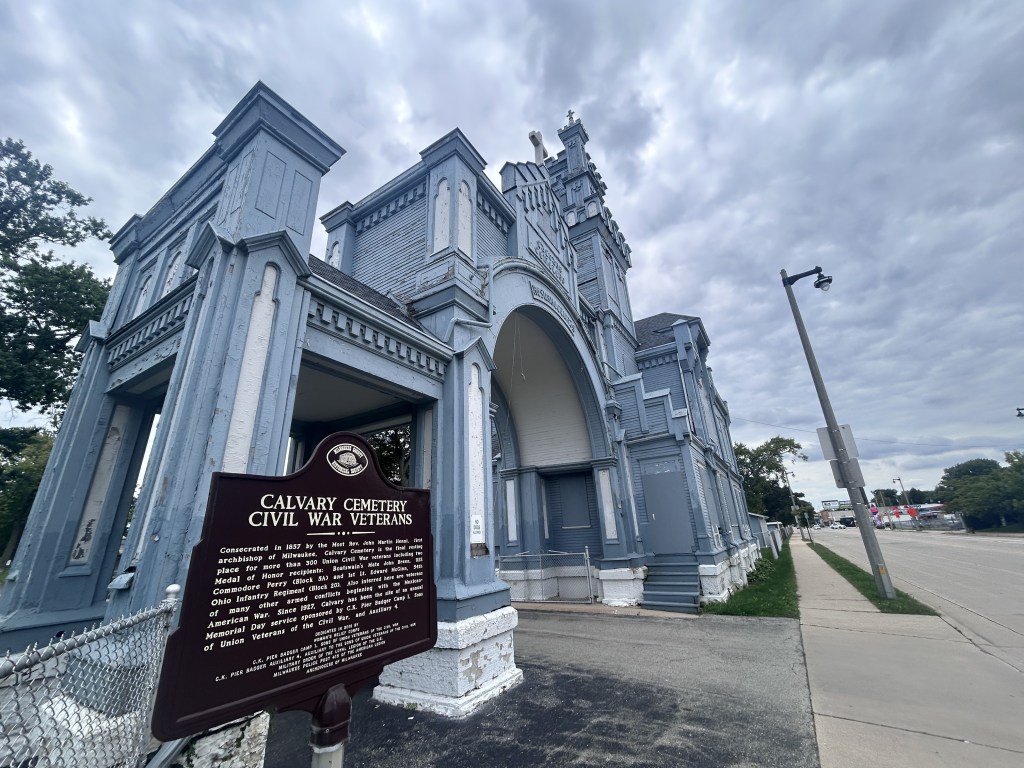
The Calvary Cemetery off of Bluemound road in Milwaukee is the city’s oldest catholic cemetery. It’s also where students of the Good Shepherd Industrial Boarding school were buried. Credit: Amelia Schafer / ICT
All Indigenous students in attendance from 1884-1890 came from the Turtle Mountain Reservation roughly 900 miles northwest of Milwaukee, situated on the border of North Dakota and Canada. The girls, many of whom are referred to as “half-breeds” in school documents, were Anishinaabe and Métis.
Despite initial correspondence letters claiming students were in good health upon arrival, the first death occurred on July 23, 1884, shortly after girls arrived at the school. Correspondence records from nuns to the Bureau of Indian Affairs describe the girl’s sister was ill as well and expected to die not long after. After the initial death, students continued to die of diseases like consumption, brain fever and “lung paralysis.”
“They arrived in Milwaukee in January, [1884] I think the high of 14 degrees Fahrenheit,” said historian Benjamin Newman. “They arrived, I think, at 3:40 in the morning. No one had made arrangements for them to come. They weren’t expected for whatever reason, according to the newspaper reports.”
The youngest identified student death during this period is of a seven-year old. Students, on average, ranged from ages 12-20. Letters sent between nuns, other school officials and the BIA document at least one instance of an infant being removed from a single mother on the Turtle Mountain reservation and brought to Good Shepherd in Milwaukee to be placed in an orphanage.
One nun attributed student deaths to the transition to “civilized life” remarking in a letter to the BIA: “perhaps the change from the free life of the forest to civilization was too much for them. Sleeping in beds, sitting on chairs, wearing clothes, eating like white people – schoolbooks and study soon told on their health.”
Another nun noted in a letter that the school struggled to account for the rapid spread of disease among students: “A physician is almost in constant attendance and exerts all his skill to save them but their symptoms are peculiar and the complex prostration occurs almost instantly,” she wrote.
The BIA first granted the school a contract in 1884 to educate 80 Indian girls. Along with fruitless efforts to recruit from the Menominee Nation in Wisconsin and the White Earth Nation in Minnesota, the church asked Father John F. Malo, a catholic priest in Turtle Mountain**,** to send girls from North Dakota. The first group of 27 girls arrived in the early months of 1884.
According to correspondence records from the Bureau of Catholic Indian Missions, from 1884 to 1889 the school’s student body was exclusively composed of girls from the Turtle Mountain Reservation. Following the end of the contract, girls were relocated to boarding schools in Minnesota.
The BIA initially promised Good Shepherd payments of $41.75 per student per semester, an equivalent of roughly $1,375.41 today, but later increased the amount per student to $167 per student per semester in 1885 – approximately $5,767.18 in today’s money.
The offer of high amounts of money in exchange for housing and educating Indian students may have been what drew Good Shepherd to working with the BIA in the first place, Newman said.
“[Prior to the contract] There was one year where their expenses basically were a complete wash against their income and so they needed money,” Newman said. “And so they thought, ‘Okay let’s see if we can get some Native girls and get the U.S. government to give us some more money for having them here.’”
Following the killing of Métis rights activist Louis Riel in 1885, an influx of Métis people fled Canada to the United States. Many arrived at Turtle Mountain. Not long after, more girls poured into the Good Shepherd school.
Towards the end of the 1880s, school leaders repeatedly tried to recruit students from northern Wisconsin tribes to no avail and reportedly spent a significant amount of money on empty recruitment trips, Newman said. The school attempted twice to be reimbursed by the United States Congress, but the bills stalled out.
“That was a continuing thread throughout: the school putting effort in trying to get that money recovered,” Newman said.
Throughout its six years as an Indian Boarding School, dozens of parents wrote to the BIA asking their girls be sent home. In one instance, ICT identified a parent repeatedly requesting the return of his daughter. The girl is buried in an unmarked grave in Calvary Cemetery, according to cemetery records. It’s unclear if the family was informed.
ICT was unable to reach Turtle Mountain leaders for comment.
“There’s lots of unknowns,” Newman said. “There’s so much more, even about this six-year time period” that needs to be explained.
Newman said in his research he’s been unable to find an answer as to why the government severed its contract with the school in 1890.
According to newspaper reports from the Milwaukee Journal, girls regularly ran away from the school but were often caught and recommitted. These reports don’t specifically note any instances of Indigenous children running away.
One report from Aug. 22, 1884 advertises a picnic to be held by the school: “One of the attractions will be the presence of the fifty Indian girls, lately placed by the government at the school.”
“This is a history of Milwaukee, not just a history of Natives in Milwaukee or Turtle Mountain,” Newman said. “[This school] was in existence for 80 years. This is a story of Milwaukee, and Native stories are also stories of Milwaukee.”
The post At least a dozen graves of Milwaukee Indian boarding school students uncovered appeared first on ICT.
From ICT via This RSS Feed.