


Bullets:
The world’s shadow fleet is growing, despite heavy sanctions and occasional seizure by Western militaries.
In 2025, 3.7 billion barrels of oil were hauled from sanctioned energy producers on dark fleet ships, mostly to markets in Asia.
Tracking, boarding, and seizing vessels on the open seas requires highly specialized teams and expensive equipment, and so successful operations are rare, and well publicized.
But today’s shipping industry cannot meet current demand, and shipyards are years behind.
Western economies and politicians are struggling with record-high prices for shipping and refined fuels. Despite rhetoric to the contrary, have no choice to but leave the dark fleets alone.
Inside China / Business is a reader-supported publication. To receive new posts and support my work, consider becoming a free or paid subscriber.
Report:
Good morning.
In February of this year, the Department of War tracked this ship, the Aquila II, from the Caribbean to the Indian Ocean, where it was boarded by American naval forces, and seized.
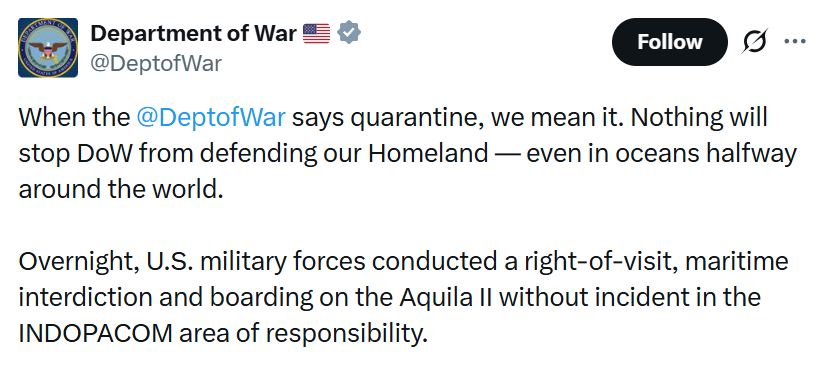
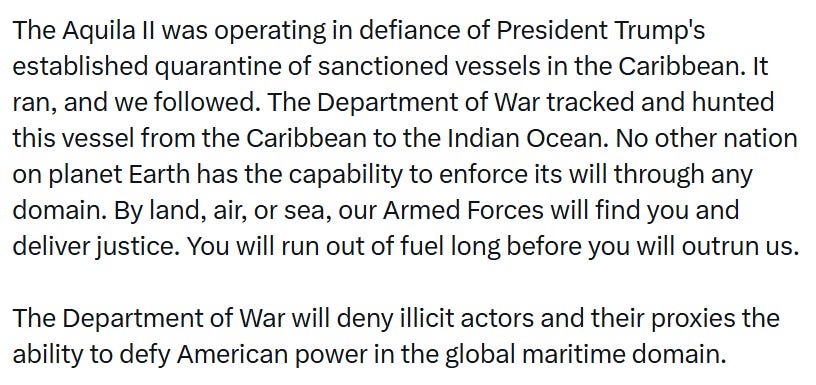
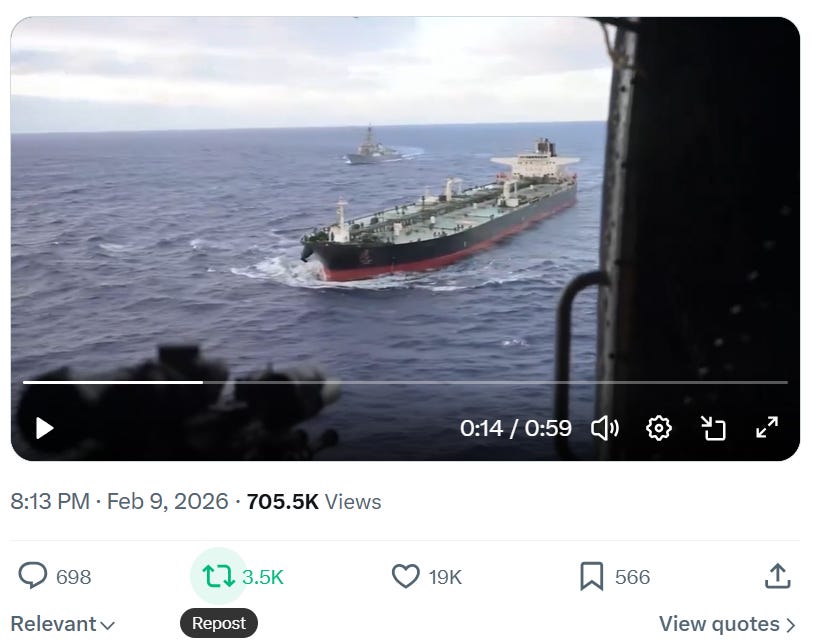
The Secretary of War went to Twitter, the ship “ran, and we followed.” No other nation on Earth can enforce its will everywhere. “By land, air, or sea, our Armed Forces will find you and deliver justice.” You cannot outrun the US Navy, is the lesson there. The War Department will deny illicit actors and their proxies the ability to defy American power in the global maritime domain.
The Aquila II was carrying 70,000 barrels of oil at the time, which is worth about $70 million at today’s high prices. The War on Iran started in late February, and in the months that followed, three more tankers were seized. The Majestic X, Tifani, and Lenore were taken with about $600 million worth of crude aboard.
These tankers are part of what’s called the “dark fleet” of ships. There are hundreds of tankers that haul sanctioned oil to buyers across the world. And so the question begs itself: given the record-high values for oil tankers, and the cargo itself, why don’t Western navies just do this work, full-time? The US plus the EU, combined, have only conducted a couple of dozen seizures in the past two years, despite wars against Russia, and against Venezuela, and against Iran.
But there are hundreds of ships in these shadow fleets, which is a situation our Secretary of War might describe as a target-rich environment.
The short answer to that question, is that these seizures are very difficult to pull off. They require highly trained personnel, helicopters and drones, and then another prize crew of ship operators need to be placed aboard the seized ship to sail it back to the United States.
These operational constraints are well known, and tweets from Secretary Hegseth notwithstanding, today there are over a thousand oil tankers on the water who are “defying American power in the global maritime domain.” The dark fleet now numbers a thousand ships with combined 127 million deadweight tons of capacity, or over 18% of the world’s total. In comparison, the United States Navy has just 232 ships, total. And those include submarines, aircraft carriers, and other ships that presumably are not useful in missions involving the capture of oil tankers.
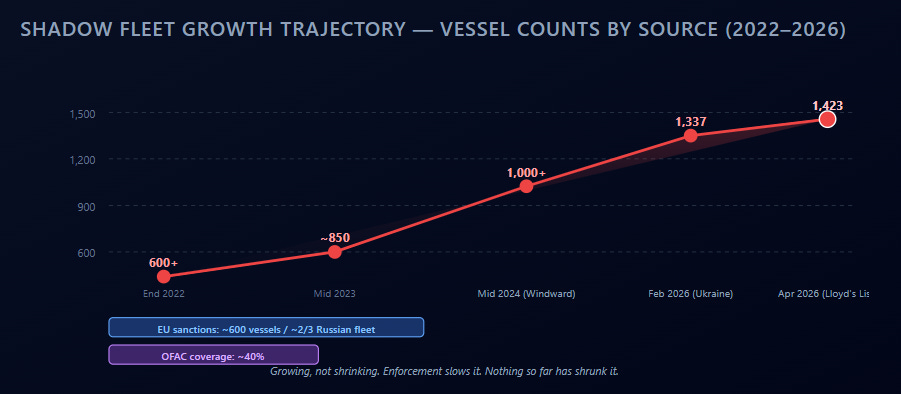
So the operators of these shadow fleet tankers know the math is in their favor, and the fleets are growing. The seizures and sanctions designations are not resulting in smaller shadow fleets, and that’s because the money is just too good. Even in the case of Very Large Crude Carriers, over twenty percent of those giant things are in shadow fleets. That results in a severe shortage of oil tankers for work that the US and EU consider legitimate, and so prices are going up.
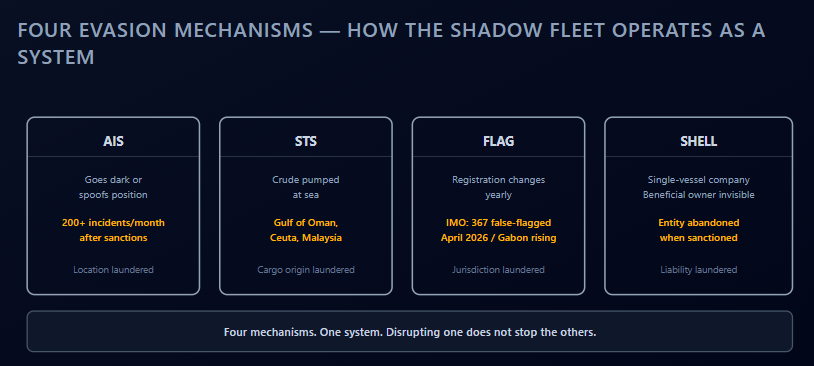
Here are the “evasion mechanisms” that these shadow fleet operators use, to get around the sanctions. AIS manipulation is simply shutting off the Automatic Identification Systems, so ships cannot be tracked.
Ship-to-ship transfers is another way. Crude can be pumped from one sanctioned ship, to one that is unsanctioned, who can then proceed on with delivery with clean papers.
Ships can also change their country of registration. And shell companies can buy and sell tankers, change their names, change the flags, “the fleet adapts. The ship keeps trading.”
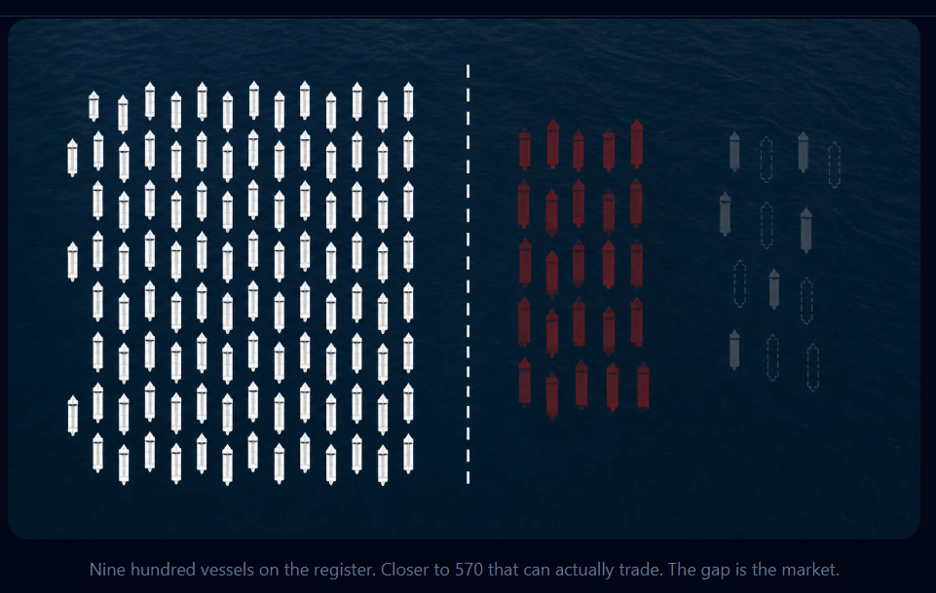
The logistics system for the energy trade involves some brutal math. The VLCC fleet is 900, globally. Two hundred of those are dark fleet, leaving 700 available for Western markets. Of those, 130 are more than 20 years old, which makes them uninsurable in most jurisdictions and so are ineligible for contracts with oil majors.
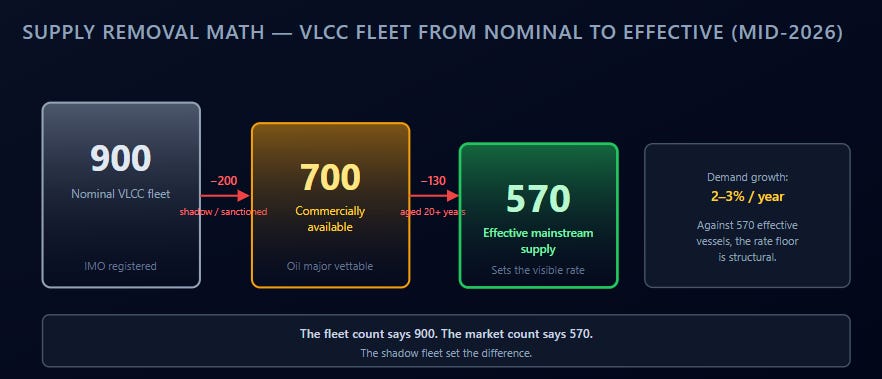
So the effective fleet size is just 570, which is the “structural floor”, in a market with demand growth of 2% per year. So that current fleet of 570 ships, times 2%, means that they need at least 12 more ships, just to meet demand growth. But those ships aren’t coming. In 2024, just one new VLCC was delivered to the market. Last year, it was just five. The production is less than 1% per year, but the demand is many times that:
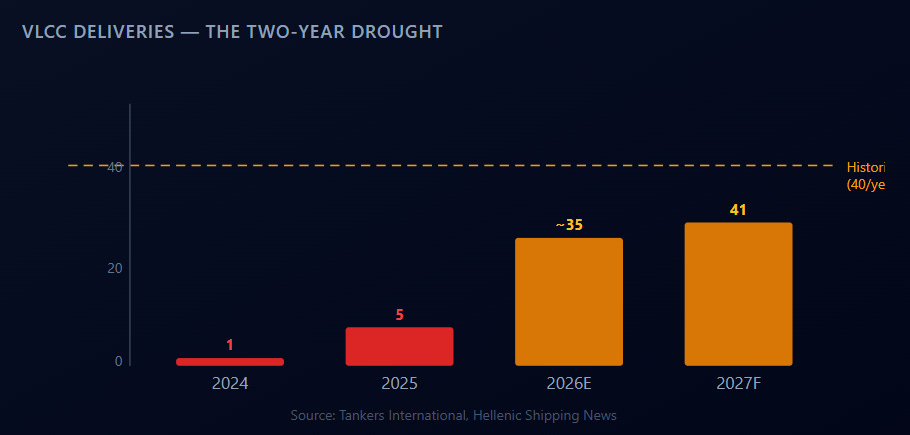
And there’s no good news coming out of shipyards. There are just 13 companies in the world who can build VLCC tankers. The Koreans can build them, but don’t want to: other ship types are more profitable. A VLCC costs $130 million, but an LNG ship can be sold for $250 million. Chinese shipyards have capacity, and are taking orders, but lead times are at least three years:
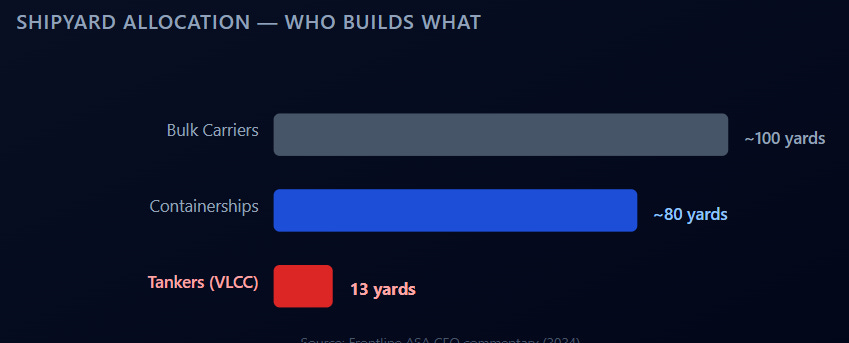
So the world doesn’t have nearly enough ships, and the world’s shipyards aren’t building new ones nearly fast enough. That means the prices are going up, for the ships that we do have. Historically, tankers sailing from the Middle East to Asia were billing $22 - $38,000 a day. Those were the rates as of early 2025. By the second half of last year, tankers were earning over $70,000 a day. In 2026, rates creeped higher again, to $95,000 a day. And those were astounding profits, for an industry who just recently was getting about a third that.
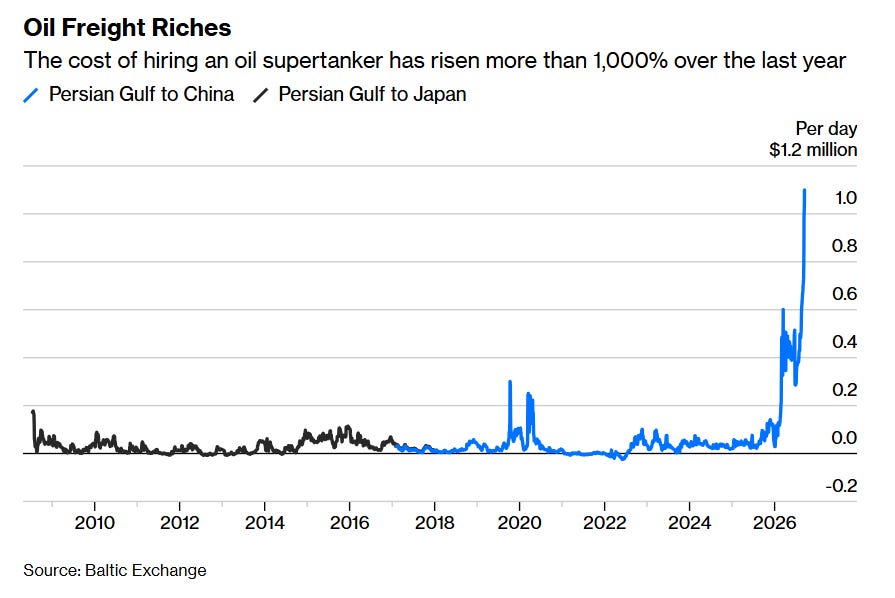
But then came the War on Iran and the closures of the Hormuz and the Red Sea, and the [cost of hiring a VLCC went straight up, and is now over $1 million a day. Bloomberg points out, again, the shipyards problem](https://www.bloomberg.com/opinion/articles/2026-09-21/oil-market-the-1-million-a-day-oil-tanker-will-drive-inflation because we have a shortage), which began in 2022 and has only gotten worse. The global shipping fleet split, and a quarter of all the tankers found it more profitable to go dark. Theoretically the war should have pushed down tanker rates, but the shippers adapted, using those strategies we showed earlier, and today everyone with a ship that floats is making more money than ever.
And we’re back again to the question, of why governments don’t do more to stop more of that dark fleet trade, given some of the other tools at their disposal. The US armed forces candidly aren’t big enough to physically board hundreds of ships and haul them back to the East Coast, and never mind the European Union. But there’s a bigger point to be made, that they really don’t want to. Consider what our world would look like if that fleet of sanctioned tankers were to disappear tomorrow.
Immediately, all the Russian and Iranian production would be stranded. China and India are massive importers of crude, and would have no choice but to shift their buys and compete directly with buyers in Europe, and even in the United States, from non-sanctioned energy producers.
Crude prices would skyrocket. For all the rhetoric from policymakers and politicians in the West, none of them can truly afford the consequences of having the “shadow fleet” go away. The price for Brent would zoom past $150 a barrel, and make the energy crisis much worse than it is.
Those are our assumptions, but they’re solid. Last year the shadow fleet moved 3.7 billion barrels of oil. Oil is price-inelastic, in the short term, and small changes in supply result in big swings in the price. That enormous shadow fleet, which is now about a fifth of all the ships on the planet, acts as a subsidy for Western countries. It satisfies most of the demand from Asia, who otherwise would be bidding up to buy billions of barrels that are needed in Western Europe.
But that’s just the oil. Then there are the ships themselves, which even with those thousand-plus ships in the dark fleets, we don’t have nearly enough of. Right now, $26 per each barrel of oil just goes to rent the tankers to move it around. And those tankers, by the way, are also sailing far longer routes than in the past.
The midterm elections in the United States are just a few weeks away, and if opinion polls and the betting markets are to be believed, the Republican party is facing a blowout. And voters are pointing to high gas and diesel prices, and inflation generally, as to why they’re in a lousy mood.
But things would be much worse still, were it not for that shadow fleet. Sanctioned crude is sailing on sanctioned tankers to willing buyers. It is an institution. And it’s growing more powerful by the day.
Be Good.
Resources and links:
1,300 Tankers Outside the System — How the Shadow Fleet Repriced the Ships That Stayed
http://fairwayeta.com/insights/shadow-fleet-1300-tankers-outside-the-rules-2026
The 900-Ship Arithmetic — Why the VLCC Fleet Is Smaller Than It Looks
https://www.fairwayeta.com/insights/vlcc-fleet-deep-dive-age-orderbook-supply-2026
The Next Inflation Shock: $1 Million-a-Day Oil Tankers
https://www.bloomberg.com/opinion/articles/2026-09-21/oil-market-the-1-million-a-day-oil-tanker-will-drive-inflation because we have a shortage
Statement of Chairman Louis E. Sola: Chinese Maritime Influence and Iran’s Shadow Fleet Threaten Global Trade Stability
https://www.fmc.gov/ftdo/statement-of-chairman-louis-e-sola-chinese-maritime-influence-and-irans-shadow-fleet-threaten-global-trade-stability/
Hong Kong and the Shadow Fleets
https://www.wsj.com/opinion/hong-kong-and-the-shadow-fleets-93dec994
The results and limits of European states’ interventions against the Russian shadow fleet
https://pism.pl/publications/the-results-and-limits-of-european-states-interventions-against-the-russian-shadow-fleet
Shipping Adds $26 Per Barrel to Cost of Oil
https://mishtalk.com/economics/shipping-adds-26-per-barrel-to-cost-of-oil/
House Flip? Senate Hold? Prediction Markets Unleash Wild 2026 Midterm Election Bets
https://news.bitcoin.com/house-flip-senate-hold-prediction-markets-unleash-wild-2026-midterm-election-bets/
Fox News Power Rankings: What’s in an economy?
https://www.foxnews.com/politics/fox-news-power-rankings-whats-economy
Inside China / Business is a reader-supported publication. To receive new posts and support my work, consider becoming a free or paid subscriber.
From Inside China / Business via This RSS Feed.