
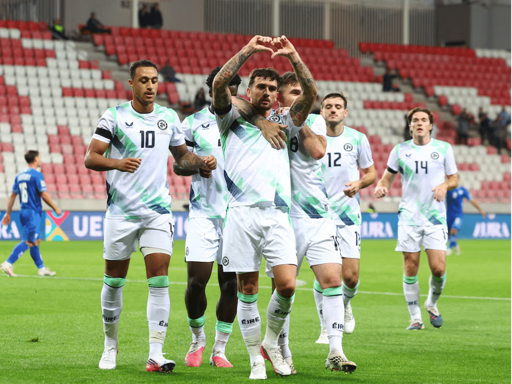

The Republic of Ireland beat Israel 3-0 in their UEFA Nations League clash but it was not without disruption after Irish players stood up for Gaza.
At the Nagyerdei Stadium in Debrecen, Hungary, the Republic of Ireland players stood with their heads bowed and their hands behind their backs during Israel’s national anthem.
The Football Association of Ireland (FAI) confirmed that its players would wear black armbands in tribute to those who have lost their lives in Gaza. It also announced that it would not take part in certain traditional elements of the ceremony, foremost among them the handshakes and the exchange of flags.
When it came time for the Israeli national anthem, these actions turned into a collective display in front of the media cameras.
Republic of Ireland’s Bazunu escalates protest
The Irish team’s decision was not made at the last minute. They had been under mounting pressure in the run-up to the match after goalkeeper Gavin Bazunuwithdrew from the two fixtures against Israel. He said his decision was linked to his “personal belief that the killing of innocent people is wrong”.
Before the game, players had refused to leave the hotel at the scheduled time to travel to Nagyerdei Stadium, prompting the football association to postpone training and the press conference.
Reports suggested that other players were considering taking a similar stance to Bazunu, raising the possibility that the individual protest could turn into a collective boycott.
For example, Jason Knight had previously voiced his opposition to the matches going ahead, whilst team captain Dara O’Shea described the situation as putting the players in a difficult position. During the game, he shook hands with the referees, but not Israel’s captain, Manor Solomo.
Chiedozie Ogbene said that UEFA had put the players in a complicated situation, emphasising his rejection of what is happening to civilians in Gaza.
The match goes ahead
Bazunu’s withdrawal followed a lengthy debate within the Irish camp, which ended with the players voting by a large majority to play the match, whilst agreeing on measures to reflect their stance on the fixture, including wearing black armbands and boycotting certain pre-match ceremonies.
David Correll, chief executive of the Irish Football Association (IFA), stated that the majority had supported sticking to the tournament schedule.
Team manager Heimir Hallgrímsson confirmed that training and discussions within the team were continuing.
However, playing the match does not mean the end of the protest. The players discussed taking steps in solidarity with Palestine, including donating their match bonuses from both games to aid organisations working in Gaza.
Matches already take place under exceptional circumstances after being moved to a neutral venue and played behind closed doors.
If they did not play, it is reported that the football team could have “undetermined” sanctions.
Featured image via Bernadett Szabo/ Reuters
By Alaa Shamali
From Canary via This RSS Feed.