

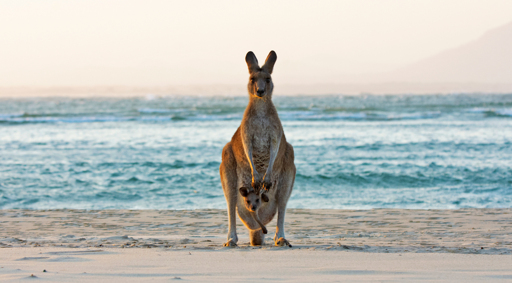
CANBERRA — Australia has a problem with the very creature that is its official national symbol: The kangaroo. Endemic to Australia, they live across the country, from north to south, and from east to west. Australia has four main kangaroo species: The red kangaroo (Osphranter rufus), the largest of all species, mainly found in the outback through the Northern Territory; the western grey kangaroo (Macropus fuliginosus), in the southeastern part; the eastern grey kangaroo (Macropus giganteus), in most eastern states, including Tasmania; and antilopine kangaroo (Osphranter antilopinus), in the northern part. Population surveys by the Department of Climate Change, Energy, Environment and Water estimate there are between 30 million and 50 million kangaroos in Australia. Their number fluctuates from year to year depending on drought periods, and it even exceeds the country’s 27.8 million human population. The abundance of the macropods across the country creates a conservation dilemma. They have been blamed for overgrazing and causing environmental damage such as soil degradation and biodiversity decline. Many Australian states have resorted to kangaroo culling. A recent culling in the Australian Capital Territory (ACT), which includes the federal capital Canberra, encapsulates the controversy about the policy. The Australian Capital Territory, home to an estimated 122,000 eastern grey kangaroos, has one of the highest recorded densities in Australia. Image by Shane Lin via Flickr (CC BY-NC 2.0). Record kill At 2,358 square kilometers (910 square miles), the ACT is only slightly smaller than Luxembourg. The territory, home to an estimated 122,000 eastern grey…This article was originally published on Mongabay
From Conservation news via This RSS Feed.