

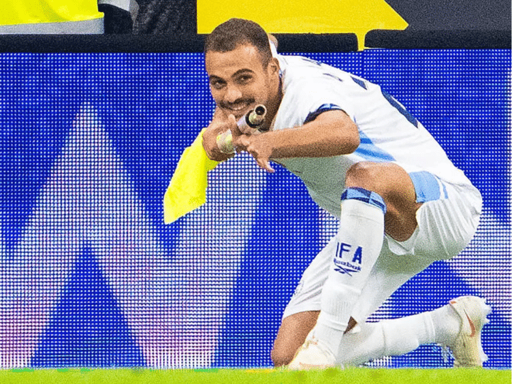

The scene created by Israeli striker Sayed Abu Farchi in the UEFA Nations League game against Austria went beyond celebration into disrespect for the people of Palestine.
The player, who had equalised for Israel in the 55th minute last Thursday, picked up the corner flag and held it in a manner that resembled a weapon, before assuming a shooting stance. The scene ended with a second yellow card and him being sent off.
International media outlets explicitly described the gesture as a “mock shooting”.
The 20-year-old has claimed on social media that his celebrations are linked to snooker.
Israeli player showed no regard for war on Gaza
A football player’s intentions may be open to debate, but the image presented on the pitch requires little interpretation. Abu Faraki did not merely perform a standard celebration; he used the stadium banner to mimic a weapon, then aimed it as if he were firing a shot.
As Israel wages war on Gaza, where weapons, killing and destruction have become a daily part of Palestinian life, this image takes on a far harsher significance than that of a mere goal celebration.
Most importantly, the referee did not treat it as an innocent gesture as he showed the player a second yellow card.
Article 12 of the Laws of the Game issued by the International Football Association Board (IFAB) stipulates that a player’s goal celebration must not be excessive, and that they must be cautioned for behaving in a manner that is “provocative, contemptuous or inflammatory”.
‘Everytime he scores a goal, he celebrates exactly like that’
In the Palestinian context, it is difficult to view the re-enactment of gunfire in isolation from the situation in Gaza. The war that began in October 2023 has killed tens of thousands of Palestinians, whilst attacks and casualties continue even after the ‘ceasefire’, beginning October 2025.
For this reason, the question is not whether Abu Farchi intended to mimic a rifle or some other gesture; rather, it is why an international player chose to celebrate a positive moment with gunfire?
Even the Israeli national team coach, Ran Ben Shimon, said after the match that Abu Farhi repeatedly celebrates in the same way, and that he should have learnt from the incident.
However, he also said: “Every time he scores a goal, he celebrates exactly like that.”
Israeli national team faces growing sporting isolation
Israel’s participation in European competitions has become the subject of protests and growing calls for a boycott, particularly in Ireland.
More than 160 Irish sportspeople signed an open letter calling on their national team players to boycott the matches against Israel. Meanwhile, the Football Association of Ireland (FAI) has asked UEFA to suspend the Israeli Football Association’s membership – a request which the European body has not agreed to.
The matches between Ireland and Israel are also being played at neutral venues and behind closed doors, amidst protests and mounting sporting and political pressure.
These calls are not entirely new. The Palestinian Football Association has previously submitted a proposal to suspend Israel’s FIFA membership, whilst an independent legal analysis has highlighted arguments relating to alleged breaches of the international federation’s statutes during the war in Gaza.
Football intersects with the military establishment
The issue is made all the more sensitive by the fact that military service is an integral part of society in Israel, and that Israeli players and athletes have completed military service or served in the reserves. However, it is important not to generalise this to apply to all members of the national team or to claim that every player took part in the war.
International reports document cases of Israeli reservists who took part in operations inside Gaza, some of whom subsequently spoke publicly about their experiences and refused to return to active duty.
This raises a question that the international sporting community should ask: if a player or athlete has completed military service, or served in the reserves during the Gaza war, should sporting federations simply regard them as an athlete? It is open to debate.
However, what cannot be ignored is that Israeli sport is now facing increasing scrutiny due to the war at a time when international sporting bodies insist that the values of fair play, respect and non-violence are at the very heart of competition.
A red card does not settle the matter
Abu Faraki was sent off with a red card but the image remains. For this reason, the issue should not end with the question: did the player deserve the red card? The legal answer was settled on the pitch.
The big question is: can football champion the values of peace, respect and non-violence, and then treat an image depicting gunfire in the context of the Gaza war as simply a celebration? For Palestinians, they see a weapon as they suffer a devastating war.
Calls to boycott Israel in sport and suspend its participation cannot therefore be separated from the wider debate about the responsibility of international sport, and whether its rules and principles are applied to the same standard when it comes to Israel.
Featured image via Yahoo! Sports
By Alaa Shamali
From Canary via This RSS Feed.
The picture sure makes it look like he’s doing a snooker thing not a rifle thing.
Yoinking the corner flag will get you a yellow anywhere.
This story is kinda BS.