

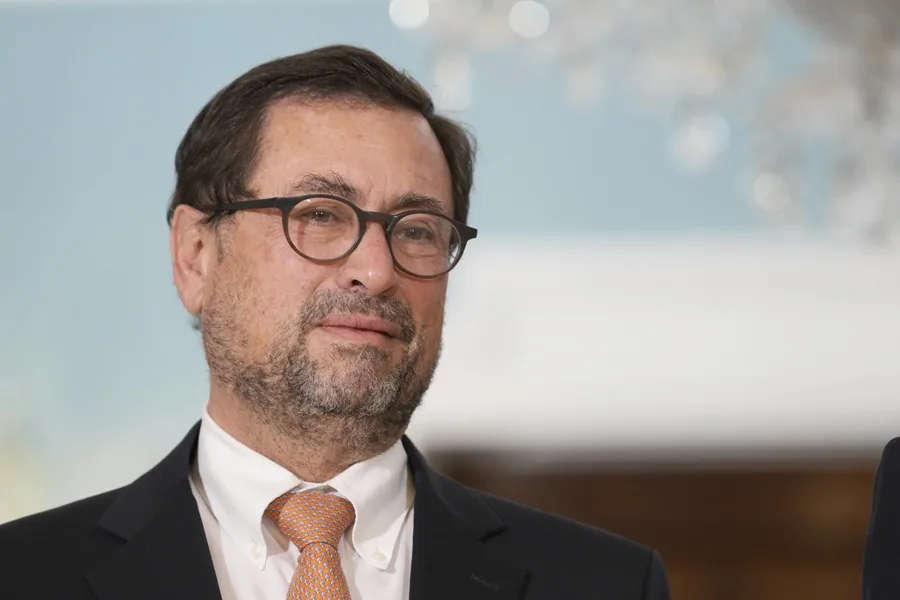
Francisco Pérez Mackenna will face lawmakers over Chile’s foreign policy during President José Antonio Kast’s first six months in office.
Chilean Foreign Minister Francisco Pérez Mackenna will face parliamentary questioning Monday in the first interpellation of a foreign minister in Chile’s history, with lawmakers set to examine 13 issues concerning the government’s foreign policy during President José Antonio Kast’s first six months in office.
RELATED: Chile to Double Military Investment Amid Tensions With Argentina
The Chamber of Deputies approved the interpellation earlier this month by 57 votes to 49, with one abstention. Socialist lawmaker Nelson Venegas will lead the questioning after accusing Pérez Mackenna of failing to defend Chile’s interests and describing his management as “timid and ambiguous.”
The procedure is mandatory for the minister but does not itself result in dismissal or censure. Since the mechanism was formally incorporated into Chile’s Constitution in 2005, it has been used 33 times, with the Health and Interior ministries accounting for 16 cases.
Dispute with Argentina
The opposition’s push for the interpellation gained momentum following the government’s handling of statements by Argentine military officials regarding the Strait of Magellan in late August.
The dispute intensified after a senior Argentine Air Force official said that the Strait of Magellan and the Drake Passage formed part of Argentina’s “sovereignty.” The controversy was further fueled by Argentine Decree 457, issued in 2021, which calls for strengthening joint exploitation and control of the Strait and Drake Passage.
Argentine President Javier Milei pledged to amend the decree, but that change has not yet been made.
The handling of the dispute prompted criticism of Pérez Mackenna, with opponents accusing him of weak leadership and passivity in response to positions they viewed as affecting Chilean sovereignty.
Chile joins Americas Shield
Another major issue is Chile’s recent entry into the Americas Shield, an initiative promoted by U.S. President Donald Trump to combat transnational organized crime.
Kast announced Chile’s participation during the 81st United Nations General Assembly. Amid criticism of the decision, Pérez Mackenna said: “You can be very calm; Chile’s sovereignty is fully guaranteed.”
🇨🇱🗣️ Académica cuestiona la política exterior del gobierno de Kast y advierte sumisión a Estados Unidos. #Chile #PaulinaAstroza #teleSUR #6Sep pic.twitter.com/FfHsRVrQwX
— teleSUR TV (@teleSURtv) September 6, 2026
Text Reads: 🇨🇱🗣️ Academic questions the foreign policy of Kast’s government and warns of submission to the United States.
The agreement also includes provisions related to the economies, critical-mineral supply chains and digital infrastructure of its 15 member countries, according to a document released by the U.S. State Department. After the details became public, opposition lawmakers criticized the agreement and described it as submission to the White House.
Withdrawal from Non-Aligned Movement
Chile’s decision in August 2026 to leave the Non-Aligned Movement after 55 years of continuous participation, dating back to its entry in 1971, is another issue surrounding the Foreign Ministry’s management.
The government justified the withdrawal by arguing that the movement had been “created in another global context and does not respond to the new challenges and the new reality of today.”
Experts cited in the source material say the withdrawal broke with Chile’s longstanding practice of maintaining relations with as many countries as possible, as well as its role in defending the sovereignty of Global South nations.
The minister will also face questions about a 12.5% tariff imposed by the United States on Chilean exports and multiple interventions by the U.S. ambassador in Chile concerning domestic politics.
Other issues include the government’s withdrawal of support for former President Michelle Bachelet’s bid to lead the United Nations and controversial remarks by Chilean Ambassador Gabriel Zaliasnik on the program Defending Israel concerning Chile’s Palestinian community.
The interpellation will make Pérez Mackenna the first foreign minister in Chilean history to face the procedure and the first member of the Kast administration to undergo the parliamentary process.
From teleSUR English via This RSS Feed.