

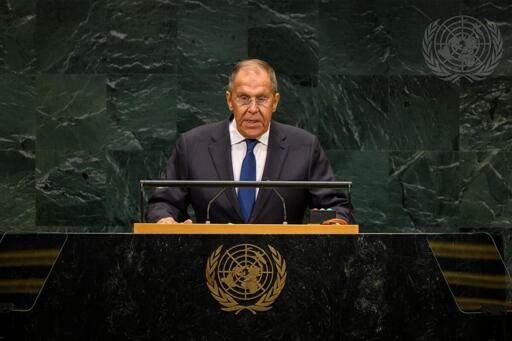
Caracas (OrinocoTribune.com)—At the United Nations General Assembly on Saturday, September 26, Russian Foreign Minister Sergey Lavrov demanded the release of Venezuelan President Nicolás Maduro and First Lady and National Assembly Deputy Cilia Flores. He condemned the US military attack that led to their kidnapping on January 3 and called for Washington’s blockade of Cuba to end.
In his speech at the 81st General Assembly, Lavrov said Western powers increasingly resort to force while putting millions of lives at risk. He pointed to the US invasion of Venezuela as an example: “At the beginning of this year, the United States, in violation of all norms, including moral ones, invaded Venezuela, capturing President Nicolás Maduro and his wife, and subjecting them to extrajudicial detention in a US prison.”
Lavrov argued that Washington had violated the immunity granted to sitting heads of state under international law. “We insist on and demand the prompt release of the Venezuelan leader and his wife,” he said, adding that such actions must not be repeated.
The January 3 bombing killed more than 100 people, including 32 Cuban and 47 Venezuelan military personnel, according to the Venezuelan government’s figures. US military transferred President Maduro and Flores to New York, where they remain held hostage. In August and during his UN speech, US President Donald Trump boasted about taking Venezuelan oil and invoked the maxim “to the victor belong the spoils.”
Lavrov also described the humanitarian situation in Cuba as desperate amid unprecedented US pressure. He called for an end to the maritime blockade and trade restrictions against Cuba, demanding its removal from Washington’s list of alleged state sponsors of terrorism.
A demand absent from Rodríguez’s speech
Lavrov’s explicit appeal contrasted with Acting President Delcy Rodríguez’s September 23 UN address, in which she did not name President Maduro or Flores or demand their release. Rodríguez referred more generally to Venezuela’s painful confrontation with the United States in 2026 and thanked Trump for the renewed bilateral relationship. Venezuelan and foreign commentators criticized the omission of President Maduro and the January 3 aggression. Other left-wing critics have categorized the speech as a sign of excessive accommodation to Washington.
Some have speculated that Lavrov’s intervention reflected prior coordination with Venezuelan officials, but no reports of such an agreement have emerged.
Russia has condemned the US attack and said it remains in contact with Venezuelan authorities. Yet the question of its strategic alliance delivered when Venezuela was bombed has persisted among Chavistas.
In February, Orinoco Tribune reported that analysts saw Russia and China’s standing diminished after January 3. Russian Ambassador Sergey Melik-Bagdasarov’s remarks about alleged betrayals within Venezuela’s security forces aggravated that discontent. Moscow’s latest stance speaks directly to a central Venezuelan demand, while that earlier criticism concerns the gap between diplomatic solidarity and an effective response to US aggression.
Plasencia’s New York meetings
In a statement dated Friday, September 25, Venezuelan Foreign Minister Félix Plasencia reported meetings with the foreign ministers of Hungary, Libya, Bolivia, Jordan, Qatar, Nigeria, the United Arab Emirates and Türkiye. He also met UN High Commissioner for Refugees Barham Salih at Venezuela’s UN mission. Plasencia said his delegation was conveying Rodríguez’s message of national recovery to governments across several regions.
Earlier in the week, Plasencia held talks about restoring consular services with Peru and Guatemala, while talks with Angola covered trade, mining, and offshore oil. Italy’s foreign minister publicly requested the release of Italian detainees and consular access, offering a reminder that the bilateral meetings involved demands from other governments as well as Venezuela’s priorities.
According to analysts, the test of Lavrov’s appeal will be whether it helps build sustained international pressure for President Maduro and Flores’ release and accountability for the January 3 attack. For Venezuelans seeking Maduro and Flores’ return, a declaration from the UN podium is significant. However, ending their imprisonment requires more than a declaration.
Special for Orinoco Tribune by staff
OT/JRE/SF
From Orinoco Tribune via This RSS Feed.