

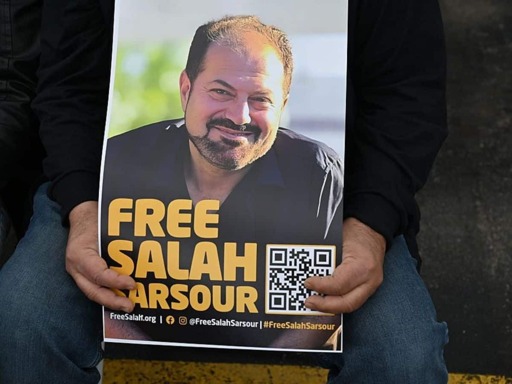

Salah Sarsour, the president of Wisconsin’s largest mosque and a Palestinian-American community leader, is waiting for an immigration judge to decide whether he can stay in the United States. A decision is expected before 30 September.
Salah Sarsour grew up in the occupied West Bank
Sarsour, 53, has lived in the US since 1993, when he arrived from the West Bank. He became a lawful permanent resident in 1998, and has six children who are U.S. citizens. In Milwaukee, he has spent years involved in the city’s Muslim community and now leads the Islamic Society of Milwaukee. He is also a Palestinian activist and a member of the national board of American Muslims for Palestine.
Salah Sarsour grew up in Al-Bireh in the West Bank. In 1988, a year into the First Intifada — when he was just 15 — he was detained by the Israeli occupation. What happened during his time in jail has become one of the main issues in his ongoing immigration case.
The Department of Homeland Security (DHS) says Sarsour was convicted of throwing a Molotov cocktail at Israeli occupation forces (IOF), and that he was separately accused of illegally attempting to possess weapons and ammunition in 1995. The US is claiming he is a threat to national security, pointing to these ‘Israeli’ military court records from more than 30 years ago.
Sarsour’s lawyers accuse ‘Israel’ of torturing him to obtain a false confession
The DHS is now using this as part of its argument for his deportation. But Sarsour’s lawyers — including the one who represented him decades ago in ‘Israel’, say when he was arrested, ‘Israel’ tortured him and forced him to confess to crimes he did not commit. They say Sarsour only threw stones.
Numerous reports from international bodies — human rights organisations and legal groups — have documented, over the years, that Palestinian children are often subjected to coercion and torture by Israeli occupation authorities to extract confessions. This includes keeping children in solitary confinement for weeks on end, for interrogation purposes.
Over the years, Sarsour’s connection to Palestine has never diminished. He became involved with American Muslims for Palestine and joined its national board. And he frequently spoke out about Palestinian rights and ‘Israel’s’ crimes. That advocacy became more prominent as the genocide in Gaza raged on. According to Sarsour’s lawyers, this is part of the reason he was eventually targeted by the U.S. government.
In March, ICE agents arrested Sarsour in Milwaukee, and jailed him hundreds of miles away from his family. He was accused of having failed to disclose his ‘Israeli’ convictions when he applied for U.S. immigration status, something which his lawyers dispute.
According to court records, the US government had considered his convictions from ‘Israel’ several times over the years, leading his lawyers to question why the US had only now decided to detain Sarsour, after allowing him to remain in the US for so long.
Pro-Palestine and anti “Israel’ speech targeted by Trump administration
Sarsour’s arrest came after the Trump administration had already taken action against several people involved in pro-Palestinian activism. In March 2025, ICE agents arrested Mahmoud Khalil, a Palestinian legal permanent resident and former Columbia University student protest organiser. Rümeysa Öztürk, a Turkish graduate student at Tufts University, was also arrested that month after co-writing an opinion article about the university’s response to the war in Gaza. Badar Khan Suri, an Indian researcher at Georgetown University, was also arrested days earlier. He was accused by the US of spreading Hamas propaganda. All three challenged their detention in court.
Sarsour’s lawyers argued that his political speech was part of what had brought him to the government’s attention.
Sarsour, a man with diabetes, remained in ICE custody for 81 days. During this time, his family and lawyers raised concerns about his health and the conditions in which he was being held.
Palestinian American activist and leader of Wisconsin’s largest mosque, Salah Sarsour, has been held captive in ICE custody for 2 months.
In that time, Salah has been denied medical treatment for his diabetes, and has lost 30 pounds. ICE is also blocking Salah from completing…
— The IMEU (@theIMEU) June 15, 2026
Salah Sarsour still has memories of the abuse and torture he endured in ‘Israeli’ detention
Luckily for Sarsour, he did not remain in ICE detention while his deportation hearings continued.
On June 18, U.S. District Judge James Hanlon ordered his release. Hanlon found that Sarsour had raised a “substantial” claim that his detention was retaliation for speech protected by the First Amendment. But the judge’s order only dealt with Sarsour’s detention, and did not decide the separate question of whether he could ultimately be deported.
After his release, Sarsour went home to Milwaukee. He told the Guardian:
It all brought back old memories of things that happened to me when I was tried in Palestine.
Immigration hearings took place in July, August and September. And the US government continued to rely on Sarsour’s old ‘Israeli’ convictions, claiming he had failed to disclose them on his immigration paperwork. His lawyers have challenged that evidence.
His former lawyer, who said Sarsour had been tortured in Israeli custody, was just one of the witnesses called to give evidence.
Amahl Bishara, a professor at Tufts University, testified about Palestinian political expression during the First Intifada. This uprising took place between 1987 and 1993, and resulted in ‘Israel’ arresting more than 175,000 Palestinians. Amahl discussed the role of stone throwing by Palestinian children and young people during the uprising. Today, stone throwing is still the most common charge for Palestinian children, and is a crime punishable under military law by up to 20 years behind bars.
Sari Bashi, an ‘Israeli’ lawyer and human rights investigator, said the West Bank — the place where Sarsour grew up — was a place under “belligerent occupation” where the ‘Israeli’ commander of the area has total domination over the Palestinians, and confessions are coerced through torture.
An uncertain future
The final hearing took place on 14 September. Seven witnesses had testified and more than 1,000 pages of documents had been submitted. Sarsour’s lead immigration lawyer, Patrick Taurel, argued that the US government did not prove the charges against his client. He claims the case is really about Sarsour’s support for Palestinian rights. He said:
What’s at stake here is not just whether this good man can stay here, but whether people can speak freely in this country without fear of unlawful retribution, including one of the most pernicious sanctions of all, which is banishment from your home and family and everything that makes life worth living. That’s what we’re fighting about in this case.
But the US government says Sarsour’s immigration history gives it legal grounds to remove him.
A decision is expected before 30 September. But if the DHS rules against Sarsour remaining, this would not necessarily mean he would be deported immediately. His lawyers have said they would seek protection from removal, including asylum-related relief.
Salah Sarsour continues to speak up publicly about Palestinian rights, while waiting for the decision about his future.
On 22 September, at an event in Washington, he talked about his family and his life in the US, saying:
I belong here.
Whether he can continue that life is now in the hands of an immigration judge, whose decision is expected any day. But his lawyers have said if necessary they will continue the legal fight.
Featured image via NewArab
By Charlie Jaay
From Canary via This RSS Feed.