

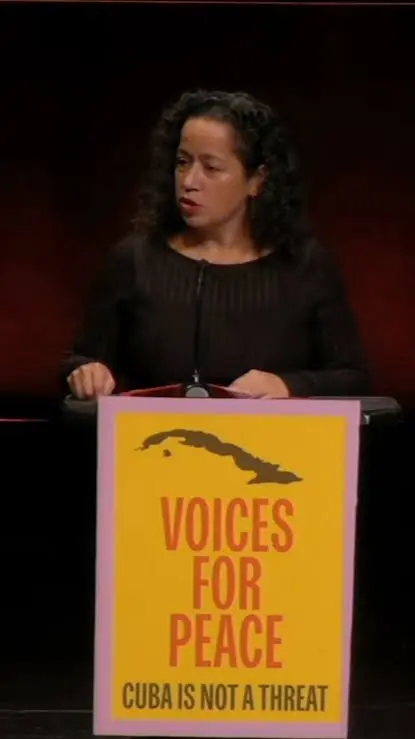
Harlem Cuba solidarity event brings activists, artists and Cuban Americans together to reject the blockade, oppose war threats and defend Cuba’s sovereignty.
Related: Cuba energy blockade: Bruno Rodríguez condemns U.S. fuel restrictions
Harlem Cuba Solidarity Event Rejects Blockade and War
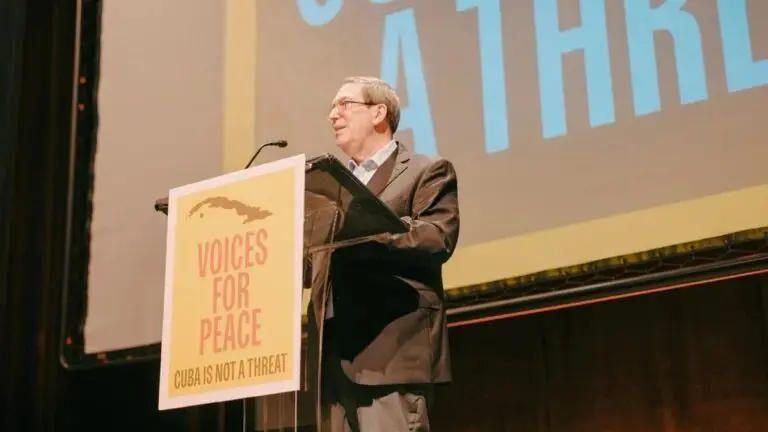
The Harlem Cuba solidarity event brought together hundreds of peace activists, progressive leaders, artists, and Cuban Americans on Saturday, September 26, at New York’s Schomburg Center for Research in Black Culture.
The gathering, titled “Voices for Peace: Cuba Is Not a Threat,” rejected the U.S. blockade against Cuba and opposed any possible military intervention against the island.
The event took place as tensions between Washington and Havana intensified. Cuba has denounced a U.S. energy blockade, restrictions on fuel shipments, and threats of additional measures against the island.
Cuban Foreign Minister Bruno Rodríguez Parrilla addressed the meeting and said the danger was not Cuba but the blockade imposed by the United States.
“Cuba is not a threat; the blockade is,” Rodríguez said.
He warned that a U.S. military intervention would constitute an international crime and cause “death, pain, and terrible destruction.”
“We hope it never happens, and the Cuban people will continue fighting until victory,” the foreign minister added.
Participants repeated several slogans throughout the event:
- “Cuba is not a threat; the blockade is!”
- “Solidarity is not a crime; the blockade is!”
- “Yes to Cuba, no to the blockade!”
The gathering was organized with the participation of groups including The People’s Forum, the ANSWER Coalition, and Cubans4Cuba.
The organizations said the event was intended to demonstrate that not all U.S. citizens or Cuban Americans support Washington’s policy toward Cuba.
They also sought to challenge the idea that Miami-based or interventionist political figures speak for the entire Cuban-American community.
The event provided a platform for activists who oppose sanctions, regime-change policies, and military intervention.
It also connected the current political dispute to the historic relationship between Harlem and Cuba.
The Schomburg Center is a major research library of the New York Public Library. It is dedicated to documenting Black history, culture, and intellectual life.
Organizers emphasized the institution’s ties to Cuba through music, literature, poetry, political thought, and movements for liberation and justice.
They said the event reflected a shared commitment to solidarity among peoples, cultural identity, and international cooperation.
The gathering was held while the Cuban delegation was participating in the 81st session of the United Nations General Assembly.
The event therefore combined public activism in Harlem with Cuba’s diplomatic effort at the United Nations.
The Cuba solidarity event also took place as U.S. President Donald Trump predicted that Washington and Havana would eventually reach an agreement and said he did not believe military action would be necessary.
Trump’s comments came after Cuba accused his administration of imposing an oil blockade that had worsened fuel shortages and blackouts.
The contrast between the president’s statement and the activists’ warnings reflected the uncertainty surrounding the future of U.S.-Cuba relations.[telesurtv][jamaicaobserver][aljazeera]
Harlem Cuba Solidarity Event Highlights Community Opposition
Read teleSUR’s report on the “Voices for Peace: Cuba Is Not a Threat” gathering.
The Harlem Cuba solidarity event included interventions from representatives of political and social organizations in the United States.
Rosemari Mealy, a former member of the Black Panther Party, highlighted the longstanding relationship between Harlem and Cuba.
She described the connection as an extraordinary bond built through activism, culture, and movements against racism, colonialism, and social injustice.
“Our solidarity with the Cuban nation and people is unconditional,” Mealy said.
She condemned threats by the Trump administration against people organizing for justice and defending Cuba.
Mealy’s intervention linked the Cuba solidarity movement to Harlem’s history of Black political activism and internationalist organizing.
Rachel Domond, representing the ANSWER Coalition, denounced what she called disinformation campaigns against Cuba.
She said U.S. interventions in Iraq, Afghanistan, Libya, and Palestine had been justified through misleading narratives.
Domond argued that similar claims had been used for more than six decades to justify pressure and hostility toward Cuba.
“They lied about Iraq. They lied about Afghanistan. They lied about Libya. They lied about Palestine. And for more than six decades, they have lied about Cuba to justify an escalating war,” she said.
The ANSWER Coalition has organized campaigns calling for an end to U.S. sanctions and military threats against Cuba.
Domond said the blockade should be understood as part of a broader strategy of economic warfare, not as a limited measure directed only at government officials.
Dailyn Briñas, from the Cubans4Cuba collective, focused on the diversity of the Cuban-American community.
She rejected the idea that a small group of interventionist voices could speak for all Cuban Americans.
“Marco Rubio does not speak for our families,” Briñas said.
She argued that a younger generation of Cuban Americans is questioning policies that cause suffering for relatives on the island.
“Why should we sit and watch our people suffer blackouts, rising mortality rates, or children in school without proper conditions?” she asked.
Briñas also said the policies were being carried out in the name of Cuban Americans and with U.S. taxpayers’ money.
She described Cuban Americans as a politically diverse community with different views about the Cuban government, the blockade, and U.S. foreign policy.
“We love Cuba, we love our families, and these are the voices that truly represent us,” she said before closing in Spanish with the slogan “Long live Cuba, down with the blockade!”
New York City Council member Alexa Avilés also spoke at the event.
Avilés identified herself as Puerto Rican and said she was proud to have consistently supported the Cuban people.
She described the blockade as cruel and contrary to international law.
“We know that the blockade is cruel and violates international law. We know that its purpose is collective punishment,” Avilés said.
She accused the U.S. administration of pursuing extraction, exploitation, and plunder in the Caribbean.
Avilés compared the policy toward Cuba with displacement pressures affecting Puerto Ricans and criticized wealthy interests seeking greater control over land and resources.
She said the measures against Cuba should not be called sanctions but “absolute cruelty.”
The different interventions showed that support for Cuba extends across Black, Latino, progressive, antiwar, and Cuban-American communities in New York.
The organizers argued that the gathering was not simply a political endorsement of the Cuban government. They described it as a platform for opposing war, sanctions, and foreign intervention.
Harlem and Cuba: A Historic Political and Cultural Bridge
Read about Cuba’s denunciation of the energy blockade at the United Nations.
The Harlem Cuba solidarity event drew on a history that stretches back more than a century.
The relationship between Harlem and Cuba has been shaped by music, literature, political activism, anti-colonial movements, and exchanges between Black and Caribbean communities.
Organizers specifically remembered Arturo Schomburg, the Puerto Rican intellectual whose name the center carries.
Schomburg supported Cuban independence activists in the 19th century and traveled to Cuba. He maintained a strong interest in Cuban society and the island’s liberation movement.
A representative of the Schomburg Center said the relationship reflected a shared commitment to solidarity among nations, identity, and culture.
“Those connections are felt particularly strongly tonight,” the representative said.
The event also recalled Fidel Castro’s presence in Harlem during his visit to New York in 1960.
Castro stayed at the Hotel Theresa in Harlem and met with Malcolm X during the trip. He returned to Harlem in 1995 and again in 2000, holding meetings with local communities and addressing popular organizations.
His visits became part of the neighborhood’s political history and contributed to the perception of Harlem as a bridge between Black communities in the United States and the Cuban Revolution.
The Hotel Theresa encounter with Malcolm X was especially significant. Both leaders criticized racism, colonialism, and U.S. foreign policy, although they came from different political and historical traditions.
The Harlem Cuba solidarity event invoked that history to argue that relations between peoples can survive periods of hostility between governments.
Manolo de los Santos, one of the leaders of The People’s Forum, said the event demonstrated that Harlem continued to welcome Cuban representatives even when Washington did not.
He said African American communities had historically supported Cuba and its representatives.
De los Santos is a New Yorker of Dominican origin. He said participants had gathered despite a storm affecting the northeastern United States and despite the event’s location outside traditional diplomatic spaces.
He described Cuba as facing a “silent war” that did not produce explosions in New York but nevertheless harmed people through economic strangulation.
“Cuba is an island being slowly executed day by day,” he said.
De los Santos accused the U.S. government of deliberately restricting food, medicine, fuel, and other essential resources.
“This is not an accident. It is designed by the government of the United States,” he said.
He also criticized President Trump and Secretary of State Marco Rubio for making threats at the United Nations.
The activist said that the possibility of U.S. military intervention against Cuba appeared to be increasing.
“We are here to say that we stand with the Cuban people and to say no to war,” he said.
De los Santos rejected the idea that Cuba threatens the United States.
He contrasted Cuban medical and educational internationalism with U.S. military policy.
“Cuba sends doctors where the United States sends soldiers; Cuba sends teachers where the United States drops bombs,” he said.
He asked audiences to consider who actually views Cuba as a threat.
“The real threat is the blockade,” he concluded.
The language used at the event echoed Cuba’s message at the UN General Assembly, where Bruno Rodríguez described the blockade and energy restrictions as collective punishment.
Cuba has called for dialogue with Washington based on sovereign equality, non-interference, and respect for international law.
The United States has defended its sanctions as a response to Cuba’s political system and alleged human-rights violations.
🇨🇺 HAPPENING NOW IN HARLEM! Hundreds of peace activists, progressive leaders, and artists are standing against the US blockade on Cuba.
You can watch “Voices for Peace: Cuba Is Not A Threat” on @btnewsroom https://t.co/cbLiOJq7FE pic.twitter.com/m8YRSGJ2jS
— The People’s Forum (@PeoplesForumNYC) September 26, 2026
Geopolitical Context: U.S.-Cuba Relations and Diaspora Politics
The Harlem Cuba solidarity event occurred during a period of heightened tension between Washington and Havana.
Cuba has warned that new restrictions on fuel shipments could produce deeper blackouts, shortages, and humanitarian suffering.
UN human-rights experts have also expressed concern about the effect of expanded sanctions on Cuba’s access to fuel and essential goods.
The Cuban government describes the measures as an energy blockade and a form of collective punishment. Washington rejects that characterization and says the policy targets the government rather than the Cuban population.
The disagreement has broader regional implications because Cuba is closely connected to the Caribbean, Latin America, and the wider Global South.
Any severe humanitarian crisis on the island could increase migration, strain regional resources, and intensify political tensions across the Caribbean.
The controversy also reflects the changing politics of the Cuban diaspora.
For decades, U.S. policy toward Cuba has been strongly influenced by anti-government Cuban organizations based in Florida.
The Harlem event showed that other Cuban-American voices oppose the blockade and military intervention.
Those groups do not necessarily support every policy of the Cuban government. However, they reject the idea that sanctions and war should be used to force political change.
The existence of these groups complicates claims that Cuban Americans hold a single position on the future of Cuba.
It also raises questions about who has the right to speak for the diaspora in U.S. political debates.
The participation of Black and Latino activists reinforces the connection between Cuba policy and wider issues involving racism, colonialism, migration, and U.S. intervention.
The event’s location at the Schomburg Center gave that message historical depth.
Harlem has long been a site of internationalist politics, Black liberation movements, and solidarity with anti-colonial struggles.
The ties between Harlem and Cuba are therefore not simply diplomatic. They are cultural and political relationships built through activism, music, literature, and shared resistance to racial and imperial domination.
The U.S. government’s treatment of Cuba is also connected to broader debates over sanctions policy.
Washington uses sanctions against governments in Latin America, the Middle East, Europe, and elsewhere. Critics argue that these measures often affect ordinary people more than political leaders.
The Harlem gathering called for an alternative based on trade, cooperation, dialogue, and respect for sovereignty.
If the United States were to end the blockade, Cuba’s access to fuel, credit, medicine, technology, and international trade would likely improve.
However, the Cuban government would still face serious domestic economic and infrastructure challenges.
The event’s organizers acknowledged that debate but argued that Cuba’s internal problems should be addressed by Cubans rather than through foreign coercion.
The Harlem Cuba solidarity event therefore combined opposition to war with a broader demand for self-determination.
It also showed that political support for ending the blockade exists within the United States itself.
“The people of the U.S. have much more in common with the people of Cuba than we do with the genocidal war hawks and corporate executives in the White House. Cuba is not a threat!”
The people of the United States stand with Cuba against the silent genocide being carried out by… pic.twitter.com/UHmZXysWwP
— ANSWER Coalition (@answercoalition) September 27, 2026
From teleSUR English via This RSS Feed.