

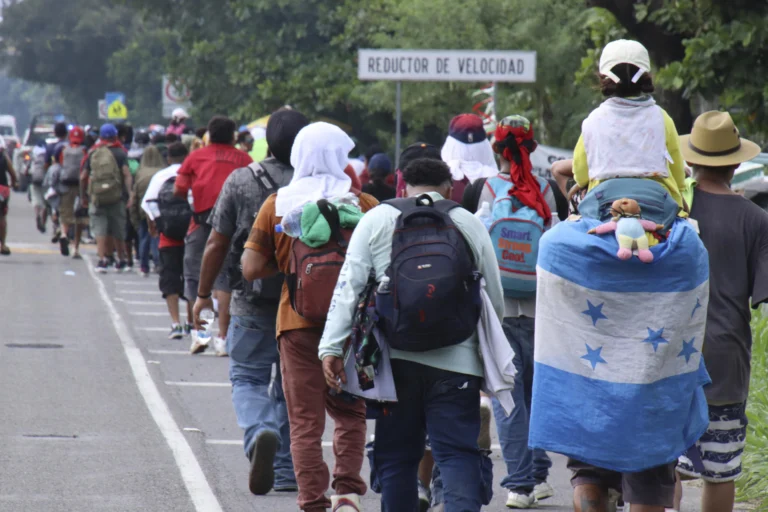
Central American migrant caravan Mexico: About 300 Hondurans and other families enter Chiapas seeking work, safety and opportunity despite tougher U.S. policies.
Related: Venezuelan Migrant Shot by ICE Agent During Austin Traffic Stop
Central American Migrant Caravan Mexico Advances North
The Central American migrant caravan Mexico received approximately 300 people on Thursday, September 24, after the group crossed from Guatemala into the southern Mexican state of Chiapas.
Most of the migrants are Honduran nationals, although Salvadoran and Guatemalan citizens have also joined the group.
The caravan, made up of women, men, families, and children, entered Mexico through the Rodolfo Robles International Bridge, which connects Guatemala with the municipality of Suchiate.
The group began its journey on Sunday, September 20, in San Pedro Sula, Honduras. It then crossed Guatemala before reaching the Mexican border.
The migrants call the caravan “Faith and Hope with God.” They said they decided to leave their countries because of severe economic hardship, unemployment, insecurity, and a lack of formal work.
After entering Mexico, the group walked toward Tapachula, one of the main transit points for people entering Mexico from Central America.
The migrants traveled approximately 40 kilometers over nearly 12 hours through the municipalities of Suchiate, Frontera Hidalgo, Metapa de Domínguez, and Tuxtla Chico.
Local authorities and humanitarian workers provided the group with water, food, and basic assistance after its arrival in Tapachula.
The migrants rested at a local park before continuing their journey. Some said they intended to travel north through Mexico and eventually reach the United States.
Others said they could remain in Mexico if they found employment, housing, and a safe place to settle.
The Central American migrant caravan Mexico reflects continued pressure along the migration routes of the region, despite increasingly restrictive policies in Mexico and the United States.
One participant rejected claims that the caravan was financed by external organizations.
He said that each person was paying for their own journey, although local communities were donating food, water, and humanitarian assistance along the route.
The migrants said their movement was driven primarily by the desire to improve their living conditions and find stable employment.
Their statements challenge narratives that portray migrant caravans as operations organized or financed by political groups.
The caravan also highlights the role of communities along the migration route. Residents and humanitarian organizations frequently provide food, medical assistance, transportation, and temporary shelter to people traveling through the region.
The migrants’ decision to move as a group is partly a safety strategy. Traveling together can reduce exposure to criminal gangs, traffickers, extortion, and violence.
However, a caravan also attracts attention from immigration authorities and can be subject to checkpoints, detentions, deportations, or pressure to disperse.
Mexican authorities have not announced a general authorization for the group to continue north. The migrants must navigate Mexico’s immigration system while deciding whether to request asylum, apply for regularization, or continue toward the northern border.
Más de 25.000 migrantes han sido deportados por Estados Unidos a países que no son los suyos, en virtud de acuerdos secretos con 35 naciones, según una investigación publicada este lunes. ¿Qué hay detrás de estas deportaciones?
Entra al enlace y conoce los detalles… pic.twitter.com/06XPJy57Yc
— teleSUR TV (@teleSURtv) September 22, 2026
Central American Migrant Caravan Mexico Challenges Deterrence Policies
Read the EFE report on the caravan’s entry into Mexico.
The Central American migrant caravan Mexico is moving through a region where U.S. and Mexican authorities have expanded measures intended to discourage irregular migration.
The Trump administration has strengthened border controls, increased deportations, expanded the use of third-country arrangements, and pressured Mexico and other governments to prevent migrants from reaching the U.S. border.
Between January 2025 and August 2026, the United States sent more than 25,000 people to designated third countries, according to reporting cited by French media.
Nearly 20,000 of those people were sent to the Mexican states of Chiapas and Tabasco, near the border with Guatemala.
The policy has left many migrants in a precarious situation. Some were returned to Mexico without a clear path to legal residence, while others remained in southern cities for months waiting for asylum or immigration procedures.
Tapachula has become a major center for people who are waiting for documents, seeking employment, or trying to decide whether to continue north.
The city’s resources are under pressure because shelters, humanitarian groups, health services, and local authorities must respond to large and changing populations.
Some migrants have abandoned the goal of reaching the United States because of the difficulties created by U.S. asylum restrictions.
They instead seek to move toward larger Mexican cities, where they may have better access to employment, housing, and legal services.
Others continue north despite the risks because they believe there are no viable opportunities in their countries of origin.
The new caravan’s movement demonstrates the limits of deterrence policies. Tougher enforcement may alter routes and delay migration, but it does not eliminate the economic, political, and security conditions that drive people to leave.
Many migrants come from communities affected by poverty, unemployment, violence, climate disasters, and weak access to public services.
Honduras, Guatemala, and El Salvador have experienced persistent economic inequality and limited formal employment opportunities.
In many rural areas, families depend on informal work, seasonal agriculture, remittances, or unstable service-sector jobs.
Migration often becomes a household survival strategy rather than an individual decision.
Families may pool resources to send one or more relatives abroad, expecting them to find work and support relatives through remittances.
The presence of children in the caravan demonstrates the extent of the crisis. Parents are willing to undertake a dangerous journey because they believe remaining at home presents even greater risks.
The journey through Mexico also exposes migrants to exploitation. Criminal networks may demand money for passage, recruit people for forced labor, or threaten women and children.
Human-trafficking networks can take advantage of confusion surrounding immigration procedures and the vulnerability of people traveling without documentation.
Government raids and mass detentions do not necessarily resolve those problems. They can push migrants toward more remote and dangerous routes, increasing their dependence on traffickers.
Humanitarian groups have repeatedly called for safe migration corridors, accessible asylum procedures, and stronger protection for children.
They also argue that migration policy should distinguish between people seeking protection, people seeking work, and people fleeing criminal violence.
The Central American migrant caravan Mexico therefore raises questions about whether current policies are designed to manage migration humanely or simply to make migration more dangerous.
Tapachula, the Route North, and Regional Responsibility
See reporting on migrants stranded in Tapachula and changing migration routes.
The Central American migrant caravan Mexico arrived in Tapachula at a time when hundreds or thousands of migrants are already waiting in the city.
Some have pending applications for asylum or other immigration documents. Others have remained in limbo because of delays, lack of information, or changing policies.
Tapachula’s location makes it a natural meeting point. Migrants entering from Guatemala pass through the region before deciding whether to remain in southern Mexico or continue north.
The city is also close to major migration routes toward Veracruz, Mexico City, the northern border, and the United States.
The caravan may grow as people already stranded in Tapachula join the group.
Local reports indicate that migrants who have waited months for a response may see collective movement as the only way to escape the uncertainty of the border region.
Traveling together can make it more difficult for authorities to detain individuals separately, but it can also result in large-scale operations designed to disperse the group.
Mexican authorities face competing pressures. The government must manage the border, provide humanitarian services, process asylum claims, and respond to U.S. demands to limit northbound migration.
Humanitarian organizations say Mexico should protect migrants regardless of their legal status.
They also call for emergency medical assistance, shelter, food, transportation, and legal support for children and families.
The caravan participants said they had received basic assistance from communities along the route, but that they were financing their own travel.
That distinction is important because migrants are often accused of being controlled by external organizations when they organize collectively.
Collective organization can instead emerge from practical needs. People share information about routes, food, transportation, police checkpoints, weather, and shelter.
The caravan also provides protection for people who would be more vulnerable traveling alone.
Women and children face particular risks during the journey. Humanitarian organizations have warned about sexual violence, kidnapping, extortion, forced recruitment, and exploitation.
The migrants’ route from Honduras through Guatemala and into Mexico covers long distances under difficult weather conditions.
Many people walk for hours in extreme heat, rain, and poor road conditions. Medical problems, dehydration, exhaustion, and injuries are common.
Local assistance can prevent deaths and serious harm, but communities cannot replace comprehensive state policy.
The arrival of the caravan has also generated a political debate in Central America and Mexico.
Supporters say the migrants are exercising their right to seek a better life and that their countries have failed to provide basic opportunities.
Critics argue that caravans create pressure on local communities and challenge national immigration controls.
The debate often ignores the role of the United States in the regional economy and security system.
Washington has historically supported governments in Central America while maintaining trade and political relationships with the region.
Critics say U.S. policy focuses on border enforcement without addressing the economic conditions and violence that drive migration.
They also argue that mass raids and deportations fail to dismantle trafficking networks or organized crime.
When migrants are forced to travel through more dangerous areas, criminal organizations can gain greater control over their movement.
A more comprehensive strategy would include legal employment pathways, regional asylum systems, development programs, anti-corruption measures, and protection for migrant workers.
Geopolitical Context: Migration, U.S. Policy, and Central America
The Central American migrant caravan Mexico reflects a regional crisis shaped by economic inequality, political instability, violence, climate pressures, and restrictive immigration policies.
Migration between Central America, Mexico, and the United States is not a new phenomenon. What has changed is the increasingly militarized response.
The United States has expanded border enforcement and pressured Mexico to stop migrants far from U.S. territory.
Mexico has become a buffer zone where migrants may be detained, returned, or left waiting while their cases are processed.
This policy shifts the burden of migration management toward southern Mexico and Central America.
Communities in Chiapas, Tabasco, Guatemala, Honduras, and El Salvador face the immediate humanitarian effects.
They must respond to people who need shelter, medical care, food, legal assistance, and protection from criminal networks.
The U.S. government argues that deterrence is necessary to reduce irregular arrivals and protect border security.
However, the continued formation of caravans shows that enforcement alone has not eliminated migration pressure.
The caravan’s members said they were leaving because of a lack of employment and economic opportunity. Their testimonies suggest that migration is driven by conditions that cannot be resolved through deportations.
The United States and Mexico also face pressure to create legal routes for workers, especially in agriculture, construction, caregiving, hospitality, and other sectors that depend on migrant labor.
Without regular pathways, employers may continue hiring workers informally, increasing exploitation and reducing access to labor protections.
The issue also affects relations between the governments of Mexico, Guatemala, Honduras, El Salvador, and the United States.
Each government must balance domestic political pressure with international commitments to protect migrants and refugees.
Mexico’s response could influence the future of regional cooperation. A policy based primarily on detention and deportation may reduce movement temporarily but increase humanitarian risks.
A policy based on processing, legal mobility, regional development, and protection could reduce the power of criminal networks.
The Central American migrant caravan Mexico is therefore not only a migration story. It is also a measure of the region’s economic and political conditions.
The group’s progress through Mexico will depend on immigration enforcement, legal procedures, humanitarian assistance, weather, and the decisions of individual families.
Some participants may continue toward the United States. Others may apply for asylum or seek employment in Mexico.
Whatever happens, the caravan demonstrates that people continue to move despite restrictive policies when they believe that remaining at home offers no safe or sustainable future.
From teleSUR English via This RSS Feed.
Crazy how this always hits the news right before an election