

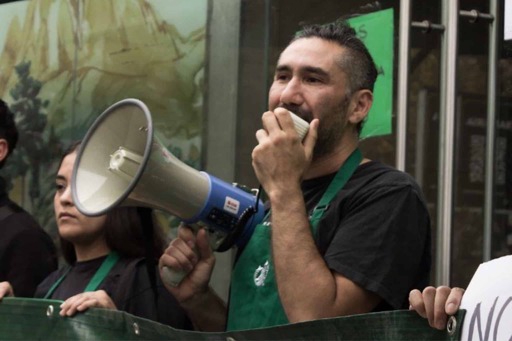
Starbucks’s union busting knows no borders. On August 10, Starbucks Chile fired Antonio “Toño” Páez, one of the best-known leaders of the Starbucks Workers Union in Chile, just two days after he formally registered as a candidate in the union’s upcoming leadership election. He is also a member of the Revolutionary Workers Party (PTR), was a candidate for Chile’s Constitutional Convention, and, in November 2025, ran for the Chamber of Deputies.
The firing is not only a renewed attack on Toño; it is a direct threat to workers’ ability to organize collectively.
Toño began working at Starbucks in 2010 and soon became active in the union. He helped organize workers during their first national strike in 2011. In January 2012, following the strike and collective bargaining process, Starbucks fired him. Workers and the union fought the dismissal, and Páez ultimately won his job back the following year. He later became president of the union.
Now, after another historic national strike in 2025, Starbucks is once again trying to remove one of the most prominent organizers in its Chilean workforce.
This time, Páez and the union went to labor court, accusing the company of anti-union practices. The court ordered Starbucks to reinstate him. Instead of complying, the company launched a legal offensive, eventually asking Chile’s Constitutional Court to challenge a provision of the Labor Code that prevents companies from appealing reinstatement orders issued in cases involving alleged anti-union practices. The Constitutional Court initially found Starbucks’s petition inadmissible, but Starbucks continued to stall the process.
The firing also comes amid what the union says is a broader pattern of pressure against its organization. The union is denouncing that other delegates and members have faced attacks and retaliation over the past year. In Páez’s case, he had already filed a workplace persecution complaint with Chile’s Labor Directorate in May, months before his dismissal.
This more aggressive posture by management is also unfolding in a political climate favorable to the bosses. The right-wing government of President José Antonio Kast has been advancing anti-worker measures, such as hourly contracts with little advance notice of shifts, that could increase precarious employment and weaken existing labor protections.
The Starbucks union has stressed that Páez’s firing is not an isolated case, saying that the dismissal “adds to a series of situations we have denounced in recent months” involving attacks on union leaders, delegates, and members. It called on unions and workers to remain alert and announced that further actions and calls for solidarity would follow.
For workers in the United States, this story should sound familiar.
Starbucks has repeatedly confronted workers trying to organize its stores, improve working conditions, and build solidarity beyond their own workplaces. In February 2022, the company fired seven workers in Memphis, Tennessee, amid their campaign to unionize their store. Five were members of the organizing committee. The Memphis Seven became one of the best-known examples of the retaliation Starbucks workers have faced during the unionization wave in the United States.
And the list is much longer.
Starbucks workers repeatedly confront the same basic problem: a multinational corporation with enormous financial and legal resources can coordinate its strategy internationally, while workers are often pushed to fight store by store and country by country.
That is why Páez’s fight cannot remain confined to Chile.
Starbucks Workers in Chile Have Already Shown Their Power
The attack comes after Starbucks workers in Chile demonstrated the power of collective organization in their historic 2025 strike.
Beginning on March 7, 1,244 workers from more than 176 Starbucks stores joined the strike, representing nearly 60 percent of the company’s workforce in Chile. At its height, more than 100 stores were shut down in a single day. Workers demanded higher wages and better working conditions and fought against a model of precarious employment in which many baristas struggled to make ends meet.
The strike lasted 25 days and ended with a new collective agreement. Workers won improvements including paid parental leave regardless of gender. Just as importantly, they strengthened an organization built through assemblies, coordination among stores, and solidarity with other sectors of workers.
Their struggle was international from the beginning. Starbucks Workers United in the United States sent solidarity to the Chilean strike, while Chilean workers had already built relationships with U.S. baristas through spaces such as the Labor Notes conference, SEIU, SBWU, and Left Voice among others. At the 2022 conference, Páez and Deborath Jofre, secretary of the Starbucks Union in Chile at the time, were part of the “Workers of the world, unite! Unions abroad take on Amazon, Starbucks, GM, and Google” panel.

During the strike, Páez told Left Voice that workers needed to respond to multinational corporations with the same level of international coordination. Starbucks may operate across borders, but workers can organize across those borders as well.
That lesson is even more important now.
An Injury to One Starbucks Worker Is an Injury to All
The outcome of this conflict depends not only on the courts’ ruling, but on the ability of the union and other organizations to coordinate solidarity efforts and turn this complaint into a force that the company can no longer ignore.
The Starbucks Workers Union in Chile is calling for national and international solidarity against Páez’s firing. Páez has called on supporters to record solidarity videos, spread information about the case, and find ways to make clear to Starbucks that attacks on workers will not go unanswered.
Workers and unions in the United States should take up that call.
Starbucks Workers United members can organize solidarity photos and videos demanding Páez’s immediate reinstatement. Unionized stores can pass resolutions supporting their coworkers in Chile. Rank-and-file unionists across the labor movement can bring the case to their locals and workplaces. Labor Notes activists and the many workers who have met Páez and his coworkers during their visits to the United States can also help build this campaign.
Now those networks of solidarity can be turned into coordinated action.
Starbucks organizes its business across borders. Its workers need to develop the ability to organize their fight across borders too. The demand should be heard from Santiago to Seattle, from Viña del Mar to New York, and in every city where Starbucks workers are fighting to organize:
Reinstate Antonio Páez. Stop the retaliation against Starbucks workers. An injury to one is an injury to all.
The post Starbucks Chile Fired a Union Leader — Workers Need an International Response appeared first on Left Voice.
From Left Voice via This RSS Feed.