



Brazilian voters abroad 2026 reach a record 918,876 across 134 countries, voting for president and vice president in 186 cities on October 4.
Related: Brazil’s Overseas Voter Roll Hits Record for 2026 Vote
Brazilian Voters Abroad 2026 Reach Record High
Brazilian voters abroad 2026 will play a larger role in the country’s presidential election, with nearly one million citizens registered to vote outside Brazil on October 4.
According to Brazil’s Superior Electoral Court (TSE), a total of 918,876 voters living in 134 countries are eligible to cast ballots in the first round of the presidential election.
If a second round is required, it will take place on October 25.
The overseas electorate represents slightly more than 0.5 percent of Brazil’s approximately 158.7 million registered voters.
Although the figure represents a small share of the national electorate, it is the largest number of Brazilians registered to vote outside the country since the electoral series began.
The number of Brazilian voters abroad has increased steadily over the past 16 years. In 2010, approximately 210,000 people were registered outside Brazil.
That figure rose to around 354,000 in 2014, approximately 500,000 in 2018, and nearly 700,000 in 2022.
Between 2010 and 2026, the overseas electorate increased by approximately 358 percent.
The growth reflects the expansion of the Brazilian diaspora, improved voter registration, and the increasing ability of citizens living overseas to maintain political ties with their country.
It also reflects the importance of electronic voting and consular registration in enabling citizens abroad to participate.
Under Brazilian electoral law, voters whose electoral domicile is registered outside the country can vote only for president and vice president.
They cannot vote for governors, senators, federal deputies, state legislators, or mayors from abroad.
The TSE will establish polling stations in 186 cities across 134 countries. Voting facilities will be located in Brazilian embassies, consulates, schools, hotels, and other authorized locations.
Brazilian voters abroad 2026 will use electronic voting machines at most of the designated polling stations.
The TSE says the arrangement is intended to provide secure and accessible voting for citizens living far from Brazil.
The largest concentration of Brazilian voters abroad is in the United States, which has approximately 265,400 registered voters.
Portugal follows with around 134,700, while Japan has approximately 88,300.
Canada has roughly 46,400 registered voters, followed by Germany with approximately 41,500.
Together, those five countries account for a significant portion of the overseas electorate.
The geographic distribution reflects historical migration patterns, employment opportunities, family ties, and the presence of large Brazilian communities.
The United States has hosted the largest number of registered Brazilian voters abroad throughout the period covered by TSE data.
Portugal’s position reflects historical, linguistic, and cultural connections, as well as the movement of Brazilian workers, students, and families to the country.
Japan’s position is linked to the Brazilian-Japanese community, including descendants of Japanese immigrants who have moved between both countries.

Brazilian Voters Abroad 2026: Profile and Voting Rules
See the official TSE information on voters living abroad.
The profile of Brazilian voters abroad 2026 is predominantly female and relatively highly educated.
Women represent approximately 57 percent of the registered overseas electorate, while men account for 43 percent.
In terms of marital status, single voters represent 52 percent of the total. Married voters account for 42 percent, divorced voters for 6 percent, and widowed voters for approximately 1 percent.
The electoral register also includes 6,614 voters with disabilities.
The data offers a demographic snapshot of Brazilians living outside the country, although it does not capture all Brazilians abroad.
Only citizens who transferred their electoral domicile to an overseas location are included in the foreign voter register.
Some Brazilians may live abroad temporarily while maintaining their electoral domicile in a municipality inside Brazil. Those voters remain subject to the rules applying to domestic voters.
The educational profile shows that 38 percent of registered voters abroad have completed higher education.
Another 29 percent have completed secondary education.
The data suggests that the overseas electorate includes a substantial proportion of voters with university degrees or other advanced qualifications.
The largest age group is between 40 and 44 years old, followed by voters aged 45 to 49 and those between 35 and 39.
The profile indicates that many overseas voters are working-age adults with long-term professional, family, or educational ties outside Brazil.
The TSE has reminded voters that participation is mandatory for citizens between 18 and 70 years old, including those whose electoral domicile is registered abroad.
Voters who cannot attend must justify their absence.
The justification can be submitted on election day through the official e-Título application or in person at overseas polling stations equipped with electronic voting machines.
The TSE will not establish separate polling stations exclusively for filing justifications.
Voters whose electoral domicile remains in Brazil but who are outside the country on election day must justify their absence within 30 days of returning to Brazil.
They may also submit their justification through e-Título, the TSE or regional electoral-court websites, or directly to their electoral registry office.
For voters registered abroad, the post-election deadlines are December 3, 2026, for the first round and January 8, 2027, for the second round.
The TSE has urged voters to verify their registration information before election day and check the location of the nearest polling station.
Many overseas voters may need to travel significant distances to reach a consulate or designated polling center.
The system does not offer “voting in transit” abroad. Voters cannot simply appear at any polling station outside their registered voting city and cast a ballot.
Those who live abroad but have not transferred their electoral domicile may need to justify their absence instead of voting in the foreign election system.
The TSE has provided information in Portuguese and through diplomatic missions to help voters understand the difference between foreign registration and temporary travel.
Brazilian voters abroad 2026 will also need to comply with identification and electronic voting procedures used at overseas polling stations.
The TSE says voting will be administered through Brazil’s electoral justice system in coordination with the Foreign Ministry and diplomatic missions.
The use of electronic voting machines is intended to speed up voting and reduce counting errors.
Votes cast abroad will be counted and transmitted to Brazil, where they will be incorporated into the national presidential result.
Because overseas voters can vote only for president and vice president, their ballots are counted separately from legislative contests.
The overseas vote may be small in national percentage terms, but it can be politically relevant in a close election.
Brazil’s presidential contest is expected to be competitive, and campaigns have increasingly targeted voters living in the United States, Portugal, Japan, Canada, and Europe.
Candidates may use overseas platforms, diaspora organizations, social networks, and Brazilian media abroad to reach voters.
Issues of particular interest may include migration policy, consular services, taxation, family reunification, labor rights, international trade, and Brazil’s relations with other governments.
Diaspora Politics and Brazil’s 2026 Election
Read the Brazilian Senate’s guide to overseas voting and absentee justification.
The record number of Brazilian voters abroad 2026 highlights the growing political importance of the Brazilian diaspora.
More Brazilians are living, working, studying, and raising families outside the country. Many continue to follow Brazilian politics and maintain strong ties with their home communities.
Digital communication has made it easier for overseas citizens to follow campaigns, participate in political discussions, and organize support for candidates.
Social media platforms have also allowed Brazilian campaigns to reach voters across borders without relying exclusively on diplomatic institutions or traditional media.
The growth of the overseas register may influence how parties design their campaign strategies.
Although foreign voters represent only around 0.5 percent of the total electorate, they are concentrated in major cities and countries with well-organized Brazilian communities.
The United States, Portugal, Japan, Canada, and Germany contain large networks of Brazilian businesses, cultural associations, churches, schools, and community groups.
These networks can facilitate political communication and voter mobilization.
The overseas vote is also important symbolically. It demonstrates that Brazilian citizenship and political participation extend beyond national territory.
Citizens living abroad can influence the presidential contest even though they no longer reside in Brazil.
The growth of the electorate also raises logistical questions. Polling stations in 186 cities must accommodate voters across multiple time zones and geographic regions.
Some voters may face long journeys to reach diplomatic facilities. Others may encounter limited transportation, language barriers, or difficulties accessing updated electoral information.
The TSE and the Foreign Ministry must ensure that polling places are accessible and that voters with disabilities can participate.
The presence of 6,614 registered voters with disabilities makes accessibility a specific administrative responsibility.
Embassies and consulates must also protect the secrecy of the vote and ensure that electronic voting machines operate correctly.
The overseas vote can become politically sensitive if technical problems, long lines, or confusion over registration prevent citizens from voting.
Clear communication is therefore essential. Voters need to know whether they are registered abroad, where they must vote, what identification they need, and how to justify an absence.
The rules also place responsibility on voters. Those who fail to vote or justify their absence may face the same electoral consequences as citizens voting inside Brazil.
Brazilian law can impose administrative restrictions on voters who fail to regularize their electoral status.
The e-Título application provides an accessible way to submit a justification, but voters may need to update the app and confirm their registration before election day.
The TSE has encouraged voters to avoid waiting until the last minute.
Geopolitical Context: Brazil’s Diaspora and Foreign Policy
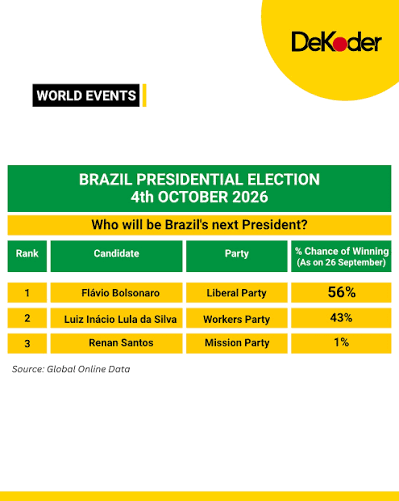
The rise in Brazilian voters abroad 2026 reflects broader changes in migration, globalization, and the political relationship between states and their diasporas.
Governments increasingly recognize citizens abroad as important political, economic, and diplomatic communities.
Brazilian migrants send remittances, create commercial connections, promote cultural exchange, and influence perceptions of Brazil in their host countries.
Their political preferences may also reflect both domestic and international issues.
A candidate’s position on trade, immigration, consular support, international cooperation, and Brazil’s relationship with the United States, China, Europe, and Latin America may affect overseas voters more directly than some domestic issues.
The countries with the largest Brazilian electorates are also important partners in Brazil’s foreign policy.
The United States is Brazil’s major economic and political partner outside Latin America. Portugal is a central connection to Europe and the Portuguese-speaking world.
Japan and Canada have significant economic, technological, and cultural relationships with Brazil. Germany is an important European partner in industry, climate policy, science, and trade.
The geographic distribution of Brazilian voters abroad therefore mirrors the country’s global diplomatic and economic networks.
The overseas vote may also become part of debates about foreign influence and election security.
Brazilian authorities have already faced pressure to prevent misinformation, cyberattacks, and foreign interference in elections.
Political campaigns operating abroad must comply with Brazilian electoral law while communicating through platforms based in other countries.
The TSE will be responsible for verifying ballots and ensuring that votes cast outside Brazil are counted under the same standards as domestic ballots.
The record number of voters abroad also raises questions about future electoral reform.
As the Brazilian diaspora grows, lawmakers may debate expanding foreign representation, creating more overseas polling locations, or improving remote voting mechanisms.
For now, Brazilians abroad can vote only for president and vice president. They do not elect representatives specifically responsible for overseas communities.
Some countries provide parliamentary representation for citizens abroad, while others use separate districts or overseas constituencies.
Brazil has not adopted such a system, but the growth of the foreign electorate could eventually revive that debate.
The 2026 election will provide a test of the current model. If participation is high and the process runs smoothly, the system may gain support.
If many voters are unable to reach polling stations or encounter administrative difficulties, pressure for reform may increase.
Brazilian voters abroad 2026 are therefore more than a statistical category. They represent a growing political community with interests in both Brazil and the countries where they live.
The result of the October election will determine Brazil’s domestic direction, but it will also shape foreign policy, economic partnerships, and the country’s role in Latin America and the wider international system.
From teleSUR English via This RSS Feed.