


Pope Leo XIV France abuse crisis: The pontiff urges vigilance, truth and reparations before meeting survivors amid renewed scrutiny of the Church.
Related: Pope Leo XIV Warns of Nuclear Weapons Proliferation During Meeting With Macron
Pope Leo XIV France Abuse Crisis Draws Renewed Scrutiny
The Pope Leo XIV France abuse crisis response took center stage on Sunday as the pontiff urged French bishops to continue preventing and repairing sexual abuse committed against minors within the Catholic Church.
Pope Leo made the appeal in Lourdes, southwestern France, hours before meeting privately with seven survivors of clerical abuse.
The pontiff called on the French bishops to maintain what he described as “maximum vigilance” and to persevere in the work of prevention, truth, justice, forgiveness, and reparations.
“In recent years, you have faced with determination the painful scourge of abuse against minors,” Pope Leo said, according to the Vatican.
“It is necessary to persevere on the path already begun, maintaining the greatest vigilance,” he added.
The Pope Leo XIV France abuse crisis message was widely anticipated because the pope had not spoken publicly about the allegations since arriving in France on Friday.
His comments came after a landmark 2021 investigation estimated that as many as 330,000 people were sexually abused as minors by clergy, religious figures, or lay workers connected to the Catholic Church in France between 1950 and 2020.
The figure includes an estimated 216,000 victims abused by priests, deacons, monks, nuns, or other members of religious orders, according to the Independent Commission on Sexual Abuse in the Church.
When abuse by lay employees and volunteers in Church institutions was included, the total rose to approximately 330,000. The estimate carries a statistical range of between 265,000 and 396,000 victims.[vaticannews][ciase]
The report described abuse as a systemic problem rather than the result of a small number of isolated offenders.
It found that Church authorities had often failed to protect children, investigate accusations, report crimes, or support victims.
The report led French bishops and religious orders to establish the Independent National Body for Recognition and Reparation, which offers compensation and other forms of assistance.
The institution has provided financial reparations of up to €60,000 for eligible survivors, although victims’ groups say compensation alone cannot address the full damage caused by decades of abuse and institutional concealment.
The Pope Leo XIV France abuse crisis message therefore focused on the need for continued action rather than presenting the Church’s previous measures as sufficient.
The pontiff acknowledged the “very difficult moments” experienced by the Church in France and praised what he called courageous measures based on listening, seeking truth, pursuing justice, and offering reparation.
He also called for a process of healing that places survivors at the center.
Pope Leo XIV France Abuse Crisis and Lourdes Meeting
Read Reuters’ report on French survivors and the pope’s Lourdes meeting.
The Pope Leo XIV France abuse crisis response was complicated by the format of the planned meeting with survivors.
The pope was scheduled to meet privately with seven victims at the Sanctuary of Our Lady of Lourdes. The meeting was organized as a confidential conversation rather than a public gathering involving all survivor organizations.
Several victims’ groups criticized the arrangement because they were not invited to participate directly.
The seven people selected to meet the pope issued a statement warning that “dialogue does not mean endorsement” and that being received by the pontiff did not mean abandoning their demands.
They said the meeting should not be interpreted as proof that the Church had resolved the crisis.
Their concerns include greater transparency, independent investigations, access to Church archives, accountability for bishops who concealed abuse, and long-term support for survivors.
The format resembles a meeting Pope Leo held during his visit to Spain in July, when he called for truth, justice, and reparations.
Such private meetings have become common in the Catholic Church’s response to abuse scandals. The Vatican presents them as opportunities for personal listening and pastoral support.
Some survivors and advocacy organizations, however, argue that private conversations can limit public accountability and prevent broader institutional demands from being heard.
The Pope Leo XIV France abuse crisis therefore involves a tension between pastoral dialogue and public transparency.
Victims may want personal recognition and an apology, but they also seek structural changes that cannot be achieved through private meetings alone.
Among the key demands are stronger reporting obligations, protection for children and vulnerable adults, independent oversight, and the publication of information about accused or convicted clergy.
Survivors have also called for clear procedures to prevent alleged abusers from moving between parishes, schools, dioceses, or religious institutions.
The 2021 report showed that abuse often continued because allegations were ignored or transferred rather than investigated.
French bishops responded by promising greater cooperation with civil authorities and expanded support for victims.
The Church has since created programs for compensation, spiritual support, psychological care, and recognition of harm.
Yet the process remains controversial. Some survivors say the procedures are slow, complicated, and dependent on Church institutions that failed to protect them in the first place.
The case of the late Abbé Pierre also affected the Church’s public image. The popular priest, widely known for his work supporting people excluded from society, was accused after his death of sexual violence.
The accusations shocked many people in France because Abbé Pierre had been regarded as a national symbol of solidarity and moral authority.
Abuse allegations have also emerged in Catholic schools, including the Betharram institution in southwestern France.
The cases demonstrate that the crisis extends beyond parishes and seminaries. It includes schools, youth programs, religious communities, and other institutions where adults exercised authority over children.
The Church’s response will therefore be measured not only by its treatment of clergy but also by how it addresses abuse committed by lay employees, teachers, volunteers, and institutional leaders.
Pope Leo’s appeal for vigilance came as French bishops attempted to restore public trust.
He said the Church must continue listening to victims and seeking truth even when the process is painful.
The pope also linked forgiveness to justice. His message suggested that forgiveness cannot be demanded from victims or used to avoid accountability.
For many survivors, forgiveness is a personal choice that cannot replace recognition of responsibility, material compensation, or institutional reform.
The Vatican has increasingly emphasized that reconciliation requires truth and justice. However, victims’ organizations continue to press for stronger guarantees and independent mechanisms.
A High-Profile Visit Marked by Huge Crowds
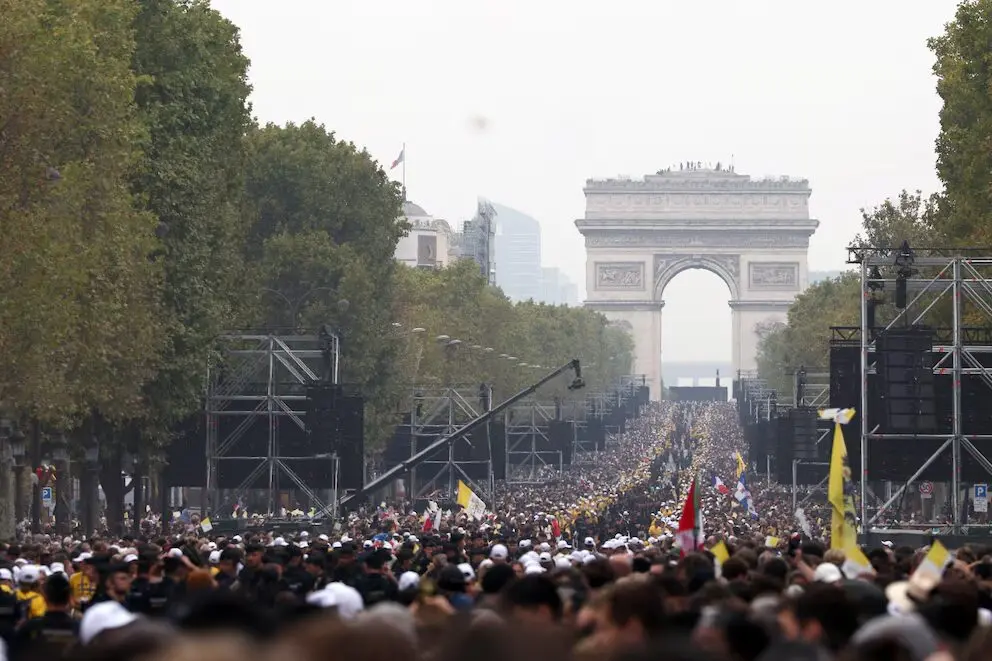
See Reuters’ report on the 800,000 people who attended Pope Leo’s Paris Mass.
The Pope Leo XIV France abuse crisis response unfolded during a four-day visit that attracted unusually large crowds.
On Saturday, approximately 800,000 people, according to the Vatican, attended an outdoor Mass in central Paris.
The gathering stretched across the Champs-Élysées and the Place de la Concorde. It was reportedly around 200,000 people larger than the number registered in advance.
The pope, 71, traveled through Paris in the popemobile and greeted crowds representing different religious backgrounds, as well as people who do not identify with any faith.
The size of the gathering was notable in France, a formally secular country where regular participation in Catholic worship has fallen sharply over recent decades.
Before the Mass, approximately 80,000 young people welcomed Pope Leo at the Stade de France, where the program included fireworks and a theatrical presentation of French Catholic history.
In his Paris homily, the pope urged Catholics not to keep their faith private but to allow it to overflow into society.
He called on believers to offer hope and companionship to people experiencing loneliness, suffering, and uncertainty.
The crowds demonstrated that the Catholic Church retains the ability to mobilize large numbers in France, even as its institutional credibility has been damaged by abuse scandals.
That contradiction is central to the Pope Leo XIV France abuse crisis. The Church can attract hundreds of thousands of people for major public events while continuing to face deep mistrust among survivors and many members of the public.
Pope Leo also visited the restored Notre Dame Cathedral, marking the first papal visit to the cathedral since the devastating 2019 fire.
At the Catholic Institute of Paris, he said he was surprised by the recent increase in adult conversions in France.
Adult baptisms have tripled since 2016, reaching approximately 13,000 this year, according to Church figures.
Experts caution that this increase does not reverse the broader decline in Catholic religious practice. Total baptisms in France fell from approximately 513,000 in 1980 to 186,000 in 2024.
The figures suggest that the Church retains a cultural and spiritual presence but faces a long-term decline in participation.
The abuse crisis has accelerated that decline by weakening trust in clergy and institutional leadership.
The pope’s visit is therefore intended to present both renewal and accountability.
The public events emphasize faith, hope, and cultural continuity. The Lourdes meeting with survivors addresses one of the most painful and unresolved issues affecting the Church’s legitimacy.
The trip will conclude on Monday in Metz, a northeastern city historically disputed by France and Germany during both world wars.
Pope Leo is expected to deliver a speech on peace and the European Union, linking the region’s history of conflict with current challenges facing Europe.
The Vatican has described the France visit as an opportunity to promote spiritual renewal, peace, reconciliation, and solidarity.
For survivors, however, the most important measure will be whether the Church implements lasting reforms after the pope leaves.
Geopolitical Context: Accountability and the Catholic Church in Europe
The Pope Leo XIV France abuse crisis has implications beyond the Church’s internal administration.
France is one of the most influential Catholic countries in Europe, even though its political system is firmly secular.
The Church’s response to abuse affects debates over institutional accountability, child protection, religious authority, and the role of civil law.
The 2021 French investigation encouraged other countries to examine their own records. Similar inquiries have taken place in Germany, Ireland, Canada, the United States, Australia, Belgium, Portugal, and Spain.
The investigations have shown that clerical abuse was not confined to one country or region. In many cases, institutions protected reputations and perpetrators rather than children.
The French report’s estimate of 330,000 victims had a global impact because it demonstrated the scale of abuse when researchers examined both clergy and lay workers.
The figure also showed the importance of independent investigations. The commission was established by French bishops and religious orders but operated independently of Church leadership.
Survivors’ groups have argued that future investigations should have access to archives, financial records, personnel files, and internal correspondence.
They also want governments to remove legal obstacles that prevent victims from pursuing claims after long periods of time.
The Catholic Church is not the only institution facing accountability demands. Schools, sports organizations, youth groups, charities, and public authorities have also been investigated for failing to protect children.
Pope Leo’s visit to France is therefore part of a wider conversation about how societies respond to institutional abuse.
The issue also has diplomatic significance. The Catholic Church operates across borders and maintains relationships with governments, international organizations, and civil-society groups.
The Vatican’s approach to accountability can influence reform processes in other countries.
If France establishes stronger independent mechanisms, it could become a model for other national churches.
If the Church’s measures are seen as insufficient, the crisis may further weaken public trust and accelerate secularization.
The Lourdes meeting also highlights the importance of survivor participation in institutional reform.
Private conversations can offer emotional recognition, but lasting change requires public reporting, legal accountability, independent monitoring, and financial resources.
Pope Leo’s emphasis on vigilance will therefore be judged by whether it produces concrete policies.
French bishops will need to demonstrate that allegations are reported promptly, victims are protected, and Church leaders cannot conceal abuse.
The Pope Leo XIV France abuse crisis is not likely to be resolved through one speech or one meeting. It is a long-term institutional challenge involving memory, law, religion, and public trust.
The pope’s call for truth, justice, forgiveness, and reparations provides a framework, but survivors and advocacy groups will continue to demand proof that those principles are being applied.
From teleSUR English via This RSS Feed.