

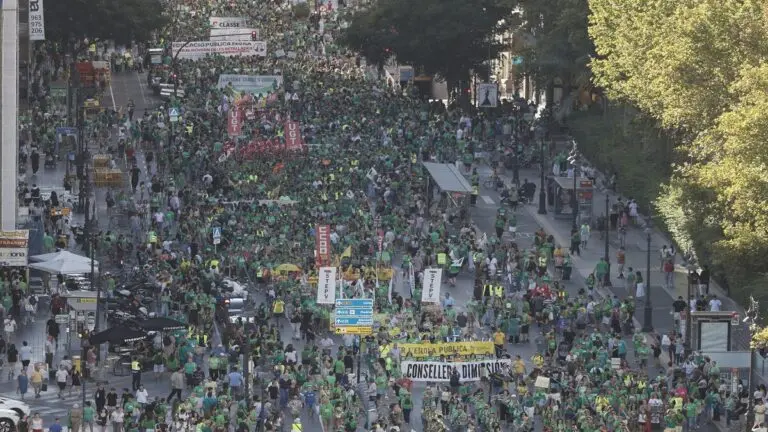
Madrid education strike: teachers, students and families march for smaller classes, higher salaries and less bureaucracy before the indefinite October walkout.
Related: Spain’s Sanchez Urges Equitable Representation and Abolition of Veto Power at UNGA
Madrid Education Strike Mobilizes Teachers and Students
The Madrid education strike gained momentum on Sunday, September 27, as teachers, students, families, and education organizations marched through the Spanish capital to demand reforms from the regional Education Council.
The demonstration began at 12 noon in Atocha and moved toward Puerta del Sol, where organizers presented their demands and called for negotiations with the regional government.
The protest served as the first major test of public opposition to the education policies of the Community of Madrid and as a prelude to an indefinite strike scheduled to begin on October 14.
According to government estimates, approximately 10,000 people took part in the Madrid demonstration. Participants marched under slogans defending public education and demanding improved working and learning conditions.[democrata][europapress]
The October action will initially affect secondary schools, upper-secondary institutions, and vocational-training centers. The strike could expand if the Education Council fails to reach an agreement with the teachers’ strike committee.
The mobilization was organized by the Unitary Strike Committee, which includes the trade unions CCOO, UGT, CGT, STEM, CNT, and Solidaridad Obrera.
The committee also includes education platforms such as Menos Lectivas, Queremos FP, Marea Verde, and Education Special Digna, along with family associations and student organizations.
The Student Union joined the march under the slogan “Teachers and students united to defeat Ayuso,” referring to Madrid regional president Isabel Díaz Ayuso.
Organizers said the objective was to channel dissatisfaction within the education sector into concrete action. They urged participants to form assemblies and strike committees in schools and colleges throughout the region.
The strike committee hopes that the size of Sunday’s demonstration will pressure the Education Council to begin formal negotiations on September 28.
The unions want an agreement before the indefinite strike begins. They say the dispute can still be resolved if the regional government accepts negotiations on class sizes, teaching hours, salaries, special-education resources, infrastructure, and bureaucracy.
The Education Council has not accepted the full platform of demands. The regional government has defended its education policies and warned that the strike could disrupt the school year if no agreement is reached.
The protest also reflects a broader debate over the state of public education in Spain. Teachers and families say schools face overcrowded classrooms, insufficient support staff, excessive administrative work, aging facilities, and inadequate climate control.
They argue that the problems are not isolated and require a comprehensive reform of the public system.
🇪🇸🏠📢 Protestas en Madrid contra la crisis de vivienda: manifestantes acamparon en la Puerta del Sol en rechazo al rentismo y la especulación.
Organizaciones como el Sindicato de Estudiantes e Izquierda Revolucionaria exigieron huelga general con consignas como "¡O la lucha, o… pic.twitter.com/X6i2eo6cGm
— teleSUR TV (@teleSURtv) September 26, 2026
Madrid Education Strike Demands Smaller Classes and Higher Pay
Read the full list of demands behind the October strike.
The Madrid education strike is centered on a series of demands intended to reduce pressure on teachers and improve student support.
The main request is a reduction in the number of students per classroom. The strike committee is calling for maximum class sizes of:
- 13 students in early childhood education.
- 15 students in primary education.
- 20 students in secondary education.
- 23 students in upper-secondary education.
- 15 students in vocational training.
The unions also want students with specific educational-support needs to count as two students when class sizes are calculated.
They argue that this would help schools provide individualized attention and reduce the segregation of students with disabilities or learning difficulties.
The organizations are requesting at least one school counselor for every 250 students. They say the current staffing levels are insufficient to address academic, emotional, social, and family needs.
Another central demand is the reduction of teaching hours. The unions want teaching loads to be brought closer to European averages.
They say lower teaching hours would allow teachers more time for lesson preparation, coordination, evaluation, student support, and communication with families.
Teachers also want a €600 monthly increase in the regional general teaching supplement.
The salary demand is intended to compensate for the loss of purchasing power and to improve pay parity among different professional groups.
The strike committee is also calling for salary equalization for vocational-training teachers, community-services staff, therapeutic-pedagogy professionals, and speech and language specialists.
Teachers say their salaries are no longer sufficient to live comfortably in Madrid, where housing and living costs have increased sharply.
David Domínguez, a teacher affiliated with CGT, said the situation in public education had reached an emergency point.
“It is not normal to see colleagues leave work crying because they are leaving their students without proper attention due to extremely high ratios and an unbearable schedule,” he said.
Domínguez also rejected the idea that the dispute should be reduced to a partisan conflict.
He said the teachers’ demands concern everyday conditions in schools and the ability of educators to provide adequate attention to students.
“Teachers’ salaries are not enough to live in Madrid,” he said. He also complained that classrooms were being closed after the academic year had already begun rather than only at the end of the school year.
The unions are demanding more resources for special education and attention to diversity.
They say schools lack the staff needed to support students with disabilities, learning difficulties, language barriers, and other educational needs.
The organizations also want the regional government to reduce bureaucracy.
Teachers spend increasing amounts of time completing forms, producing reports, entering data into administrative platforms, and complying with procedures that they say take time away from teaching.
The strike committee is calling for at least one full-time administrative assistant in every school to help manage paperwork.
The unions also want a regional plan to improve school infrastructure, with particular attention to heating, ventilation, and air conditioning.
Extreme temperatures have made classrooms uncomfortable and, in some cases, unsafe for students and staff.
The organizations say climate control must become a basic part of the region’s school infrastructure rather than an optional improvement.
Early-childhood educators working with children aged zero to three are also included in the demands.
They are seeking salaries that reflect their responsibilities, lower child-to-educator ratios, and the implementation of a two-educator model.
The educators argue that caring for very young children requires specialized attention and cannot be treated as a low-cost extension of the wider education system.
Negotiations, Public Education, and Political Pressure
See the latest report on the Madrid demonstration and the October strike.
The Madrid education strike will depend on whether negotiations begin before October 14.
The Unitary Strike Committee has said the protest and the indefinite walkout can be avoided if the Education Council agrees to a serious negotiating process.
Union representatives expect talks to begin on September 28. They want the regional government to discuss the demands collectively rather than address individual issues separately.
The committee also plans to organize assemblies in schools and training centers. These meetings will allow educators, students, and families to discuss strike preparations and decide how to participate.
The Student Union says students have a direct interest in the dispute because overcrowded classrooms, insufficient counseling, and poor infrastructure affect their education.
Students are also concerned about the quality of vocational training. The Queremos FP platform says vocational centers need better facilities, more teachers, and stronger links with employment opportunities.
Families have joined the mobilization because they say the quality of public education affects all households, regardless of whether parents work in the education sector.
They are particularly concerned about support for students with special needs, classroom closures, and the lack of staff during periods of illness or absence.
The regional government faces a difficult political calculation. Conceding to the full platform could require a substantial increase in public spending.
Refusing negotiations could lead to an indefinite strike that disrupts classes, examinations, vocational training, and school schedules.
The government may also face pressure from private education providers if families seek alternatives during the strike.
However, unions argue that additional investment is necessary because the region’s economic resources are being directed toward other priorities.
The dispute has become part of the broader political conflict between Madrid’s conservative regional government and national political forces that support stronger public investment.
The slogan referring to Ayuso shows that the protest is not only about workplace conditions. It also challenges the regional government’s education model.
Madrid has one of Spain’s largest education systems and has experienced sustained political debate over public and private schooling, school admissions, funding, and the role of charter institutions.
The strike committee says the movement seeks to defend public education rather than attack individual schools or teachers.
The regional government has described its policies as an effort to provide families with greater choice. Critics say that model can increase inequality between schools and weaken public institutions.
The October strike will therefore be closely watched across Spain. Other education sectors may use the Madrid dispute as a reference for their own demands.
The conflict could also influence negotiations over national teacher salaries and working conditions. Education is managed through a combination of national regulations and regional authorities, so decisions in Madrid may affect debates in other autonomous communities.
The protest is taking place at a time when education systems across Europe face pressure from inflation, staff shortages, larger classes, and growing mental-health needs among students.
Teachers in several countries have organized strikes over workload, wages, and deteriorating school infrastructure.
Geopolitical Context: Public Education and Social Policy
The Madrid education strike reflects a wider debate over the role of public services in Europe.
Education systems are under pressure from demographic changes, migration, rising housing costs, digitalization, and the growing need for mental-health support.
The demand for smaller classes is connected to the quality of teaching, but it is also connected to social equality. Students from low-income families often depend more heavily on public schools and may be most affected when support services are limited.
The call for stronger special-education resources reflects international commitments to inclusive education and the rights of students with disabilities.
Teachers’ demands for lower workloads and better salaries also reflect a global problem: educators are leaving the profession because of burnout, low pay, and administrative pressure.
If the Madrid government reaches an agreement, it could demonstrate that public investment and social dialogue can prevent a prolonged education crisis.
If negotiations fail, the indefinite strike could become one of the largest education conflicts in Spain in recent years.
The political consequences could extend beyond Madrid. A prolonged strike would place education policy at the center of national debate and could increase pressure on regional governments across Spain.
The dispute also raises questions about how governments balance fiscal limits with their obligation to provide quality public services.
The unions argue that education spending is not merely a cost but a long-term investment in social development, employment, and democratic participation.
The regional government is likely to emphasize budget constraints and the need to preserve financial stability.
The outcome will depend on whether both sides can identify immediate measures and create a longer-term timetable for structural reform.
The September 27 march has already demonstrated that the dispute extends beyond teachers. Students, families, unions, cultural groups, and community organizations are now involved.
The next decisive date is September 28, when negotiations may begin. If no agreement is reached, teachers and students will return to the streets on October 14.
From teleSUR English via This RSS Feed.