

The Thirty-First Art Bulletin (September 2026)
Listen to ‘Pioneers Who Open the Road’ (1934), composed by Nie Er with lyrics by Sun Shiyi for Sun Yu’s film The Big Road, a landmark of Shanghai’s left-wing cinema of the 1930s.
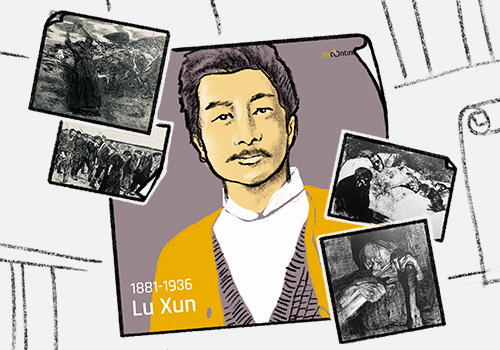
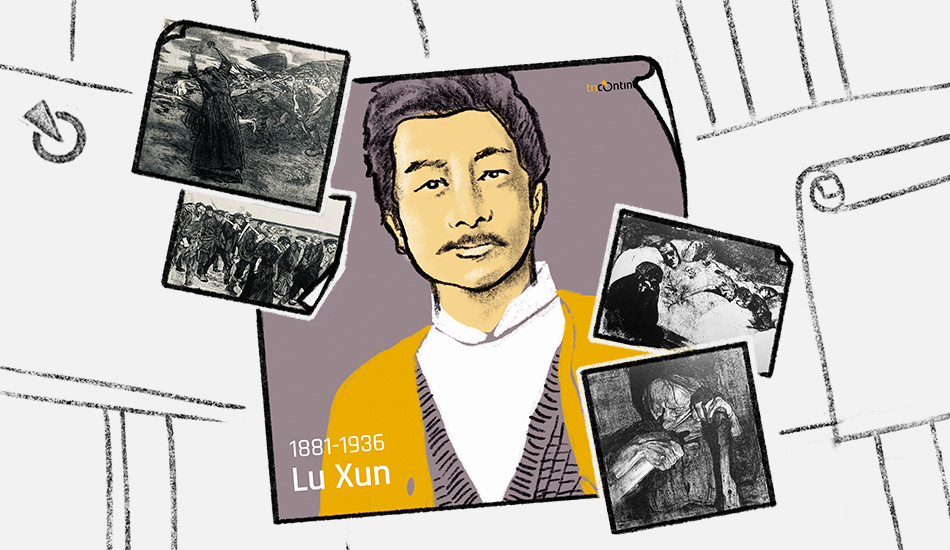
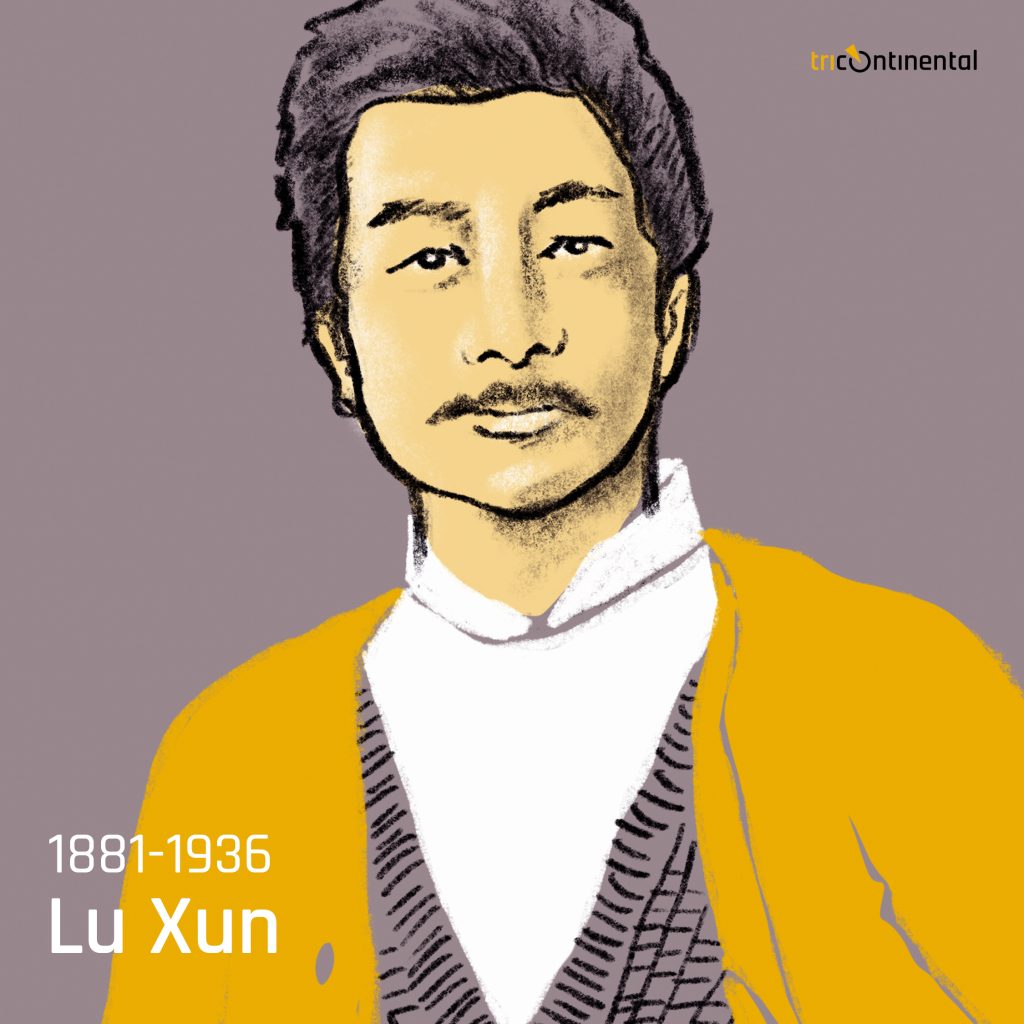
As I sat on a plane from Hong Kong to Beijing, I reread the speeches that Lu Xun – known as the father of modern Chinese literature – had delivered in Hong Kong almost exactly a century earlier. It is commonly said that around 1927 Lu Xun bid farewell to fiction and made a leftward turn ideologically. He increasingly turned to zawen – short, polemical essays – as his principal means of intervening in the political and cultural struggles of his time, awakening the Chinese people, and giving voice to a nation living under semi-colonial and semi-feudal conditions. To mark ninety years since Lu Xun’s passing in 1936, this art bulletin revisits several zawen from the final decade of his life.
One such text is ‘Voiceless China’, a speech Lu Xun delivered at the Chinese YMCA of Hong Kong on 18 February 1927. Lu Xun championed baihua, or vernacular written Chinese, over Classical Chinese. He criticised the use of an ‘archaic language good only for expressing ancient and obsolete ideas’. In a society where illiteracy remained widespread, the distance between Classical Chinese and the language of everyday life placed yet another barrier between most people and the written word, while Classical Chinese itself could no longer adequately express their thoughts, feelings, and struggles. Lu Xun therefore called on young people to ‘transform China into a China with a voice’, insisting that only then could they ‘live in the world with others’. For him, this search was also part of a wider internationalist struggle, with China’s liberation bound up with that of other colonised peoples. ‘Have we heard voices from Egypt?’ he asked. ‘Have we heard the voices of Vietnam and Korea? Aside from Tagore, does India have any other voices?’
Against Despair
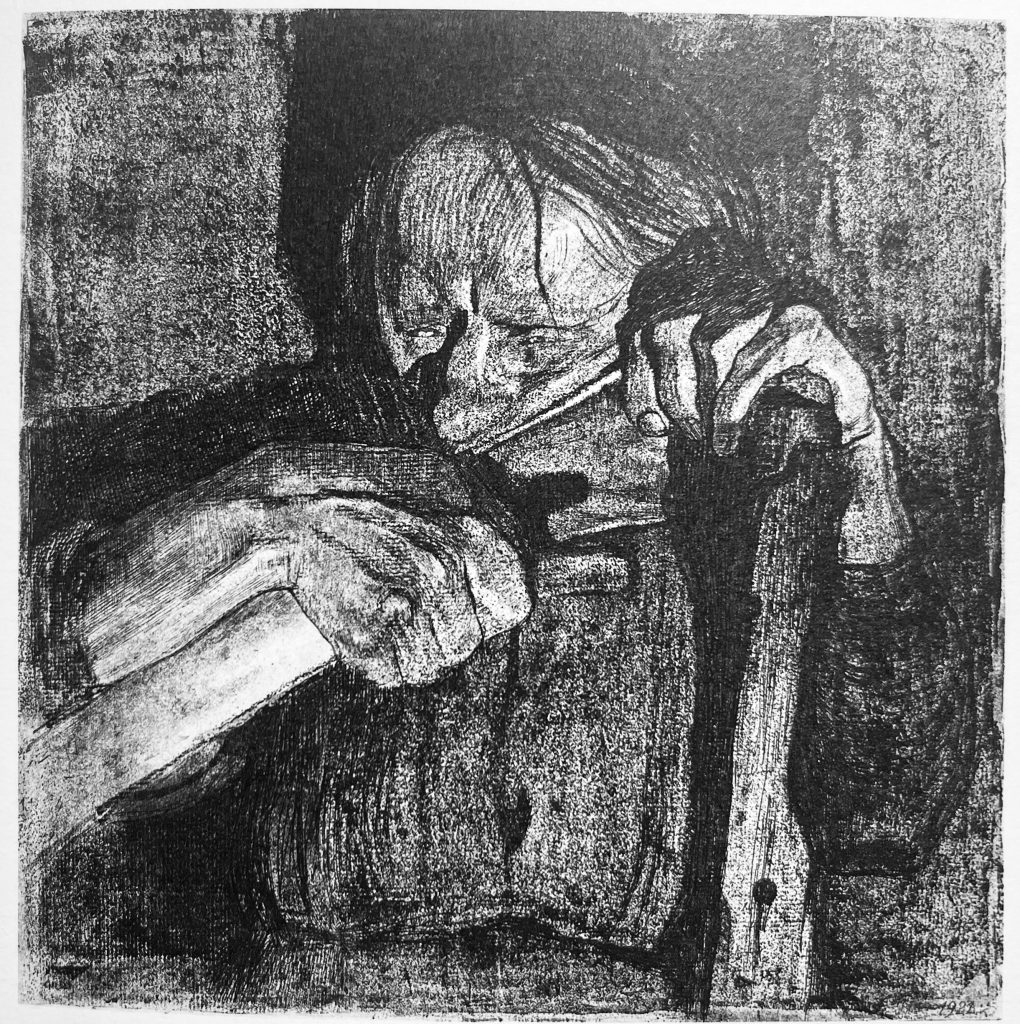
Käthe Kollwitz, Sharpening the Scythe, 1905.
The following day, on 19 February, Lu Xun delivered another speech at the Hong Kong YMCA, returning to the question of how China’s new voice might be created. In ‘The Old Tunes Are Finished’, he looked to revolutionary Russia – ten years into its socialist revolution – as a guiding light, a society where a new voice had emerged and the old songs were no longer being sung. For Lu Xun, this process was neither solitary nor individualistic. One person’s awakening could give rise to others, linking individual transformation to a broader collective awakening.
The year 1927 was tumultuous for China. By then, the republic established after the 1911 Revolution, which had brought an end to more than two thousand years of dynastic rule, had failed to overcome warlord rule, feudal oppression, and foreign imperial domination. With the support of the Comintern, the Chinese Communist Party (CPC) and the nationalist Kuomintang (KMT) had formed the First United Front, a short-lived alliance aimed at defeating the regional warlords and unifying China. One of its most important military institutions was the Whampoa Military Academy, founded with Soviet assistance, where Nationalist and Communist cadres trained alongside one another. Chiang Kai-shek served as its commandant, while Zhou Enlai had directed its Political Department. On 8 April 1927, the academy invited Lu Xun to speak on ‘Literature in Times of Revolution’. Reflecting on the persecution of radical students he had witnessed in Beijing, Lu Xun lamented, ‘Literature, oh literature, you are a most useless thing. Only those without power talk about you; no one with real strength bothers to talk, they just murder people. Oppressed people who say a few things or write a few words will be killed’.
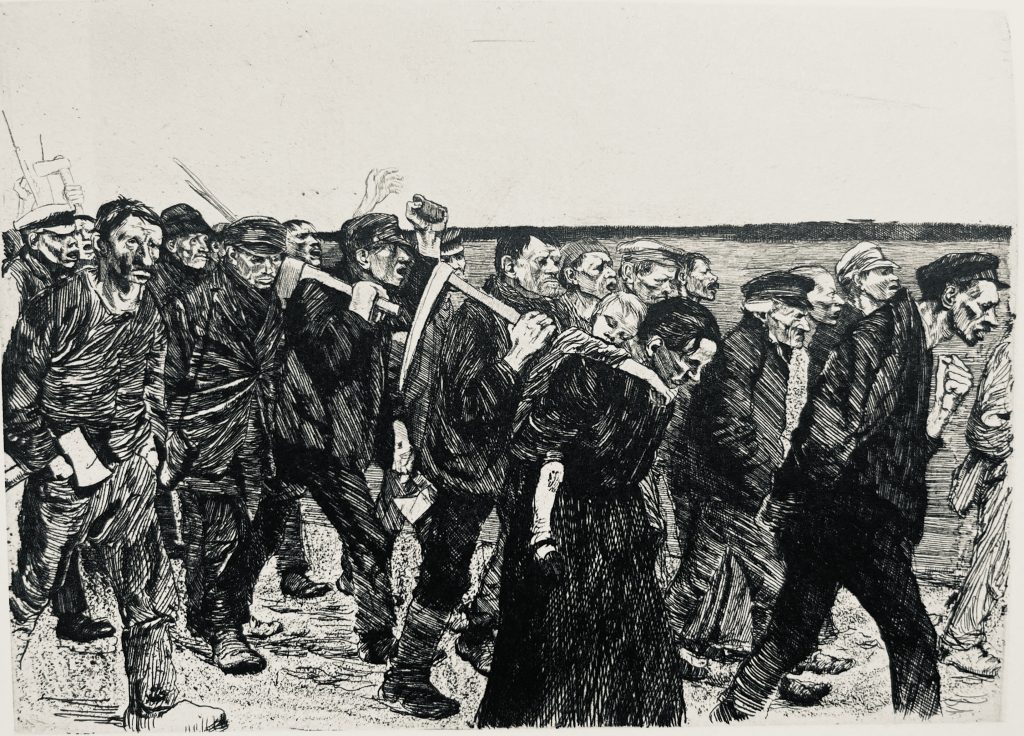
Käthe Kollwitz, March of the Weavers, from the series A Weavers’ Revolt, 1893–1897.
Given the situation of China at the time, Lu Xun asked a sobering rhetorical question: ‘What value does this literature have for the people, then?’ Yet he never ceased to write, making it his personal philosophy to ‘resist despair’. In Wild Grass, his collection of prose poems published that same year, he confronted hope and despair not as simple opposites but as illusions that could both paralyse action. Rather than retreat into a lost past or defer everything to a promised future, he insisted on grappling with the present through struggle and creation.
Revolutionary times do not necessarily produce revolutionary literature. For Lu Xun, it was not enough simply to bear witness to and condemn suffering and injustice; it was necessary to cultivate revolutionaries and a revolutionary programme. ‘Only when revolutionaries start writing will there be revolutionary literature’, he stated in his speech. Similarly, it was not enough to produce literature about peasants and workers. ‘The true liberation of the workers and peasants’, he argued, was necessary to make possible a true ‘people’s literature’. Revolution, in turn, could liberate the oppressed classes and, at the same time, liberate literature – a literature that, in Lu Xun’s words, ‘wants to resist, and it wants revenge’. He ended his speech at the military academy by contrasting the force of literature with that of armed struggle: ‘For myself, I’d naturally prefer to hear the sound of artillery. It seems to me that the sound of artillery is a much finer thing than the sound of literature’. Four days later, events in Shanghai would give those words a brutal immediacy.
A Revolutionary Literature Written in Comrades’ Blood
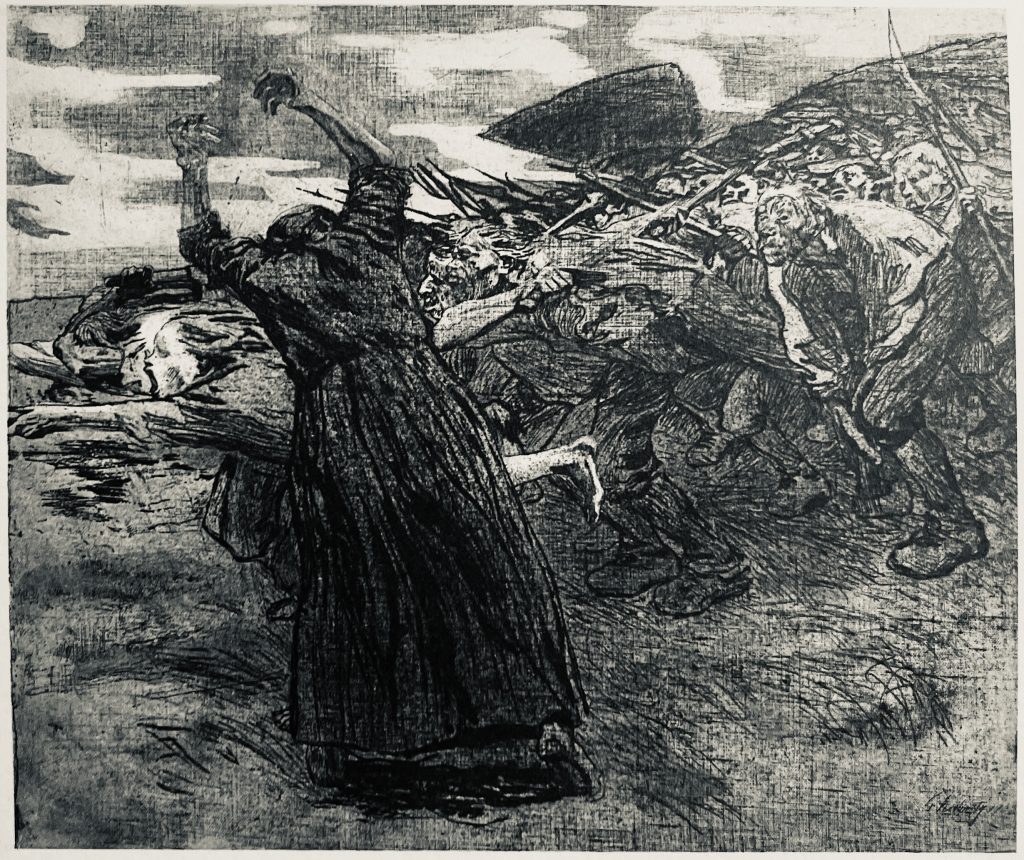
Käthe Kollwitz, Outbreak, from the Peasants’ War series, 1902.
A mere four days after Lu Xun’s speech, in a betrayal of the First United Front, Chiang Kai-shek’s KMT forces and their allies massacred Communist-led workers in Shanghai, initiating both the anti-communist repression that became known as the White Terror and the collapse of the United Front. As the repression spread, the CPC responded with a series of armed uprisings, including at Nanchang, along the Hunan-Jiangxi border and in Guangzhou. Their defeat, together with the White Terror, contributed to the CPC’s turn towards agrarian revolution and rural armed struggle. At the 7 August Emergency Conference, held clandestinely in Hankou, now part of Wuhan, the CPC adopted what was later summarised as the general orientation of agrarian revolution and armed resistance to the reactionary KMT. Mao’s words at that meeting later became the well-known phrase, ‘political power grows out of the barrel of a gun’. The following month, Mao led the Autumn Harvest Uprising, whose forces formed the First Division of the First Workers’ and Peasants’ Revolutionary Army before retreating towards the Jinggang Mountains.
Amid the White Terror, Lu Xun left Guangzhou, where he served as dean and head of the Chinese Language and Literature Department at Sun Yat-sen University. He settled in Shanghai, where he spent the remaining nine years of his life politically active and engaged in the systematic study of Marxist and Soviet literary theory. In 1930, Lu Xun became one of the founding members and leading figures of the League of Left-Wing Writers. In his speech, ‘Some Views on the League of Left-Wing Writers’, he warned against ‘salon socialism’ – radical talk cultivated in the safety of the sitting room but detached from actual social struggle. Revolution, he told the roomful of writers and poets, is ‘painful, inevitably mixed with dirt and blood, and nothing at all interesting and perfect as the poets imagine’. What is asked of the writer is lowly work – not the drama of destruction but the slower, thankless labour of construction. Within a year of the League’s founding, Lu Xun’s warning took on flesh. On 17 January 1931, KMT police in the Shanghai International Settlement arrested a group of Communist organisers at a clandestine meeting. Five young writers connected to the League were among those arrested and, on 7 February, they were secretly executed at Longhua. In response, Lu Xun wrote that ‘the first chapter of revolutionary literature of the Chinese proletariat… has been written with our comrades’ blood’.
Let Them Go on Hating Me
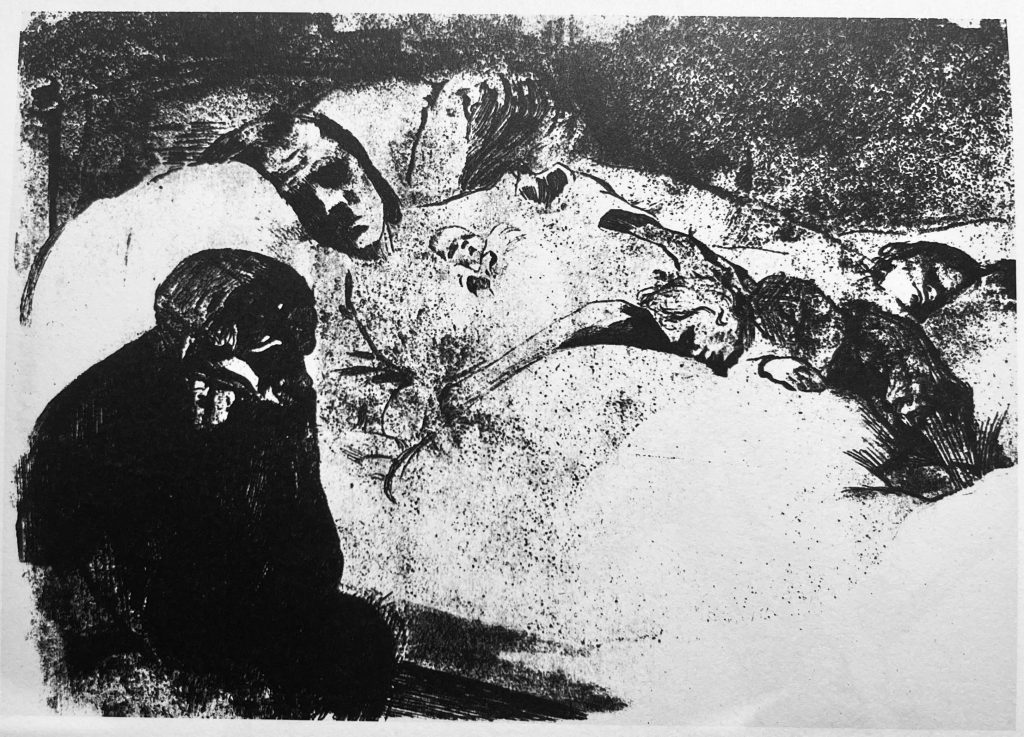
Käthe Kollwitz, Unemployment, 1909.
In the last year of his life, 1936, with failing lungs, Lu Xun wrote more than thirty essays on subjects ranging from the New Woodcut Movement – the socially engaged printmaking movement he had helped launch and champion – to the killing of the young writers at Longhua and the literary debates of the time. ‘Death’, written on 5 September 1936, sits at the centre of this final collection. It opens not with Lu Xun’s own mortality but with that of the German socialist printmaker Käthe Kollwitz, whose work depicted war, poverty, working-class struggle, and mourning. Earlier that year, Lu Xun had prepared Collected Prints of Käthe Kollwitz, a volume of twenty-one reproductions of her prints, published in Shanghai in July 1936, and had asked the US journalist and activist Agnes Smedley, who knew Kollwitz personally, to write a preface. Smedley’s preface recounted a conversation with Kollwitz in which she asked why death had become such a persistent theme in her later work. Kollwitz replied that perhaps it was because she was growing older.
The exchange led Lu Xun to reflect on death and on Chinese attitudes towards it – from the condemned peasant who calmly faces execution to people of modest means preparing materially for the afterlife by choosing their burial place and coffin, burning paper money, and relying on their descendants to make offerings after their death. Later in ‘Death’, Lu Xun left seven instructions as if he were writing a will. The fifth was addressed to his son: if he had no particular talent, he should find an ordinary job and ‘under no circumstances should he become a phony writer or artist’. The seventh warned his family to have nothing to do with people who injure others while preaching tolerance and opposing revenge. From there Lu Xun arrived at the essay’s most famous line: ‘I have a great many enemies, and what should my answer be if some modernised person asked me my views on this? After some thought I decided: Let them go on hating me. I shall not forgive a single one of them either’. The Kollwitz prints reproduced throughout this art bulletin are drawn from the collection Lu Xun prepared in the final months of his life.
Cultivating Soil Is More Important than Simply Demanding Genius
One of my favourite zawen essays by Lu Xun is from 1924, based on a lecture he gave to the alumni association of the middle school affiliated with Beijing Normal University. In ‘Before the Appearance of Geniuses’, he reflects on the metaphor of the soil. Five years after the May Fourth Movement, amid continuing calls for cultural and social transformation in China, one of the loudest demands in literary circles was for the appearance of a ‘genius’ to save culture. Geniuses, Lu Xun said, do not spring from deep forests; they emerge from the masses that nurture them, from the soil that lets them grow. Yet the same society that called for geniuses was destroying the soil from which they might emerge. Antiquarians, nativists, and hack critics trampled tender shoots while still calling for the flower. In a China where destructive critics dominated, ‘the masses in this kind of environment are but dust, not fertile soil’. He closed with a patient instruction: ‘cultivating soil is more important than simply demanding genius’.
It has been ninety years since Lu Xun returned to the soil. He did not live to see the worst of Japanese fascism – which claimed nearly 24 million Chinese lives – nor the eventual Communist victory in 1949, the flower that grew out of the soil of the Chinese Revolution. As he wrote in the last line of ‘Before the Appearance of Geniuses’, ‘cultivating good soil bears its own rewards. When a lovely flower emerges from the soil, people will naturally appreciate it, and the soil itself can also take pleasure in appreciating it’. And the soil, if we take it seriously, may itself have a spirit, a voice, and a new tune of its own.
Warmly,
Tings Chak, co-coordinator of the Art and Culture Department of Tricontinental: Institute for Social Research.
From | Tricontinental: Institute for Social Research via This RSS Feed.