

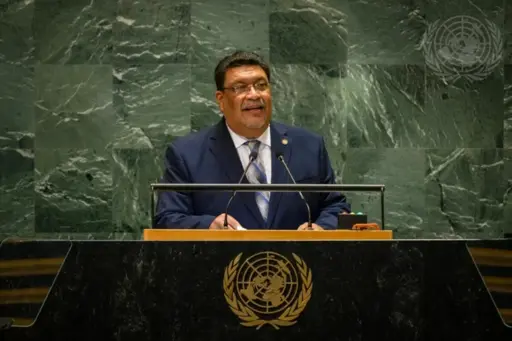
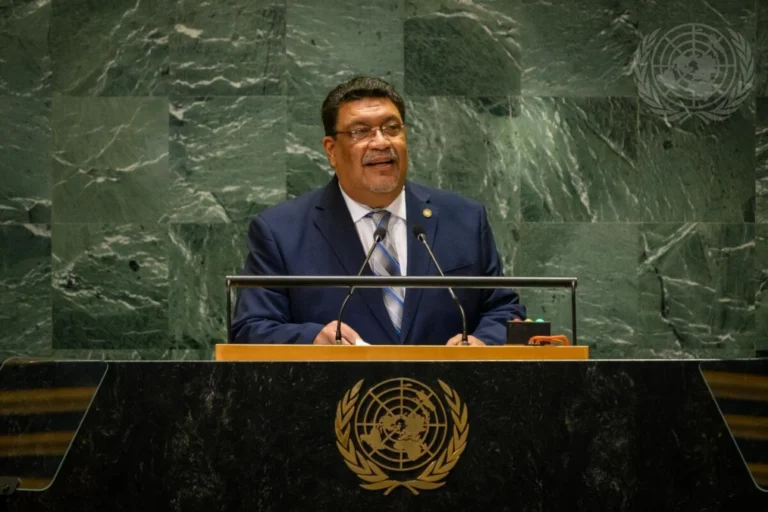
Nicaragua UN multipolar order: Foreign Minister Valdrack Jaentschke calls for peace, poverty reduction, BRICS cooperation and stronger Global South representation.
Related: Lavrov UN Multilateralism Speech: 7 Strong Warnings Against Western Escalation
Nicaragua UN Multipolar Order Agenda Takes Center Stage
The Nicaragua UN multipolar order message was presented at the 81st United Nations General Assembly as Foreign Minister Valdrack Jaentschke called for a world based on peace, solidarity, sovereignty, and complementary development.
Speaking in New York on Saturday, September 26, Jaentschke said the right of peoples to live in peace should be treated as a fundamental principle of international relations.
He argued that external interference and foreign intervention are among the main causes of instability in Latin America and the Caribbean.
According to the Nicaraguan minister, outside interests have contributed to insecurity, organized crime, drug trafficking, and social instability across the region.
Jaentschke said those problems cannot be addressed only through military operations or security measures. He urged governments to confront the social causes of violence by strengthening education, healthcare, food security, housing, employment, and economic opportunity.
“We cry out, with our Rubén Darío, for peace, peace, peace,” Jaentschke said, invoking the Nicaraguan poet to call for an end to armed conflicts and a renewed international effort to eliminate extreme poverty and misery.
He said the international community must pursue a better world based on dignity, freedom, fraternity, and harmony.
Nicaragua’s intervention took place during the UN General Assembly’s general debate, held under the theme “Restoring trust, managing transformation: A United Nations that delivers for all.”
The debate brought together representatives of governments from across the world amid wars, economic instability, widening inequality, humanitarian emergencies, and growing disagreements over the role of international institutions.
Jaentschke said the UN must help create conditions for peace and development rather than reproduce divisions between powerful blocs.
He emphasized that peace is not merely the absence of war. It also requires social conditions that allow people to live with dignity and exercise their rights.
The Nicaraguan government has repeatedly criticized sanctions, military intervention, and foreign pressure against developing countries.
The minister’s speech reflected Managua’s broader foreign-policy position, which emphasizes national sovereignty, non-interference, international cooperation, and the right of each country to select its own development model.
Nicaragua UN multipolar order diplomacy is increasingly linked to its relations with Russia, China, Cuba, Venezuela, and the BRICS group.
Nicaragua UN Multipolar Order Supports BRICS and Global South
Read the official UN record of Nicaragua’s 81st General Assembly debate.
The Nicaragua UN multipolar order proposal places BRICS at the center of efforts to reform the international system.
Jaentschke said BRICS countries are becoming increasingly important in the global geopolitical landscape and praised their role in promoting solidarity, security, and development.
“We want to highlight the strength being acquired by the most populous and perhaps most solidarity-oriented countries of the world in BRICS,” he said.
He argued that these countries are seeking better living conditions and the right to development through cooperation, peace, and complementary economic relations.
BRICS originally included Brazil, Russia, India, China, and South Africa. The group has since expanded to include countries from the Middle East, Africa, and Asia.
For Nicaragua, the importance of BRICS lies not only in its economic weight but also in its potential to create alternatives to Western-dominated financial and political institutions.
The group includes major energy producers, industrial powers, food exporters, and countries with significant populations and natural resources.
Nicaragua’s position is that a more balanced global system would allow developing countries to play a larger role in decisions affecting trade, finance, technology, energy, and security.
The government has supported the use of national currencies in trade, greater representation for developing countries in international institutions, and stronger South-South cooperation.
The issue of poverty was central to Jaentschke’s argument. He said resources devoted to wars, military interventions, and sanctions should instead be directed toward eliminating hunger, improving public health, expanding education, and promoting sustainable development.
The minister described poverty and inequality as security issues because they can create conditions exploited by organized crime and drug-trafficking networks.
He said criminal groups frequently take advantage of unemployment, exclusion, weak institutions, and the absence of social services.
Nicaragua urged the international community to coordinate its response to organized crime while protecting fundamental rights.
Jaentschke called for policies that combine security measures with investment in education, healthcare, food, housing, and community development.
His position rejects approaches that treat poverty primarily as a policing problem.
Nicaragua also expressed solidarity with Cuba, which is facing intensified U.S. sanctions and what Havana describes as an energy blockade.
Jaentschke defended the “heroic Cuban people” in their struggle for peace, sovereignty, and national independence.
Cuba has accused Washington of blocking fuel imports and imposing pressure on companies and governments that trade with the island. The United States maintains that its sanctions are intended to pressure the Cuban government over human-rights and democratic issues.
Nicaragua’s support for Cuba reflects a wider position among governments and movements that oppose unilateral coercive measures.
Jaentschke also reaffirmed Managua’s support for the One China principle. Nicaragua recognizes the People’s Republic of China as the sole legal government representing China.
The principle rejects formal diplomatic recognition of Taiwan as a separate state. China has made support for the One China principle a central condition of its diplomatic relations.
Nicaragua restored diplomatic ties with Beijing in 2021 after ending its recognition of Taiwan.
The minister also expressed support for Russia’s opposition to fascism and defended what he called Russia’s right to peace.
He said Nicaragua supports efforts to confront fascist ideology and respects Russia’s right to defend its security interests.
Western governments reject Moscow’s justification for its military operation in Ukraine and accuse Russia of violating Ukrainian sovereignty.
Nicaragua’s position places it among the Latin American governments that have maintained close political and diplomatic ties with Moscow despite Western sanctions and pressure.
Peace, Development, and Nicaragua’s Foreign Policy
See the UN’s schedule and documents for the 81st General Assembly.
The Nicaragua UN multipolar order message also emphasized the need to strengthen the UN as a representative institution.
Jaentschke said the international system must be based on equality among states and respect for sovereignty.
He argued that international organizations should not be used to impose the foreign-policy priorities of a small group of powerful countries.
Nicaragua has called for reforms to improve the representation of Africa, Asia, Latin America, and the Caribbean in global decision-making.
The country has also expressed interest in having a Latin American representative elected as the next UN secretary-general.
According to Nicaraguan officials, the next secretary-general should be committed to peace, development, cooperation, and the interests of the Global South.
The demand comes as governments debate the future of the UN amid wars and increasingly polarized international relations.
The organization faces criticism over its inability to stop conflicts, enforce international law, or prevent humanitarian crises.
Nicaragua argues that the answer is not to weaken multilateral institutions but to democratize them.
The government says a more balanced UN would strengthen international cooperation and make it more difficult for powerful countries to impose unilateral decisions.
Jaentschke’s speech also addressed the role of dignity and goodwill in international relations.
He urged delegations to preserve those principles while confronting global challenges including poverty, crime, war, climate change, food insecurity, and economic inequality.
Nicaragua’s foreign policy frames sovereignty and development as interconnected. A country cannot pursue independent social policies, Managua argues, if it remains vulnerable to sanctions, foreign intervention, or external political pressure.
The government has therefore sought closer relations with countries that support non-interference and multipolarity.
This includes Russia and China, as well as Cuba, Venezuela, Iran, and other countries involved in South-South cooperation.
The policy has given Nicaragua diplomatic allies but has also increased tensions with the United States and European governments.
Washington has criticized Nicaragua’s political system and imposed sanctions on government officials and institutions.
Nicaragua argues that those measures represent interference designed to force political change.
The country’s participation in BRICS-related forums and its support for China and Russia have strengthened its diplomatic alignment with non-Western powers.
At the same time, Nicaragua remains economically connected to the United States through trade, remittances, and regional commerce.
That creates a complex situation in which Managua seeks political independence while navigating economic realities.
The call to combat organized crime also reflects Nicaragua’s security priorities. Jaentschke described drug trafficking and organized crime as forms of terrorism that threaten communities and strip societies of their wealth.
He urged governments to cooperate against criminal networks while addressing the social conditions that allow them to operate.
That approach combines regional security coordination with investment in social services.
Nicaragua says communities are safer when people have access to schools, hospitals, food, jobs, and public infrastructure.
Geopolitical Context: Latin America and the Multipolar World
The Nicaragua UN multipolar order appeal reflects a wider transformation in international relations.
Latin American and Caribbean governments are increasingly seeking greater autonomy from Washington and stronger relations with China, Russia, India, Iran, and other emerging powers.
The region is divided over how to respond to U.S. sanctions, military pressure, trade disputes, and diplomatic demands.
Some governments favor closer cooperation with the United States, while others support a more independent regional policy through CELAC, BRICS partnerships, and South-South institutions.
Nicaragua’s position is among the most openly critical of U.S. interventionism.
Managua argues that the Monroe Doctrine continues to shape Washington’s policy toward Latin America and the Caribbean.
It says sanctions and political pressure are modern forms of intervention that limit national sovereignty.
The United States rejects that interpretation and says its policies respond to concerns over governance, human rights, security, and democratic institutions.
The debate over multipolarity also involves economic alternatives. BRICS countries are working to expand trade, financing, payment systems, and investment outside traditional Western structures.
Nicaragua sees those initiatives as potential tools for reducing dependency on the dollar and increasing the bargaining power of developing countries.
However, BRICS members do not share identical political interests. India maintains strong ties with the United States, China has competing interests with several countries, and Brazil seeks to balance relations among major powers.
The group’s future influence will depend on whether it can convert political statements into practical institutions.
Nicaragua’s appeal for peace and poverty reduction also highlights the relationship between security and development.
The region’s organized-crime crisis cannot be separated from unemployment, inequality, weak public institutions, and the movement of illicit financial resources.
Governments that rely only on military force may reduce violence temporarily without addressing the conditions that sustain criminal networks.
Jaentschke’s call for education, healthcare, food, and security therefore reflects a broader development-centered approach.
The speech also demonstrates that the UN remains an important space for countries with limited military and economic power to express their political positions.
Nicaragua cannot determine the direction of the international system alone, but it can use the General Assembly to build alliances, defend sovereignty, and support reforms.
The Nicaragua UN multipolar order agenda is likely to continue through its diplomatic cooperation with Russia, China, Cuba, Venezuela, and BRICS countries.
For Managua, peace, social development, and multipolarity are part of a single political vision.
The government argues that a more balanced world would create the conditions necessary to eliminate poverty and allow all peoples to pursue their own path of development.
🚨 Ante la Asamblea General de la ONU, el cocanciller nicaragüense Valdrack Ludwing Jaentschke ratificó el compromiso de su país con la paz mundial, la erradicación de la pobreza y la cooperación solidaria. 🇳🇮🕊️ #teleSUR #Nicaragua #26Sep pic.twitter.com/F9WwdIrm1L
— teleSUR TV (@teleSURtv) September 26, 2026
From teleSUR English via This RSS Feed.