

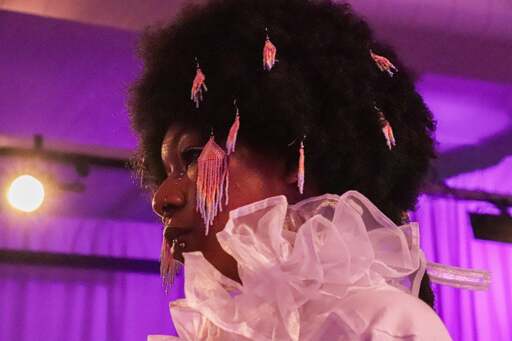

Details at Cheyenne LeGrande’s show at Indigenous NYFW on Sept. 11. Photo by Dionne Philips
Backstage at Indigenous New York Fashion Week (INYFW), Dusty LeGrande helped lace up garments from his sibling Cheyenne Rain LeGrande’s collection. A year earlier, Cheyenne had been there to model and help him with his own designs.
“It’s kind of so special because now he’s backstage with me, helping me lace up these garments, and it’s kind of nice that we can help each other out in that way,” she told IndigiNews.
The artist from Bigstone Cree Nation closed the Emerging Voices show on Sept. 11 with a collection that included laced-up mini skirts, tops with jingle dress cones and a wearable art piece made from 3,300 pop can tabs and ribbons.

A model showcasing LeGrande’s designs including the piece made from pop tabs and ribbons. Photo by Dionne Phillips
INYFW’s second year ran from Sept. 10 to 15, bringing together 30 Indigenous designers for six shows in Lenapehoking (Lenape homelands), on the island Mannahatta (Manhattan).
Just off Fashion Avenue, the American Indian Community House was transformed for the event, with seats lining the runway and fabric cascading to the floor.
Korina Emmerich (Puyallup descent) and Liana Shewey (Mvskoke), co-founders of Relative Arts and INYFW, organized the event with volunteers and professionals.
The six shows featured Contemporary Culture, Emerging Voices, Knowledge Keepers, Thought Leaders, Luxury and Couture. Designers came from around the world, including several with ties to Indigenous communities in “Canada.”

A design for Creator Complex on the runway by Nishina Shapwaykeesic-Loft who is Kanien’kehá:ka from Tyendinaga Mohawk Territory. Photo by Dionne Phillips
Family ties behind the designs
Cheyenne Rain LeGrande ᑭᒥᐊᐧᐣ, brought their background in visual and performance art to the collection, describing fashion as “a way for me to tell stories and express my queer identity.”

Cheyenne Rain LeGrande at the 2026 INYFW. Photo by Dionne Phillips
Their work offered bright interpretations of traditional hide garments, including laced-up dresses and headpieces, with colour and fringe throughout. The collection also featured the latest version of their Moccasin Platform in black, which LeGrande said would be available soon.
“I think that Indigenous futurism is definitely a theme that is talked about in my work,” she said.
“I think it’s really special to see what emerging designers are doing, and what an honour to get to be a part of that group.”
Presenting a collection at INYFW was an evolution LeGrande said “makes sense” given their love of fashion and wearable art. Watching their brother’s designs evolve, they have also been thinking about how their own work might grow. They recalled conversations with Dusty, who has his own label, Mobilize Waskawewin, about what their work could become.
“I’m kind of thinking always about how do I take a concept, almost like a seed, and let it keep growing,” she said.

One of LeGrande’s designs on the runway. Photo by Dionne Phillips
Models walked to a song LeGrande wrote and their mother translated into Cree.
“She is a singer-songwriter who writes in our language and is a really big inspiration to me,” LeGrande said of their mother.
LeGrande became tearful while describing a hug from their brother at the end of the show.
“I don’t know if I would be where I am in fashion if it wasn’t for him,” she said.
“I feel so grateful to be a part of this and share my art with everyone in this kind of way.”

Cheyenne LeGrande blowing kisses to the crowd after her show. Photo by Dionne Phillips
LeGrande also had encouragement for younger generations hoping to share their work.
“You can do it,” she said.
“You just gotta create and believe in yourself and trust the ancestors; they’ll guide you.”
As the show came to a close, Emmerich commended the designers.
“Congratulations to the Emerging Voices designers,” she said.
“I’m so impressed by everyone’s work, and for a lot of them, it’s their first runway show.”
The joy of playing dress-up
Dusty presented his Mobilize Waskawewin collection in the Thought Leaders show on Sept. 12.
“My collection tonight was dreaming up what we’re going to be wearing in the next revolution, but that was truly inspired by my children,” he told IndigiNews.
He opened with a spoken-word performance.

Dusty performed spoken word to begin his runway show. Photo by Dionne Phillips
“The spoken word that I began the show with talked about my children and how they’ve been little Elders to me. How they’ve taught me how to evolve, how to love myself in better ways, and it continues to grow,” he explained.
He said it was scary to perform spoken word in front of people for the first time, but he wanted to “bring a new flavour to the runway.”
“What I try to do with Mobilize is bring back that energy of playing dress up as a kid. I think we all had those moments. We all loved it. Just because we’re adults doesn’t mean we can’t do that anymore,” he said.

A brightly coloured design is modelled for the Mobilize Waskawewin show. Photo by Dionne Phillips
Models twirled, sending fringe swinging around a coat bearing the rainbow words “2 SPIRIT,” or raised their arms to reveal a black spirit marker design.
“When I do shows, I like the models to represent themselves and who they are. So the ask is never for them to move or do a certain choreography, but to actually just represent who they are, to move in what makes them feel that way, to listen to the music, that moment, and just to deliver it in their own power,” he explained.
Cheyenne also modelled in Dusty’s show.

Cheyenne LeGrande modelled for her brother’s collection. Photo by Dionne Phillips
“It’s really neat, and it’s really comforting and feels very safe to have your family alongside you,” he said.
“As a family, to be a brother and sister to both, having a collection shown this fashion week is just so cool.”
Showing his work to people from around the world also allows younger relatives, including nieces and nephews, see what is possible, he added.
“My life is really chaotic, and to be able to spend the last few weeks creating and sewing, and now being here with all these Indigenous cousins and sharing this space. It’s just very rewarding,” he said.
“I’m just very happy to be in this moment, be in this place.”
A space built with care

Emmerich and Shewey address the audience at the final 2026 INYFW show. Photo by Dionne Phillips
Planning for INYFW began in 2022, ahead of its first event in 2025. In its second year, it was included in the official New York Fashion Week calendar.
Emmerich said organizing INYFW was a natural progression from their existing relationships with designers, who trusted the care and respect they brought to the work.
“We really, really, really appreciate anything that’s made with intention, with storytelling, which most of our work is, and to just be able to share that with everyone and on a platform that is well deserved for them.”
“The team has a lot of commitment to this, and it’s beautiful to see it being indigenous-led, back of house to front of house to hair and makeup,” Shewey said.
Emmerich said many in her generation have built things they didn’t see growing up.
“It’s just important to build a community of support and protection,” she said.
Her background in fashion informed the co-founders’ vision for a safer industry for Indigenous people.
“We’re interested in coming up with solutions to the effects of colonialism and late-stage capitalism, and you know, just the general lack of care and safety that is in an industry like this,” Shewey said.

Indigenous Enterprise open the Sept 11 Emerging Voices show. Photo by Dionne Phillips
A portion of ticket sales went to the American Indian Community House, a nonprofit organization serving Native Americans living in New York City.
“That’s what’s so cool about hosting it here this year, is that all the money stays within community,” Emmerich said.
“We had to prove that it can be done because we’re not gonna ask for permission. We’re gonna show them, and then they’re gonna want to be a part of it,” Emmerich said.
Speaking about holding the event on Indigenous land in Lenapehoking, she added, “This is where we’re from. We deserve to hold this space.”
“I see this as an amazing stepping stone for designers and models to start and grow in a comfortable and safe community space.”

Ayimach_Horizons designs on the runway by designer Jason Baerg who is a registered member of the Métis Nation of Ontario. Photo by Dionne Phillips
Shewey agreed, describing it as a reminder of what Indigenous communities can achieve, as it’s “a way that looks towards futurity and what we are capable of producing on our own.”
Emmerich credited decades of relationship building with helping bring together INYFW’s community of creatives. Those connections include relationships developed at Vancouver Indigenous Fashion Week, Indigenous Fashion Arts in Tkarón and SWAIA Native Fashion Week.
She added that they are making global connections and “really trying to meet more people to kind of rebuild those relations and solidarity with each other. Because I feel like that divisiveness of colonialism and making us feel othered or different or separated or divided, that doesn’t need to be that way.”
“We are all different. We are so diverse,” she said.

Paint is used by a model wearing designs by Quandamooka artist and designer Delvene Cockatoo-Collins. Photo by Dionne Phillips
Teton Trade Cloth by Lenape donated fabric for designers to use. Elisa Harkins, who is also Mvskoke, opened the show with traditional hymns, and coastal designers Vina Brown and Pam Baker honoured the co-founders with a blanketing ceremony.
“It’s so special to be able to bring out artists from our communities and our homelands,” Shewey said.
Songs, movement and opportunities to grow

Lear Producer for INYFW – Sun Roller – smudges the space after a show on Sept. 12. Photo by Dionne Phillips
Between shows, there was cedar smudging, while performances featured traditional songs and dances.
Opening acts included Indigenous Enterprise on Friday, Elisa Harkins, who is Mvskoke, singing traditional hymns on Saturday, and Acosia Red Elk, an enrolled member of the Umatilla Tribe, on Sunday. A hoop dance by ShanDien Sonwai LaRance, who is Hopi, Tewa, Navajo and Assiniboine, closed Sunday’s show.

Acosia Red Elk opens the Couture show on Sept. 13. Photo by Dionne Phillips
“Everybody’s really showing the intention of the work and storytelling through the designs and through the movements and the model choreography and the projections, their music,” Emmerich said.
“It’s very immersive in sharing different traditional ways in front of an audience, and it’s safe to do that.”
The finale Couture show drew a sold-out crowd to the packed space, which organizers joked doubled as a sweat lodge.
The night concluded with TOC Legends House of Design, a collection by Baker showcasing years of her work. The Tlingit, Haida and Squamish told IndigiNews that the culture included in her designs educates audiences while telling a story.
“It’s basically my ultimate goal since the late ’80s is to educate people – we’re still here,” said Baker.

A design by Himikalas Pam Baker is displayed on the runway. Photo by Dionne Phillips
Evening programming gave participants opportunities to gather between runway events. Emmerich and Shewey described INYFW as “more than just a runway,” with space to create and enjoy Indigenous community.
They also arranged opportunities for designers to meet with fashion industry professionals, “talking to people about expanding their vision and what the possibilities are.”
“We’re really trying to break down those walls and give people the information that’s needed, because this industry is changing drastically, and I feel like the indigenous leadership… especially going towards sustainability, is important,” Emmerich said.
“I see it growing pretty exponentially. Honestly, I feel like the buzz has just exploded, and the expectations are really high because we are New York Fashion Week,” Emmerich said.
Potlatch on the runway
Vina Brown of Copper Canoe Woman, from Haíłzaqv Nation with Nuučaan̓uɫ roots, offered a look into potlatch culture through her show.
Brown told IndigiNews that she was inspired by the ways people used materials from the land to make clothing, and how trade shaped those garments. Her wearable art brought those influences into the present, featuring ermine, cedar, dentalium and other shells.

Copper Canoe Woman’s designs with shells, cedar and ermine fur are displayed in her collection at the Luxury show. Photo by Dionne Phillips
For Brown, Indigenous-led fashion events make participation more accessible and give communities the opportunity to welcome others on their own terms. She hopes audiences leave feeling inspired to create something themselves.
In her show, a model danced down the runway wearing a button blanket with her Hupał design. Its sun and moon represented the masculine, feminine and everything in between, which her Granny Elsie would say we all have within us.


Copper Canoe Woman’s Hupał button blanket is danced down the runway. Photo by Dionne Phillips
“You really see in that thread in there that, you know, we don’t have to choose one or the other. We can flow,” Brown said.
“I just really always want to give a place and a voice to that through my art, especially for Youth.”
Brown hopes Youth feel welcome in the fashion community, especially in spaces Indigenous people create for themselves.
“When we create our own space, we make it more accessible for our people, and that is huge for us because then instead of saying try to break down barriers and doors to get into that community, we can create our own table, and then we invite people in, and we share,” she said.
“You got to feel it to heal it. So if we can evoke things in people to make them feel something, get back in their bodies, make them inspired, they take it home – that good medicine they create, then that’s really done our job.”
The post Indigenous New York Fashion Week brings family and futurity to the runway appeared first on Indiginews.
From Indiginews via This RSS Feed.