

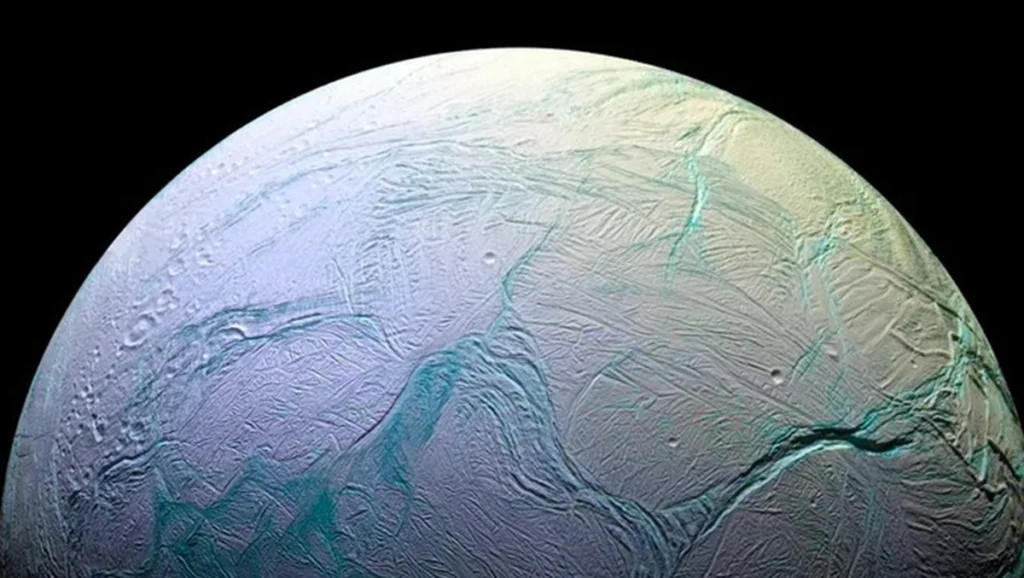
Studies suggest the moon’s subsurface ocean could support ancient metabolic systems.
On Friday, Science Advances published two studies conducted by German universities suggesting that certain microorganisms could withstand the environmental conditions on Enceladus, one of Saturn’s moons.
RELATED:
U.S. Faces Global Criticism After Deploying Weapons in Space
This natural satellite is considered one of the most promising places to search for extraterrestrial life in the solar system because scientists suspect that beneath its icy crust lies a global ocean of liquid water and, farther below, a rocky core.
One of the studies, led by Ludwig Maximilian University of Munich, succeeded in reproducing the conditions believed to exist in that ocean: a very low concentration of oxygen, a very high concentration of carbonate and highly alkaline conditions, with pH values of 10 or 11.
After recreating those conditions, including their hydrothermal interaction with the rocky seafloor, the researchers introduced the archaeon Methanothermococcus okinawensis into the controlled environment.
It is a methane-producing archaeon that normally lives near hydrothermal vents in Earth’s deep oceans. It does not need oxygen — which is scarce on Enceladus — to survive, but it does require hydrogen and carbon dioxide.
The results were “surprising,” according to the Free University of Berlin. In the simulator, the archaeon continued to grow, producing methane from hydrogen generated by reactions between water and rock.
Under the simulated conditions, the microorganisms were even able to adapt their metabolism to low concentrations of carbon dioxide.
“We were very surprised,” said researcher Nozair Khawaja of the Free University of Berlin and one of the article’s authors. It was an experiment in which “we did not expect such a satisfactory result.”
On Saturn’s moon, specific geochemical conditions could allow one of the oldest known metabolic systems on Earth to function, even in highly alkaline environments, researcher Frank Postberg noted.
That result “does not mean that there is life” on Enceladus, but if there is, future space missions could have many opportunities to find traces of it if they analyze individual ice grains originating from the plumes ejected by the moon.
This isn’t science fiction. On Enceladus, one of Saturn’s icy moons, enormous plumes of water vapor and ice particles erupt from cracks near its south pole and shoot into space. And here’s where it gets REALLY interesting… Scientists believe Enceladus has a global subsurface… pic.twitter.com/t36B97HqYZ
— cosmic pulse (@cosmicpulsee) September 21, 2026
Biosignatures Could Even Be Collected from Space
The composition of those plumes is the focus of the second study, which presents new evidence that it is easier than previously thought to determine the components of the ocean hidden beneath the icy surface.
Because of Enceladus’ cryovolcanic activity, gigantic plumes break through cracks in the crust at the south pole, ejecting ice particles hundreds of kilometers into space.
NASA’s Cassini spacecraft passed through those plumes multiple times to analyze their composition and, in fact, that ocean is the only extraterrestrial body of water from which scientists have been able to directly analyze samples.
Using data from Cassini, long-term laboratory experiments and theoretical models, the team determined that the ejected particles are usually composed of a single highly concentrated substance that had previously separated from the rest.
“Enceladus makes our work much easier when it comes to preparing samples for analysis, something that normally requires a great deal of effort in Earth’s chemical laboratories,” because the ocean’s components “separate from one another and, at the same time, become concentrated in individual ice particles,” Postberg explained.
When studying Enceladus’ plumes, this mechanism is useful for characterizing the ocean as a potential habitat for life and is of particular interest in the search for biosignatures, or measurable indications of life.
If one of those ocean droplets contained components from extraterrestrial microbes, they could separate from the rest during the freezing process and remain in a small fraction of the ice particles at high concentrations and in a relatively pure form.
Future spacecraft will have to analyze many individual ice particles from the gas plume, but if they encounter one containing microbial material, they could identify biosignatures in the particle “with relative ease using technology that is already available,” the scientist said.
teleSUR/ JF
Source: EFE
From teleSUR English via This RSS Feed.