

Former Israeli intelligence officers describe how artificial intelligence turned urban warfare into a factory of civilian casualties.
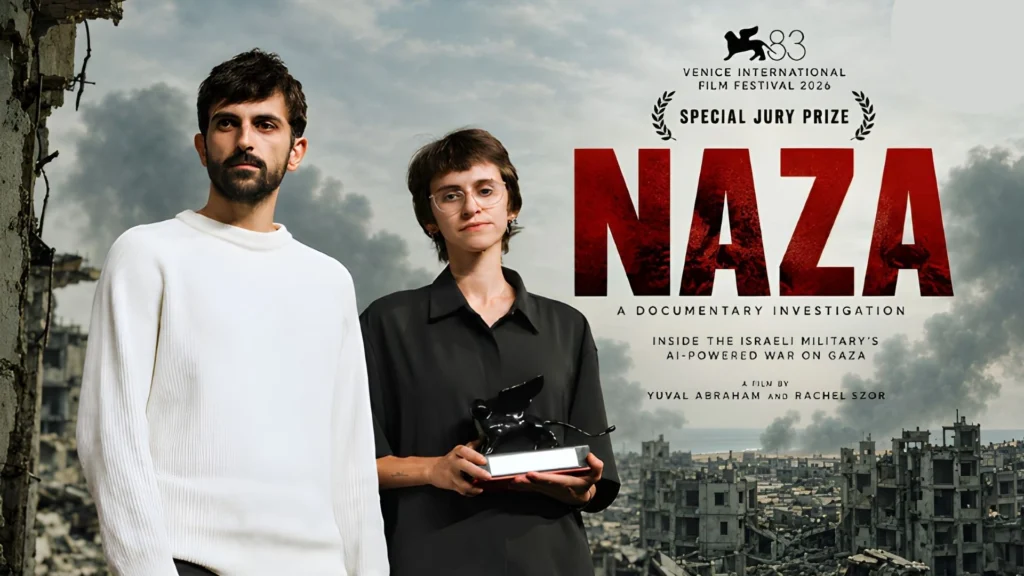
The documentary NAZA has become a central cultural artifact in the international discussion about military technology and Israeli state violence. Directed by Israeli journalists and filmmakers Yuval Abraham and Rachel Szor, the 80-minute British co-production examines the systematic integration of artificial intelligence and automated surveillance within the Israel Defense Forces (IDF) during the genocide in Gaza.
RELATED:
Israel Threatens Directors of ‘Naza’ Documentary
The film derives its title from Nezek Agavi, a Hebrew military acronym that translates to “collateral damage”. Within IDF operational protocol, this term specifies the pre-approved quota of Palestinian civilian casualties deemed acceptable when targeting a single individual or facility.
The documentary presents how digital infrastructure, mass surveillance, and automated algorithms calculate civilian destruction, framing human lives through numerical metrics.
Inside the System: Plot and Whistleblower Testimonies
The documentary NAZA, produced by Yuval Abraham and Rachel Szor, Israeli journalists and filmmakers based in Jerusalem. Abraham and Szor, who previously co-directed the Academy Award–winning documentary No Other Land, worked with producers Harry Davies, Lindsay Poulton and James Wilson of JW Films, alongside executive producer Jonathan Glaz
NAZA documentary builds on investigative reports published between 2023 and 2025 by independent outlets +972 Magazine and Local Call (Sikha Mekomit), as well as the British newspaper The Guardian.
The narrative of NAZA documentary unfolds almost entirely at night on the rooftops of Tel Aviv, overlooking the urban landscape where Israel’s military and intelligence operations are planned. The documentary remains focused on the mechanics of military decision-making rather than sensationalized narrative twists.
NAZA details how intelligence officers use automated targeting systems, frequently referred to in military contexts as “Lavender” or “Where’s Daddy?”, to process mass data, monitor cell phones, and auto-generate strike lists in real time.
The documentary’s core rests on testimonies from 24 anonymized active-duty and veteran Israeli military and intelligence personnel. To protect their identities from Israeli prosecution, the interviewees appear with obscured faces and digitally altered voices.
These insiders describe a system where automated tools mark thousands of individuals as targets, often approving airstrikes on residential family homes with minimal human oversight.
Among the accounts featured in the film, one operative describes how strikes are designated with specific numerical threshold tags, such as “20 NAZA,” indicating that military commanders explicitly authorized the deaths of up to 20 innocent civilians to eliminate one low-level target.
Another insider in the documentary reflects on the emotional detachment created by remote surveillance technology, stating that remote operators hear personal household conversations through hacked devices, creating a process that turns the bombardment of populated urban districts into an automated “factory of targets”.
The testimonies directly address and reject official Israeli assertions that high civilian mortality rates result primarily from the use of human shields, demonstrating instead that civilian loss of life is systematically calculated and accepted before initiating air attacks.
Israel’s government doesn’t want you to see what its own soldiers and intelligence officers are saying about Gaza.
The new documentary NAZA, by Israeli filmmakers Yuval Abraham and Rachel Szor, features testimony from 24 Israeli military and intelligence insiders describing mass… pic.twitter.com/aVTITd5eYQ
— Medea Benjamin (@medeabenjamin) September 14, 2026
Reception and International Recognition
The film premiered in competition at the 83rd Venice International Film Festival. Following its initial screening at the Palazzo del Cinema, the audience responded with a standing ovation lasting nearly 25 minutes.
Venice Festival organizers and critics noted that the reception reflected international interest in the documentary’s technical documentation of Israeli military practices.
On September 12, 2026, the Venice International Film Festival jury awarded NAZA the Special Jury Prize. In their formal citation, the jury highlighted the film’s detailed examination of institutional accountability and its documentation of automated warfare systems.
During his acceptance speech alongside co-director Rachel Szor, Yuval Abraham stated: “We believe that the denial of a crime is what helps it persist. International audiences must watch this film because the systemic nature of these operations must be publicly understood rather than ignored”.
The Israel Defense Forces Spokesperson’s Unit issued a formal statement rejecting the allegations presented in the documentary. The military stated that the film relies on unverified, anonymous claims from individuals whose specific roles and credentials could not be confirmed.
Furthermore, state representatives maintained that the IDF adheres to international legal principles of distinction and proportionality, asserting that targeting decisions are made by human commanders rather than automated algorithms.
“NAZA”, a documentary about Israel’s AI-powered mass killing in Gaza, received a 25-minute ovation at the Venice Film Festival.
It features Israeli intelligence personnel and whistleblowers discussing how Palestinians were targeted.
Al Jazeera’s Dmitry Medvedenko reports. pic.twitter.com/6aGRX8w4Ab
— Al Jazeera English (@AJEnglish) September 11, 2026
State Opposition and Legal Controversies
Following its festival success, NAZA encountered opposition from the Israeli political establishment. Culture Minister Miki Zohar publicly accused Abraham and Szor of defaming the nation during active hostilities, calling for an investigation into whether the publication of military testimonies constituted treason.
National Security Minister Itamar Ben-Gvir condemned the directors, while members of the Knesset requested that the Interior Ministry review the legal status of the filmmakers.
In September 2026, Prime Minister Benjamin Netanyahu released a public address announcing legislative proposals directly referencing the NAZA documentary. The proposed measures include legislation allowing the state to revoke the citizenship of individuals who defame military personnel abroad, as well as reforms raising financial penalties in defamation lawsuits related to state security forces.
Prime Minister Netanyahu stated: “We are addressing anti-Israel statements worldwide, and public depictions that present the military in this manner are unacceptable”.
The public debate inside Israel coincided with protests outside the private residences of the directors and their family members. Right-wing activist groups organized demonstrations demanding legal action and criminal prosecution against the whistleblowers and production team.
In response, international press freedom organizations, including the Committee to Protect Journalists, issued statements urging the Israeli government to ensure the safety of the journalists and protect their freedom to report on public institutions. Concurrent statements signed by dozens of civil rights groups defended the directors’ right to publish critical investigative work.
Protestors tonight gathered outside the home of the parents of Rachel Szor, in the affluent town of Savyon, (when she is not there, she is abroad) one the directors of the NAZA movie and are terrorizing them and counter-demonstrators by calling for their death. This is what… pic.twitter.com/jHqSqyUw05
— Shaiel Ben-Ephraim (@academic_la) September 17, 2026
Distribution Channels and Screening Strategy
The directors and production team face challenges in distributing the documentary due to safety concerns and administrative pressure. In Israel, public venues and cinema chains have declined to schedule screenings of NAZA, citing security risks, potential legal action, and potential loss of state funding under existing cultural laws. Mainstream television networks and commercial digital platforms in several Western countries have also refrained from purchasing broadcasting rights, citing ongoing legal reviews regarding military intelligence confidentiality.
To address these distribution obstacles, the producers partnered with The Guardian to release NAZA globally through open-access digital platforms in November 2026. This distribution method permits viewers to stream the 80-minute documentary free of charge, bypassing traditional theatrical networks and commercial broadcast platforms.
In addition, the production team collaborated with local Palestinian civil society organizations, cultural centers, and international human rights non-governmental organizations to arrange non-commercial public screenings across the West Bank, East Jerusalem, and refugee communities in neighboring countries.
(WATCH) We have the first trailer for Yuval Abraham and Rachel Szor’s ‘NAZA,’ which debuted to huge acclaim at this year’s Venice Film Festival
Check it out here: https://t.co/KUiHs7WcMB pic.twitter.com/1qKytxseQL
— Deadline (@DEADLINE) September 25, 2026
Dissent in the Cultural Sector
The release of NAZA aligns with a movement among international filmmakers, artists, and cultural workers examining the humanitarian impact of military operations in Palestine.
This artistic documentation includes various projects, such as the 2024 film From Ground Zero, an anthology of short films directed by Palestinian artists inside Gaza and coordinated by filmmaker Rashid Masharawi. That project documented daily life under bombardment, providing direct accounts from impacted residents.
The work of Abraham, Szor, and their collaborators illustrates the role of investigative cinema in documenting contemporary military practices.
By detailing the operational mechanics behind automated target generation and military decision-making, NAZA contributes primary data to ongoing legal and academic analyses of modern warfare.
As international human rights organizations and legal bodies continue to evaluate events in the region, documentary films remain a significant medium for recording eyewitness testimony and examining institutional responsibility.
Sources: TeleSUR – Al Jazeera – Al Mayadeen – El País – Anadolu Agency – BBC – CNN – France 24 – DW – Resumen Latinoamericano – Página 12 – Xinhua – CGTN – RT – La Base Red – Brasil de Fato – TRT World – The Guardian
From teleSUR English via This RSS Feed.