

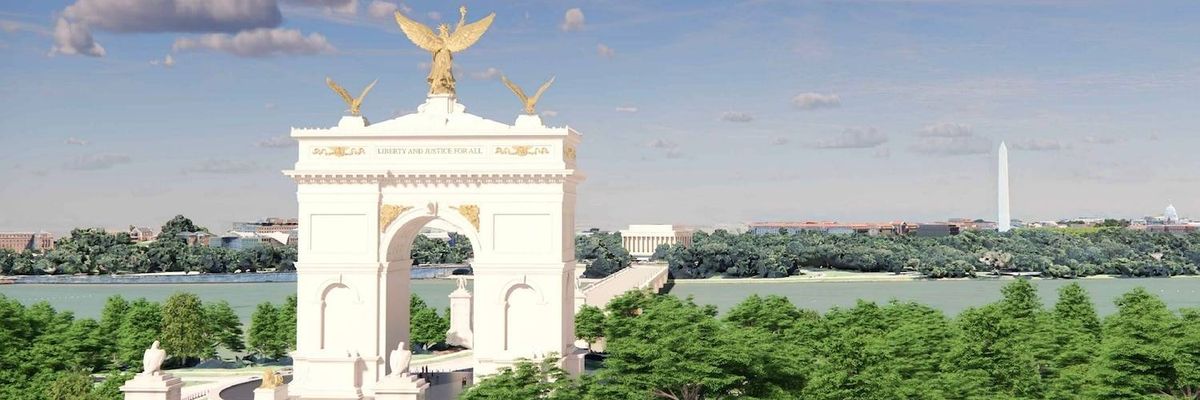
While Americans are stressed about the economy and President Donald Trump’s approval rating has hit a historic low, the second-term Republican is focused on vanity projects like his proposed 250-foot “Triumphal Arch,” which opponents are trying to block.
The watchdog group Public Citizen is planning a protest and press conference for the morning of October 1 at Memorial Circle in Washington, DC. Speakers include Congressman Don Beyer (D-Va.), military veterans, and other critics of the “self-indulgent project” that lacks congressional approval—and which Trump is now trying to push as a national security project.
“Trump’s planned construction is not only illegal,” Public Citizen said in a Thursday statement, pointing to the lawsuit it filed on behalf of three Vietnam War veterans and an architectural historian. “It is an affront to American veterans and their families.”
“The arch will sit on Memorial Circle along the Potomac River, impeding the symbolic line-of-sight between the Lincoln Memorial in DC and Arlington National Cemetery in Virginia, where hundreds of thousands of our nation’s military members have been laid to rest,” explained the group, which has secured from a federal judge temporary restrictions on work at the site.
Beyer—whose district includes Arlington National Cemetery—headed to the site on Thursday. He said in a statement that “after hearing from constituents who saw construction equipment at the site of Trump’s proposed vanity arch, I drove down to Columbia Island to see for myself. When I arrived, I found workers operating heavy equipment who told me they were conducting archaeological work to evaluate the composition of the soil.”
“When I asked whether this work was a precursor to construction of the arch, they said that they could not answer,” the congressman continued. “The logical conclusion, however, is that the presence of this heavy equipment and additional surveyors is a clear indication that the Trump administration is preparing to move forward with construction. That would be deeply troubling. Trump’s arch is illegal and immoral, and the administration is also under court order requiring 48 hours’ notice before work proceeds.”
“Yet, the administration appears to be pushing ahead with activity at the site even while it still has not done the basic work necessary to understand the consequences of this project,” Beyer warned. “There has been no adequate assessment of the regional impacts of this 250-foot structure on public safety, vehicular traffic, air traffic, or historic sites, including the implications of Trump’s latest ravings about using the arch as a base for drone and sniper operations.”
Beyer, who also shared video of his visit to the site on social media, added that “Donald Trump and his administration are determined to find a way to push this project through by any means necessary, regardless of the law or the concerns of the people who live here, but my constituents have made their views abundantly clear: They do not want this project. Neither do I. I will continue doing everything in my power to stop this illegal and reckless attempt to turn our nation’s capital into a monument to Donald Trump."
In May, Beyer and Dina Titus (D-Nev.)—who, as co-chair of the Congressional Humanities Caucus, led challenges to the administration’s illegal attempts to fund the arch using the National Endowment for the Humanities budget—introduced the Arlington National Cemetery Viewshed Protection Act, which would explicitly prohibit construction of Trump’s project.
“As President Trump strips away the necessary safety nets from Americans who are struggling to afford their basic needs like groceries and healthcare, he builds his unauthorized, grandiose Triumphal Arch. While destroying historical monuments and artifacts important to our American identity, he is erecting monuments to honor himself,” Titus said at the time. “The American people deserve a leader who is responsibly using federal funding for critical government services, not for self-promotion.”
After months of pushback over the project, Trump announced last Sunday that “at the strong request of the United States Military, and for National Security purposes, I have agreed to convert the magnificent Triumphal Arch, planned since the Civil War Era many years ago, at the Receptive Circle adjoining the Arlington Memorial Bridge, into a top grade Military Complex/Triumphal Arch, to house, store, and have the rapid ability to use large numbers of drones, plus Snipers, on both the roof and plaza areas, and additionally have and hold large quantities of sniper ammunition in storage.”
“There will be no facility like this anywhere in the World,” the president wrote on his Truth Social platform. “Out of the 59 top cities and Capitals, Washington, DC, IS THE ONLY ONE IN THE WORLD THAT DOES NOT HAVE A TRIUMPHAL ARCH, but it will now and, by far, the greatest of them all!”
The Hill reported Friday that analysts and lawmakers “are perplexed by President Trump’s surprise declaration,” with Michael O’Hanlon, a senior fellow at the Brookings Institution think tank, telling the outlet that adding military elements to the arch “is not totally fictional or crazy—but also not optimal.”
Whether or not the project include military components, “to build an arch on federal land (that is not in the White House complex), the administration needs to navigate a lot of bureaucracy,” The Washington Post noted Thursday. “The administration has argued the arch doesn’t need to abide by DC’s height laws for buildings and that it doesn’t need congressional authorization because Congress authorized something similar a century ago nearby.”
However, the Advisory Council on Historic Preservation—whose members are picked by the president—has attempted to abide by Section 106 of the National Historic Preservation Act and related regulations, and consulted with local officials “to seek ways to avoid, minimize, or mitigate adverse effects to historic properties that would result from this undertaking.”
ABC News highlighted that “the law says federal officials don’t have to reach an agreement with state officials on mitigation of those harms, but they do have to try. Those consultations can then be unilaterally terminated if there’s a failure for parties to meet in the middle.”
The council’s vice chair, Travis Voyles, on Thursday wrote to Tammy Stidman, associate regional director for lands and planning at the National Park Service, that “we are hereby terminating consultation,” but the panel “will develop and transmit its final comments to the secretary of interior,” aiming to deliver them by October 7.
According to the Post, “The administration is hoping to start construction by November.”
From Common Dreams via This RSS Feed.