

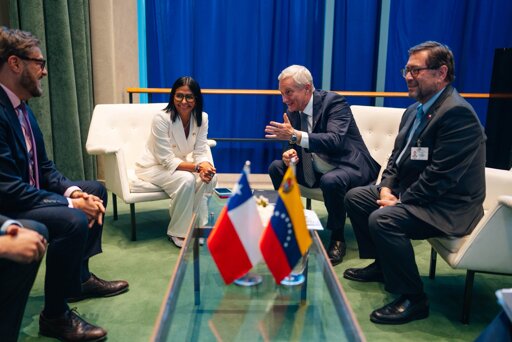
Caracas (OrinocoTribune.com)—Venezuela’s Acting President Delcy Rodríguez has welcomed a new dialogue with Chile after meeting President José Antonio Kast in New York. The encounter brought together a Chavista leader and a far-right politician whose election campaign made the removal of Venezuelan migrants a central promise.
“Chile and Venezuela are meeting again through dialogue and diplomacy,” Rodríguez wrote regarding the meeting that took place this Wednesday, September 23, stating that they discussed the normalization of bilateral relations and shared challenges. Venezuela’s foreign ministry said the conversation took place at the UN headquarters and covered regional and bilateral issues. Foreign Minister Félix Plasencia, Senior Deputy Foreign Minister Oliver Blanco, and Vice President for Economic Affairs Calixto Ortega were part of the Venezuelan delegation.
Kast offered a more specific account in his remarks after the meeting, detailing that the two discussed documents for Venezuelans in Chile and restoring consular services, with full diplomatic relations a possible later step. He said he hoped diplomatic relations could resume in the coming months. However, neither government has yet announced a deportation agreement.
Chile y Venezuela vuelven a encontrarse a través del diálogo y la diplomacia. 🇻🇪🇨🇱
Sostuve un cordial encuentro con el presidente de Chile, José Antonio Kast, pic.twitter.com/IEjdxhAlNe
— Delcy Rodríguez (@delcyrodriguezv) September 24, 2026
Migration behind the rapprochement
Kast won the Chilean presidency after campaigning on a xenophobic discourse that repeatedly cast migrants, particularly Venezuelans, as a threat and promised mass expulsions. His need to normalize ties with Caracas is now urgent: without Venezuelan consular cooperation, his government cannot readily arrange the documents and direct flights required for the large-scale deportations it promised.
In an interview on Thursday, Kast linked the diplomatic opening to the possibility that Venezuelans would return home and said he hoped an improving Venezuelan economy would encourage voluntary returns. His government has not secured an announced agreement for mass deportations.
That distinction matters for the hundreds of thousands of Venezuelans living in Chile. Access to passports and consular help would benefit them, but normalizing relations must not turn their rights and safety into a bargaining chip for Kast’s expulsion program.
Sovereignty and elections at the UN
Rodríguez also used her Wednesday address to the UN General Assembly to reaffirm Venezuela’s historical claim to the Essequibo territory and to call on Guyana to resume direct negotiations under the 1966 Geneva Agreement. She said Venezuela would hold elections and had begun talks with opposition sectors, but provided no date as of yet, arguing that Venezuelans and their institutions should determine the appropriate moment. Analysts suggest that her position was a commitment to a vote, not a promise to rush one on a timetable set abroad.
The absence of a date drew angry objections from far-right Venezuelan opposition politicians who want an immediate electoral calendar. Juan Pablo Guanipa called for a date to be set as soon as possible, while Delsa Solórzano demanded specific guarantees and dates.
In the US empire, Republican Ted Cruz and Democrat Jeanne Shaheen have jointly demanded expedited elections; their resolution was introduced in August, before the UN speech. However, the discontent of far-right politicians towards Trump’s relationship with Venezuela is growing—according to experts—and might jeopardize the chance of victory of the Republicans in the upcoming midterm elections.
Venezuela and Chile Begin Normalization of Bilateral Relations
The Kast meeting leaves two questions for the new bilateral dialogue: whether Chile will restore practical services for Venezuelans, and whether its demand for mass removals will shape the terms of normalization.
Special for Orinoco Tribune by staff
OT/JRE/AU
From Orinoco Tribune via This RSS Feed.