

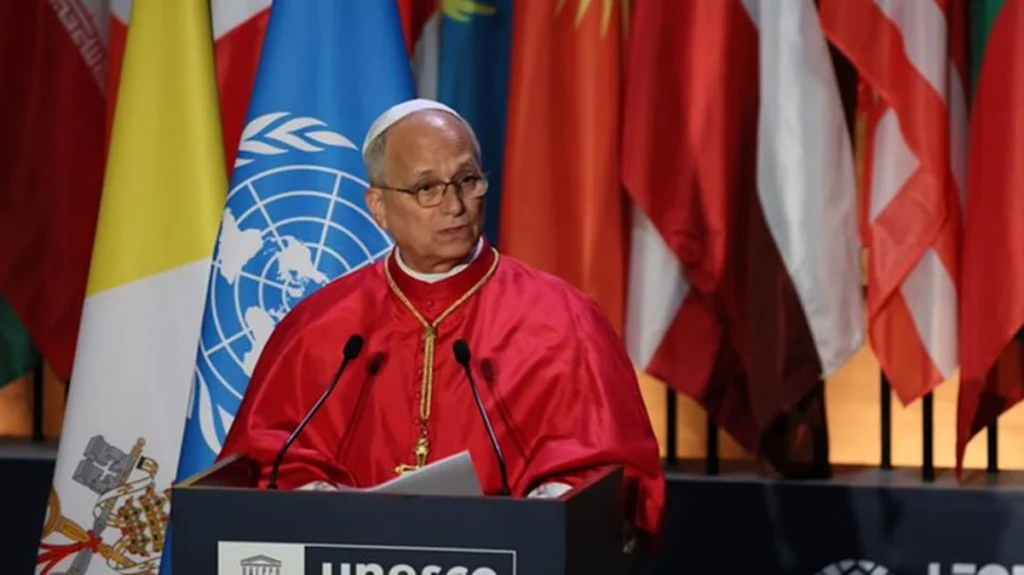
He warned of AI-related risks and urged the international community to protect human dignity.
During a visit to Paris on Friday, Pope Leo XIV attended the headquarters of the United Nations Educational, Scientific and Cultural Organization (UNESCO).
RELATED:
French Sexual Abuse Victims Say Access to Pope Leo XIV During Visit Is Insufficient
From there, he called for technologies to “continue to serve the human person, rather than becoming another instrument of domination and injustice.”
In an extensive address, the pope reflected on the dignity of human life and the need to protect it in view of the risks posed by new technologies such as artificial intelligence (AI).
The pope recalled that “throughout the centuries, many tasks once performed by human beings have been entrusted to machines” and that even now, “certain artificial systems have even been given the name of our human faculty of thought: intelligence.”
“Our ideas and relationships risk becoming impoverished because of a process of dehumanization. The paradox is becoming increasingly evident: while intelligence is attributed to computer systems, we struggle to recognize the inalienable dignity of people, whose lives are judged according to the criterion of efficiency and, when they are considered no longer productive, are rejected and discarded,” the pontiff lamented.
Pope Leo XIV (@Pontifex): "Communication has become much faster but not necessarily more truthful. Information is abundant, but that is not synonymous with wisdom. Without a shared ethical foundation, the many channels of communication risk multiplying false information and… pic.twitter.com/9so0vVaBBP
— CSPAN (@cspan) September 25, 2026
Referring to his encyclical “Magnifica Humanitas,” which is dedicated to human dignity and artificial intelligence, Pope Leo XIV urged the scientific community “to cooperate tirelessly in the name of our common history,” so that, from a diversity of perspectives, a convergence of visions and harmony in action may emerge.
“We have means capable of connecting people and continents instantaneously; however, at the same time, we are witnessing new forms of isolation, material and spiritual poverty and abandonment,” the pope said, warning that “communication has become much faster, but not necessarily more truthful; information is abundant, but it is not synonymous with wisdom.”
“Artificial intelligence amplifies this problem,” because “although these systems can correlate data, they cannot answer questions about the meaning of human life, which has its roots in lived experience,” he added.
For this reason, he said, the challenges of communication and education “turn the search for truth into a matter of social justice and historical equity.” “Without truth, language becomes subject to the logic of violence and the arbitrary will of the powerful,” the pope warned.
In this way “others are excluded in the name of profit, and innocent people are killed in the name of freedom. Instead of respecting the law, those in power invoke it when it suits them and ignore it when it constrains them, even treating justice itself as if it were a commodity that can be bought and sold.”
Pope Leo XIV received prolonged applause as he entered the UNESCO auditorium in Paris ahead of his address. 👏🇫🇷✝️
A warm welcome for the Holy Father at one of the world’s leading institutions for education, science and culture.#PopeLeoXIV #UNESCO #Paris #France #PapalVisit pic.twitter.com/UIHotmYaib
— SG News (@SGNews123) September 25, 2026
The pontiff also encouraged the entire international community to pay special attention to protecting children and young people: “In the digital age, their vulnerability must never become an opportunity for exploitation.”
He also called for caring for “the smallest and the poor: children in their mothers’ wombs and in the various theaters of war; people with physical and intellectual disabilities; older adults; migrants and refugees; and all those whom arrogance excludes by considering them unproductive.”
And all of this comes amid a drift that tends to “exploit and plunder, to extract as much as possible from every living being, to consume without preserving and destroy without cultivating.” For this reason, Leo XIV emphasized that “the current ecological crisis is also an anthropological crisis.”
“The most terrible of human works is war because in it science itself is placed at the service of an inhuman will to destroy and kill … peace cannot be built solely through treaties, nor through agreements between opposing forces. Peace is authentic when it springs from the virtue of justice and not from a simple contract, from a right will rather than from an unstable balance of interests.”
TeleSUR/ JF
Source: EFE
From teleSUR English via This RSS Feed.