

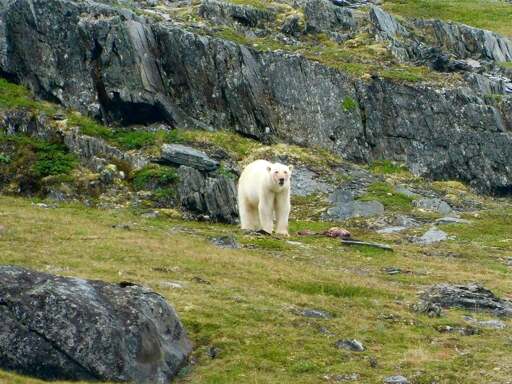

A nanuk (polar bear) in Tongait KakKasuangita SilakKijapvinga (Torngat Mountains National Park) in northern ‘Labrador.’ Photo by Frey Blake-Pijogge
After retiring from his career as a federal conservation officer, Derrick Pottle — an Inuk Elder from Tikigâksuagusik (Rigolet) — devoted himself to guiding people on the land, carving, hunting, and training bear guards.
The seasoned instructor and guide founded BearSafe Planning in 2005, which trains and certifies students to perform the role of guarding for all bear species found in the region — including polar bears, grizzly bears, and black bears.
Pottle’s three-day course is advertised as offering “safety, protection, confidence in bear country.” Bear guards work to monitor for bears and prevent encounters with humans out on the land.
“The whole objective of the course,” he told IndigiNews, is firstly “people’s safety” around bears. But that aim “is followed very closely” by “bear safety,” he explained.
“We want to prepare people … to recognize some of the potential signs that the bear is not comfortable,” he continued. “They may feel threatened, they may feel intimidated, and they may even charge or attack you.”
He teaches his students “how to recognize those signs, how to prepare yourself for them, the tools you have to use to do your job.”

Inuk Elder Derrick Pottle is founder of BearSafe Planning in Rigolet, Nunatsiavut. Photo by Frey Blake-Pijogge
‘More and more bears’ year-round
Pottle developed BearSafe Planning’s training program with input from groups that included Parks Canada, conservationists, Inuit Elders, and academics.
It initially started “out of a necessity,” Pottle said, after the creation of Tongait KakKasuangita SilakKijapvinga (Torngat Mountains National Park) in northern “Labrador,” part of the 2005 Labrador Inuit Land Claims Agreement.
“They needed bear guards there … We didn’t have trainers in Nunatsiavut at the time,” he recalled. “Somebody had to do it.”
As climate change impacts landscapes across the North, he said the need for trained bear guards is only growing for “all species of bears.”
“We’re seeing more and more bears now in this time of our lives than we ever saw before,” he said.
“People are seeing polar bears in this part of Inuit Nunangat — where polar bears used to travel north late in the spring — and now are staying all summer long.”
He added that, among the many changes Inuit are seeing in their environment because of climate change, animals are also adapting their behaviour.

Tikigâksuagusik (Rigolet) is a community of more than 325 residents in the Nunatsiavut region of northern ‘Labrador.’ Photo by Frey Blake-Pijogge
“They’re showing up in places where we’ve never seen them before,” he said.
The province’s Endangered Species Act lists polar bears as “vulnerable,” while the federal government deems them a “species of special concern.”
An estimated 60 to 80 per cent of the world’s polar bear population lives in “Canada,” according to Environment and Climate Change Canada (ECCC).
Weighing up to 650 kilograms, the massive carnivores are “reliant on sea ice to travel, mate, and hunt,” the department’s website states.
“Climate change is the main threat to polar bears,” ECCC states, “because it results in sea ice loss, which leads to fewer opportunities to hunt its preferred prey of seals.”

Sherri Wolfrey, a certified bear guard and secretary of Northern Lights Academy in Rigolet.
Photos courtesy Sherri Wolfrey


‘What to expect … if you came upon a bear’
The role of a bear guard can offer employment opportunities, but also can be used for personal safety, Pottle explained.
“Lots of people just use the bear guard course for their own personal protection when they’re out on the land with their families fishing, hunting and participating in Inuit lifestyle.”
Sherri Wolfrey, a mother of four, is a trained bear guard in Rigolet as well.
Wolfrey recounted how, in 2015, she became “interested in the program and just thought ‘Okay, maybe someday I might want to try for a job that involves bear monitoring.’”
Wolfrey is the secretary of Northern Lights Academy in Rigolet, and said she uses her training when she’s out on the land.
“Especially up in that area in the bottom of the Mealy’s, it was so beautiful up there,” she told IndigiNews.

READ MORE: ‘Foundational instability’: As permafrost thaws, Nunainguk’s ground is shifting beneath its residents’ feet
Last year, she was contracted as a bear guard in the Akami-Uapishkᵁ-KakKasuak (Mealy Mountains National Park Reserve).
It was the first time she used her bear guard certification for work, she said proudly.
“It’s good to have the training,” she explained, “because when you do what I like to do, especially being at the cabin … you could know what to expect and what to do if you came upon a bear.”
Employment opportunities for certified bear guards vary, Pottle says, with some contracts extending over a period of time, while others might be for daytrips out on the land.
Pottle’s own experience as a bear guard goes back to “before there were bear guards,” he recalled. People in his community would call him to escort them out on the territories with boats, dog teams or Ski-Doos” because he “knew the land.”
In a short video from Nanuk Narratives, BearSafe Planning founder Derrick Pottle explains safety around nanuk (polar bears). Courtesy Nanuk Narratives/Youtube
Respecting knowledge of the land
BearSafe Planning offers its course on demand. It’s been taught to class sizes of up to 30 students at a time.
But it’s not just about teaching others, Pottle said. He also learns from participants in their own communities as they share their own personal knowledge of bear safety.
“I talk to the Elders, I talk to the hunters, I talk to the students,” he said.
“A lot of these people live on the land all their lives, so they have lots and lots of experiences and stories. So we learn from one another.”
The Elder says bear guards trained professionally are “no different than any other aspect of the workforce,” he said.
“It’s not always easy to find employment in the North, and bear guarding can give people — if they choose to — an opportunity to make a good living from it.”

READ MORE: Inuit grapple with loss of caribou 13 years into ‘Labrador’ hunting ban: ‘I feel like a big part of me is gone’
Working as a bear guard can be part-time or full-time, he said, and usually varies by season; for instance, cruise ship operators will hire bear guards to keep tourists safe when they visit the North at this time of year.
Group outings and land-based programs in Nunatsiavut and elsewhere across the Inuit Nunangat region also often hire bear guards. Additionally, various Inuit governments and agencies will have trained professionals for outings, he said.
Over two decades, teaching more and more students about bear safety has been personally rewarding, he said.
“A lot of people have never fired a deterrent,” he explained. “You’re doing something you love, and you’re going into communities, and you’re … bringing knowledge.
“Our role is to keep people safe, and make sure people enjoy the land and enjoy the surroundings — and get the job done and come home safe at the end of your work day.”
The post In a changing northern landscape, Inuit bear guards keep people safe in the wilderness appeared first on Indiginews.
From Indiginews via This RSS Feed.
Reminds me of my time as bear guard, but with all the flack I’ve been getting over the last few days I won’t go into details.
