

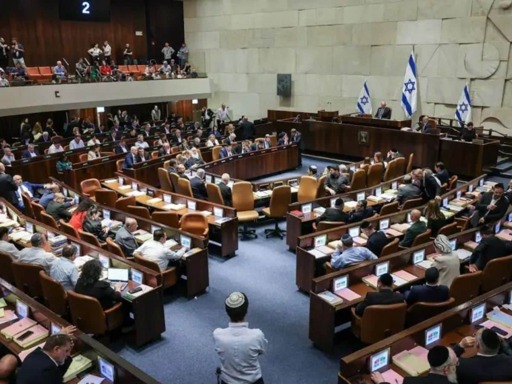

‘Israel’s’ Central Elections Committee has voted to bar the two main Palestinian-led political lists from next month’s Knesset election. More than a million Palestinian citizens of ‘Israel’ have the right to vote, but their main political parties could now be prevented from standing.
All Palestinian representation in Knesset has been disqualified
On 23 September, the committee voted to disqualify Ra’am — the United Arab List led by Mansour Abbas, and the Joint List — an alliance of the Hadash, Balad and Ta’al parties, led by Yousef Jabareen. It also voted to disqualify two individual candidates — Member of the Knesset (MK) Ofer Cassif and former MK Sami Abu Shehadeh.
The Joint List said these politicians were trying to discourage Palestinian Israelis from voting because they feared their ability
to bring down the government of genocide and racism.
Ra’am called its exclusion:
political and unacceptable.
But the Supreme Court gets the final say. Adalah — the Legal Centre for Arab Minority Rights in Israel, has described the proceedings as an attack on the political rights of Palestinian citizens. It is representing the parties and candidates, and will appeal the disqualifications before ‘Israel’s’ Supreme Court.
‘Israel’s’ Central Elections Committee “has long been used as a platform for incitement”
The petitions against the Arab parties came from Netanyahu’s Likud party, and Ben-Gvir’s Otzma Yehudit, or Jewish Power party.
A party or candidate can be barred from Knesset elections for several reasons. The reasons can be: rejecting ‘Israel’s’ existence as a Jewish and democratic state, inciting racism, and supporting armed struggle against ‘Israel’.
The attorney-general’s representatives argued that the evidence against the parties did not meet this legal threshold required to disqualify them. But the Election Committee voted to disqualify both.
In a statement, Adalah described the hearings as:
an arbitrary, inciting and racist process, devoid of any legal process.
Adalah’s Miriam Azem tells the Canary:
What we are witnessing is a steady erosion of the rights of Palestinian citizens, a long-running process that has now become even more extreme: from the Nation-State Law, to arrests for opposing the war and speaking out against Israeli war crimes in Gaza, to yesterday’s decision by the Central Elections Committee- a politicized body that has long been used as a platform for incitement, to disqualify the entire Arab leadership in the Knesset.
Adalah is fighting these disqualifications because the right to elect and be elected is one of the last remaining ways for Palestinian citizens to participate in political life, and because the disqualifications are based on illegitimate claims aimed at inciting against and delegitimizing Arab parties and candidates.
Ben-Gvir, a convicted criminal stays on the ballot
The day after these disqualifications, the committee considered petitions from the ‘Israeli’ opposition, against Ben-Gvir’s Otzma Yehudit. They accused the party of inciting ‘violent racism‘ and undermining democracy. But the committee rejected them, so Otzma Yehudit will be able to contest the 27 October election.
The result means both major Arab-led electoral lists have been barred while a far-right party, led by a convicted criminal, remains on the ballot. Among other things, Ben-Gvir — who opposes Palestinian statehood — has been convicted of incitement against Arabs, and support for terrorism. He also repeatedly advocates inhumane and illegal hard-line policies toward Palestinians.
A system of domination and apartheid
‘Israel’ describes itself as a Jewish and democratic state. Palestinian citizens of ‘Israel’ vote in national elections, can stand for the Knesset and have served in ‘Israeli’ governments. But various laws and policies give Jewish citizens rights and status that are not available to Palestinians, institutionalising discrimination against them. The 2018 Nation-State Basic Law enshrined Jewish supremacy and apartheid into law. It defined the right to exercise national self-determination in ‘Israel’ as
unique to the Jewish people.
But reports from human rights organisations, examining ‘Israeli’ law and policies affecting Palestinians, all agree: “Israel’ is an apartheid state.
In its report titled This is Apartheid, B’Tselem said the system operating across the territory under Israeli control is based on the advancement of Jewish supremacy over Palestinians. And it amounts to apartheid. Human Rights Watch reached a similar conclusion, saying Israeli authorities were committing the crimes against humanity of apartheid and persecution against Palestinians. Amnesty International also concluded that ‘Israel’s’ system of oppression and domination over Palestinians amounted to apartheid under international law.
What does “democracy” in Israel mean?
Adalah, while representing the banned parties and candidates, will argue that the evidence presented to the Central Elections Committee does not meet the legal requirements for disqualification. The Supreme Court has overturned similar decisions in the past. But this time the court is being asked to consider the exclusion of both main Palestinian-led lists, as well as two individual candidates.
‘Israel’ points to its elections as proof that it is a democracy. Palestinian citizens of ‘Israel’ have the right to vote, and Palestinian politicians have sat in the Knesset for decades. But this time, they could find that there is no Palestinian-led party for them to vote for. If the bans are upheld by the Supreme Court, 1.2 million Palestinian citizens of ‘Israel’ could go to the polls in October without the main Palestinian parties to vote for.
There will be an election, with ballot papers. But for non-Jewish voters, the choice of who should represent them could already have been taken away.
Featured image via MiddleEastMonitor
By Charlie Jaay
From Canary via This RSS Feed.