

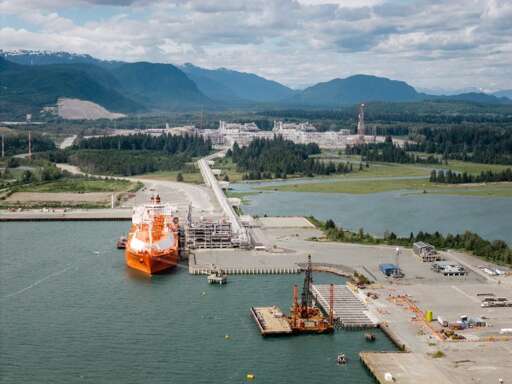
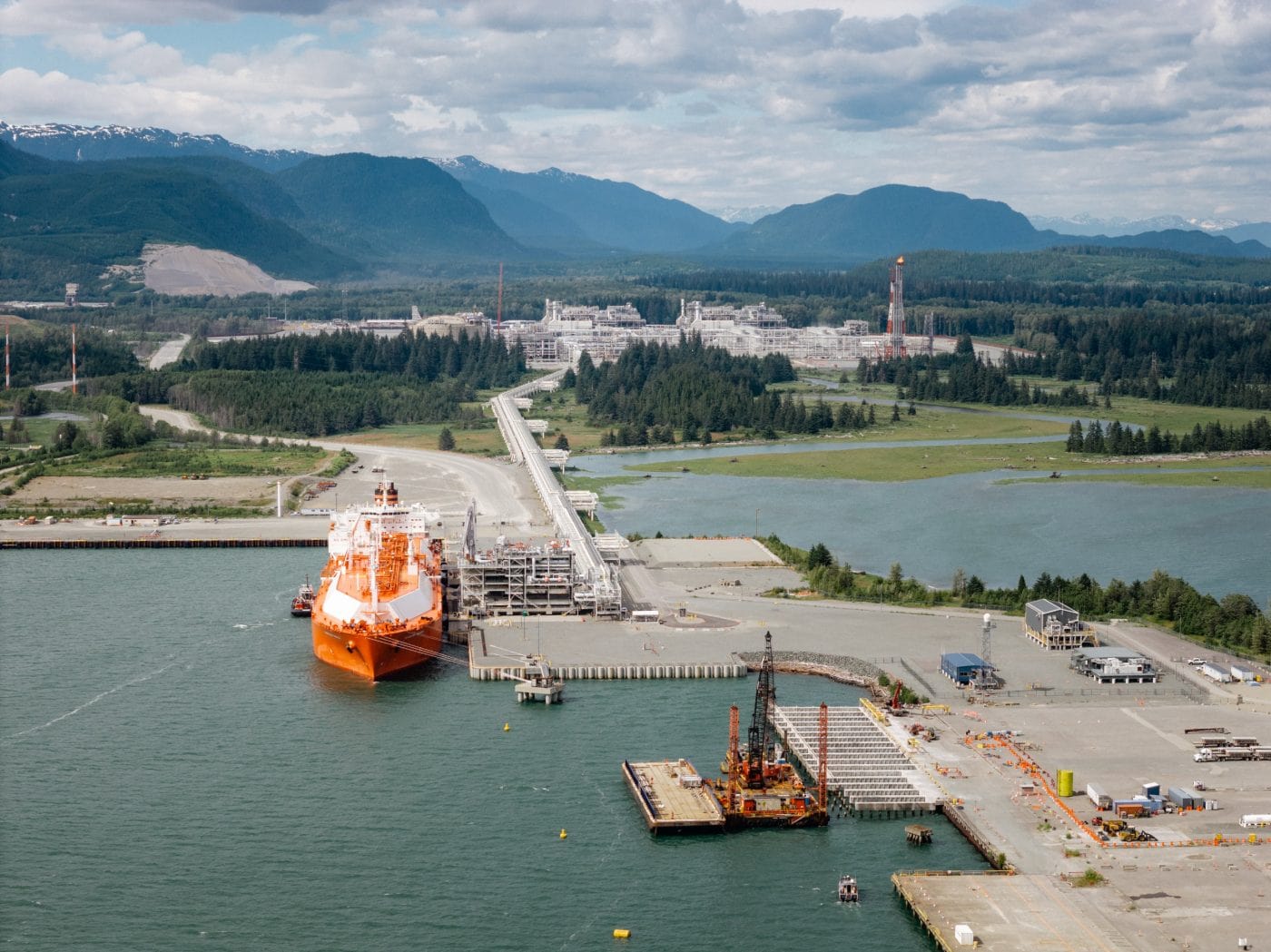
As the September sun dips down towards the mountains on the western side of the Kitimat Valley in northwestern B.C., a blueish haze hovers over the coastal community.
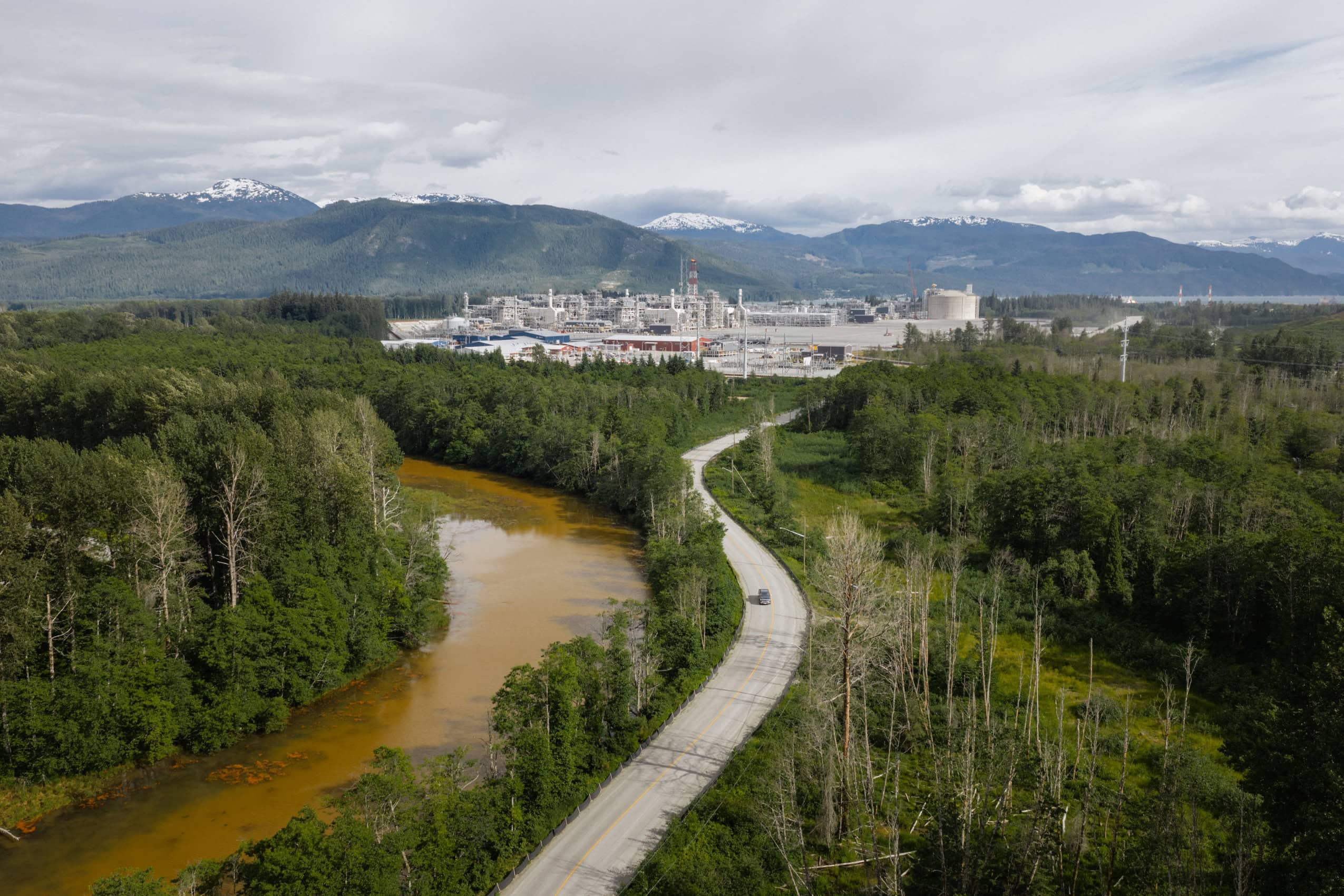
The familiar plume from Rio Tinto’s aluminum smelter, a source of local air pollution for more than seven decades, now mixes with emissions from the LNG Canada gas liquefaction and export facility, which started shipping cargoes overseas last year. At the centre of the sprawling industrial site, an orange flame glows continuously from the top of a red and white tower. That’s the flare stack, which earned the new gas plant the dubious distinction of being among the world’s highest sources of flaring emissions last year.
LNG Canada, owned and operated by a consortium of five foreign companies led by Shell, maintains its emissions are safe. Some residents aren’t so sure.
At open-house events at the town’s recreation centre over two days in mid-September, company executives, engineers and other employees field questions from members of the public. Moments after walking into the fluorescent-lit room, I’m recognized by a company representative who asks if I plan to interview anyone while I’m there. I laugh, shaking my head incredulously. He grins and says he’s read my reporting. A few minutes later, Teresa Waddington, a senior executive at LNG Canada and registered professional engineer, approaches to shake my hand.
LNG Canada is holding the event so community members can weigh in on plans for a permit amendment. The consortium wants an increase in allowable emissions levels to account for its need to keep the flare burning 24/7 — until the stack can be redesigned in 2028.
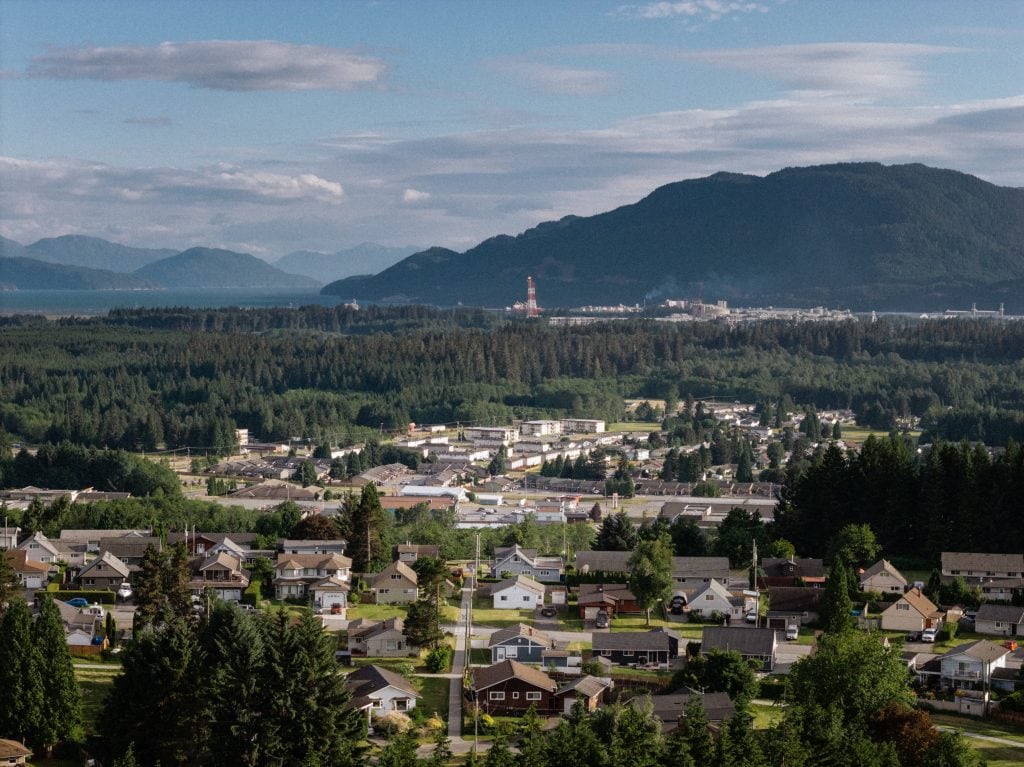
LNG Canada hosted public meetings in September to give residents of Kitimat, B.C., the chance to weigh in on an amendment which would allow the company to flare more gas than in its original permit.
Waddington tells me it’s not a perfect solution to problems that have plagued the flaring system since commissioning began in late 2024, but says the company has made significant progress to reduce flaring levels over the past couple of months. She says the original permit didn’t account for “higher flaring volumes” associated with getting an LNG plant up and running.
But that’s not the whole story.
Kitimat sits at the end of a 100-kilometre long fjord, hemmed in by mountains. Its geography means the town experiences a specific set of weather conditions: regular high winds, temperature inversions, rollercoaster pressure systems fed by the Pacific Ocean and more. LNG Canada’s flare stack wasn’t built to handle those conditions.
When the liquefaction facility fired up its flare stack, locals and workers alike quickly realized something was wrong. As first reported in The Narwhal, an integrity issue with the main stack was identified and later reported to the BC Energy Regulator. For months, the community was subjected to excessive noise, towering flames lighting the night sky, black smoke and a concoction of unidentified chemical smells and various other emissions as plant operators tried to get things under control.
“There is an operational issue with the flare design where at very low flow rates, the gas being burned moves from the tip of the flare to within the flare tip itself, causing a hot spot in the metal there,” Waddington tells me later in an email, after I follow up on our conversation. “To prevent these hot spots, more gas is sent through the flare system … to push the flame back up to the top of the flare tip.”
This “assist gas” amounted to around 10 per cent of all gas that was sent to the coastal plant last year. Locals nicknamed the flare, which reached heights of around 90 metres at times, the “Eye of Mordor” after J.R.R. Tolkien’s The Lord of the Rings.
While LNG Canada is working to amend its permits, the consortium also appears poised to make a final investment decision on an approved expansion, which would double production at the Kitimat plant. As Reuters recently reported, a decision on the project’s second phase could come as early as October. Both the federal and provincial governments have signalled strong support for the expansion.
In the community, vast work camps built to support construction of the LNG plant sit vacant and quiet. Today, the flare burns low, a dull fiery glow at the heart of the haze like the ember of a cigarette seen across a dimly lit room. It’s been calmer and quieter lately — but problems persist, and the gas being burned daily continues to exceed government permits.
Flaring not a danger to human health, LNG Canada says
Kitimat is no stranger to industry. The community was built on Haisla lands in the 1950s as a company town — serving what was then known as the Aluminum Company of Canada, or Alcan.
The town’s residents, while not accustomed to living alongside a liquefied natural gas plant, are familiar with being an industrial hub. As Kitimat mayor Phil Germuth previously told The Narwhal: “Being a town that was built by industry, people understand that every once in a while you’re going to have to put up with something to get the bigger goal in the end.”
Kitimat is also a small town, with a population of around 8,000, and a major industry like LNG Canada has extensive connections throughout the community that might make dissenting residents think twice about openly voicing their opinions.
Several community members The Narwhal spoke to, who asked not to be identified, said they’re grateful for LNG Canada grants they’ve received or sponsored programs they’ve participated in, but worry about how the combined emissions from the two major industrial facilities might be affecting their health. Most who shared their views say they’re not against having a gas plant in town — but they’re skeptical about claims the emissions aren’t harmful.
The coastal community of Kitimat, B.C. is home to roughly 8,000 people. Some residents are changing their day-to-day routines, afraid of the impacts of air pollution from the nearby LNG facility.
One resident tells me they avoid strenuous activity outdoors now — just in case. Another, who owns and operates a local business, wonders why Rio Tinto, which produces more hydroelectricity than it uses and sells the balance to BC Hydro, and LNG Canada, which is liquefying natural gas extracted from deposits in the northeast, don’t provide the town with free electricity and gas.
“I’d much rather not pay for hydro and gas,” they shrugged.
According to LNG Canada and the provincial regulator, excess flaring isn’t a problem for human health. Because the gas is burned at the flare stack, it’s mostly converted to carbon dioxide and water vapour, Waddington says. In other words, more gas being flared doesn’t necessarily increase local pollution levels — which have remained below provincial guidelines, according to the BC Energy Regulator. This claim is substantiated by local air quality monitoring, much of which was implemented when Rio Tinto underwent a major expansion between 2011 and 2015.
“There is a long-established air quality monitoring network that monitors ambient air quality in the Kitimat region, on an ongoing basis … to ensure no impact to human health,” Waddington says.
They’ve reduced the flaring volumes significantly since installing a new flare tip in July, Waddington adds, but until the whole system can be redesigned they will still need to burn more gas than originally planned.
The new flare tip has “the same design [with] upgraded metallurgy [that enables it to] operate with a bit more backburn and manage hot spots,” which she explains reduces the amount of extra gas being flared by about 60 per cent. “We are working with the company that designed the flare tip to improve this design further and to ensure it operates as expected in real-world conditions.”
But there are other emissions from the plant, too, including black smoke from the stack, which indicates particulates and unburned gases. As The Narwhal recently reported, LNG Canada predicted black smoke would be emitted between 15 and 60 minutes one to three times per year while it stabilized early operations, but the plant has exceeded that estimate.
In April, the BC Energy Regulator ordered LNG Canada to identify the root cause and implement a fix by October. On Sept. 21, the regulator posted the first report since implementing these measures, which identified “20 black smoke events that occurred between April 22 and July 31, 2026, including events that LNG Canada self-reported as non-compliances.” The regulator noted LNG Canada also reported “four additional black smoke events during August 2026” and community members told The Narwhal of at least one event in September.
Still more types of emissions, visible only through an optical gas imaging camera, are also being released at the plant. Details of these emissions were published in August by The Narwhal and Point Source after being observed by Tim Doty, a former oil and gas inspector with the state of Texas.
“The emissions that could not be seen with the bare eye were shocking,” he said at the time, after monitoring emissions at the Kitimat facility with a camera earlier in the year.
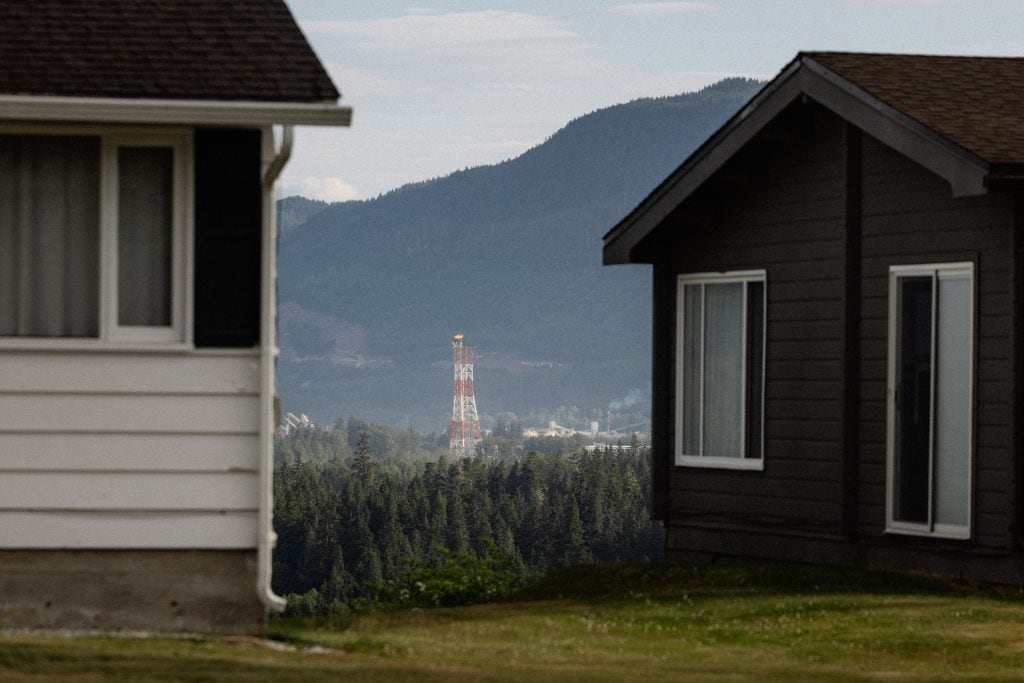
A flare burns regularly at LNG Canada’s export terminal in Kitimat, B.C., The facility has some nearby residents concerned about elevated levels of flaring and black smoke.
In Strawberry Meadows, the residential neighbourhood closest to the plant, several homes and serviced lots are listed for sale. They’re nice houses: modern design, tucked in amongst the trees on quiet streets. But while the entire town is adjusting to living with the new industrial project, it’s this area that has experienced the most noise and emissions.
Around this time last year, one resident of the neighbourhood told The Narwhal he and his family couldn’t sleep for days on end.
“We maybe got two hours’ sleep this whole weekend. I’m just useless now.”
Because of the imminent provincial election, the regulator was unable to answer questions, noting “government is in a caretaker mode” and communications, including from Crown agencies like the BC Energy Regulator “are limited to critical health and public safety information.” A spokesperson sent links to data — LNG Canada’s daily and monthly flaring amounts, the latest air quality data map and B.C.’s air quality objectives and standards — along with a statement about its ongoing oversight of the liquefaction facility.
Residents ‘more curious than concerned:’ LNG Canada executive
At the open house, community members speak quietly with company reps, asking questions about flaring, emissions, smells and more.
Joanne Spencer, another senior executive with LNG Canada, says most residents who come through are more curious than concerned. Between four sessions over two days, around 120 people stop by.
“This is quite an engaging way to talk to members of the public,” she says, gesturing around the room at clusters of employees speaking with residents. “If you’re looking at somebody in the eyes, it gives the opportunity for you to acknowledge that they’ve understood or [see if they] have another question.”
For her part, Waddington says she’s committed to show up at council meetings and “many other places where people congregate to engage in the conversation on what LNG Canada is doing well and where we need to improve.”
She tells me she previously worked as a plant manager at a Shell gas facility in Scotland where flaring “attracted community interest and concern.”
“As a result of a prolonged flaring incident, many of the staff from the facility were facing hard questions from concerned community members in their day-to-day lives,” she says, explaining she experienced tension while going about the community.
“It was important to me then, as it is to both me and LNG Canada now, that the company engages directly with [the] community when they have concerns to provide information, listen for what matters and how we can improve in those areas or better communicate about them.”
The Narwhal’s reporters are telling environment stories you won’t read about anywhere else. Stay in the loop by signing up for our free weekly dose of independent journalism.
From The Narwhal | News on Climate Change, Environmental Issues in Canada via This RSS Feed.