

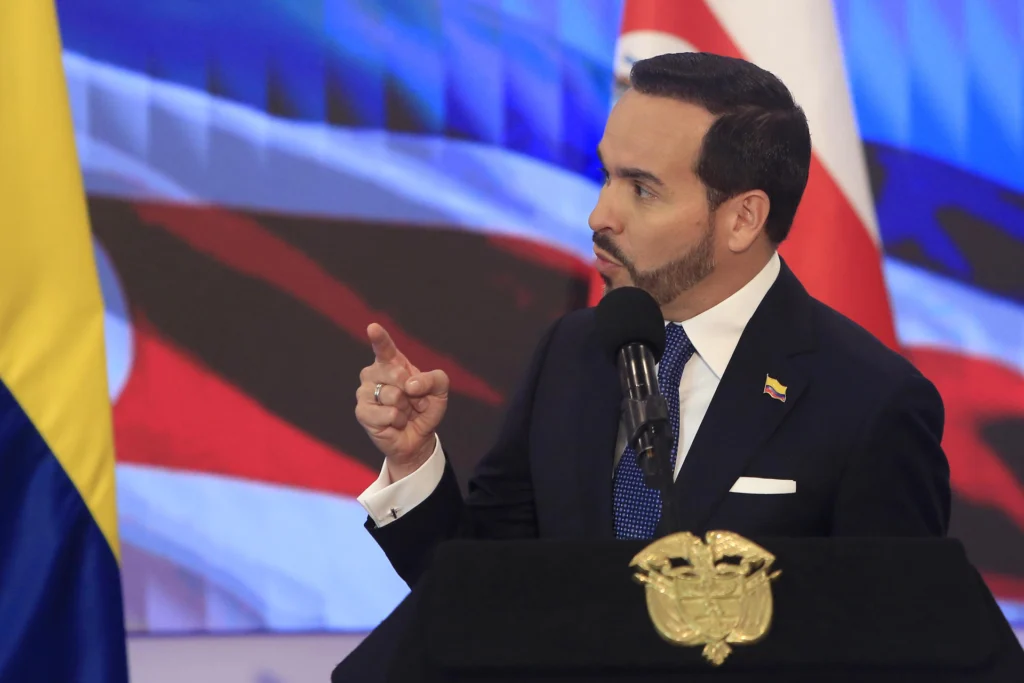
Colombia’s government, led by far-right President Abelardo de la Espriella, announced Thursday that it has broken diplomatic relations with Iran, a measure that has been in effect since September 19.
Colombian government declared Iran’s Islamic Revolutionary Guard Corps (IRGC) a terrorist organization on Thursday, just hours after formalized the severance of its diplomatic relations with the Islamic Republic of Iran, through a statement issued by the Ministry of Foreign Affairs.
In the statement, Colombian Foreign Ministry said the designation responds to the fact that the IRGC “represents a serious danger to international peace and security.”
RELATED: Colombian President Seeks to Reduce Peace Tribunal’s Budget
The break in diplomatic relations formally took effect on September 19, though the Foreign Ministry publicly announced it three hours after Vice President José Manuel Restrepo addressed the U.N. General Assembly in New York, a speech in which he made no mention of the matter. To support its decision on the IRGC, Colombia’s government noted that the organization “is classified as an international terrorist organization by the European Union, North America, several countries in the Middle East, Latin America and Oceania, among others,” according to the official statement.
Regarding the diplomatic rupture itself, the Ministry said in a separate statement that Colombia “formally broke diplomatic relations with the Islamic Republic of Iran” as of September 19, 2026, citing “the pillars guiding the government’s foreign policy on national and hemispheric security, and the fight against transnational crime.”
Ver esta publicación en Instagram
Una publicación compartida de teleSUR English (@telesurenglish)
Consular Services Continue
Despite the diplomatic break, the Foreign Ministry clarified that it does not extend to consular relations, citing Article 45 of the 1961 Vienna Convention on Diplomatic Relations and paragraph 3 of Article 2 of the 1963 Vienna Convention on Consular Relations. Consular services will continue operating normally, with Colombia’s embassy in New Delhi, India, assuming concurrent responsibility for diplomatic and consular affairs with Iran going forward.
The decision brings to an end more than five decades of diplomatic relations between Bogotá and Tehran and aligns President Abelardo de la Espriella’s government with the position held by United States and the European Union toward the Iranian government.
Diplomatic relations between Colombia and Iran date back to April 28, 1975, and though there have been interruptions in the level of representation, both countries have maintained diplomatic ties and signed cooperation agreements in areas such as culture and consular affairs. Iran has an embassy in Bogotá, while Colombia manages its relations with Tehran through its embassy in Türkiye, which has concurrent accreditation for that country.
Under the presidency of Gustavo Petro (2022-22026), bilateral contacts were maintained. In February 2023, Petro received the credentials of the then-Iranian ambassador, Ahmad Reza Kheirmand, and that same month, the Colombian Vice Minister of Foreign Affairs met with his Iranian counterpart, Ali Bagheri.
#Atención | El Ministerio de Relaciones Exteriores, en nombre del gobierno de Colombia, informa que, a partir del 19 de septiembre de 2026, rompió formalmente las relaciones diplomáticas con la República Islámica de Irán. 👇🏻 pic.twitter.com/tdj3uNNUeN
— Cancillería Colombia (@CancilleriaCol) September 24, 2026
Text reads: “The Ministry of Foreign Affairs, on behalf of the government of Colombia, reports that, as of September 19, 2026, it formally severed diplomatic relations with the Islamic Republic of Iran.”
Foreign Policy New Alignment
The break with Iran comes amid a broader realignment of Colombia’s foreign policy under De la Espriella, who has deepened ties with United States and restored diplomatic relations with Israel, reversing the rupture Petro imposed on that relationship in May 2024 over Israel’s military offensive in Gaza. The new Colombian government agreed in July, even before formally taking office, to restore relations with Israel and announced plans to strengthen bilateral cooperation, including the opening of a Colombian embassy in Jerusalem.
That broader diplomatic pivot has also been reflected in Colombia’s relationship with Washington. De la Espriella has signed agreements with the administration of U.S. President Donald Trump and hosted U.S. Secretary of State Marco Rubio during an official visit to Colombia.
The decision to sever ties with Iran marks one of the clearest early signals of De la Espriella’s foreign policy direction since taking office, positioning Colombia firmly within a bloc of regional governments aligned with Washington’s approach to Tehran and the broader Middle East, in pursuit of U.S. security and economic interests.
The move comes on the same day Israeli Prime Minister Benjamin Netanyahu defended his country’s attack on Iran’s nuclear facilities before the UN General Assembly, calling the strikes “a necessary decision to prevent what he described as an existential threat.”
The current scenario contrasts with the position established during the administration of former President Gustavo Petro, who had severed relations with Israel in May 2024.
From teleSUR English via This RSS Feed.