

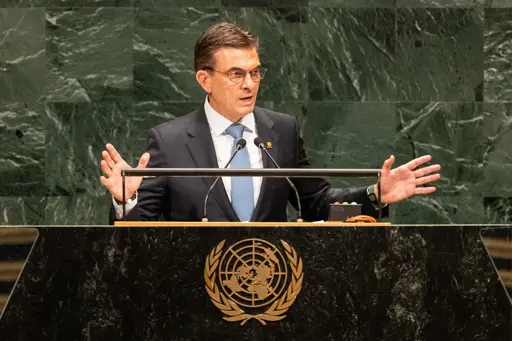
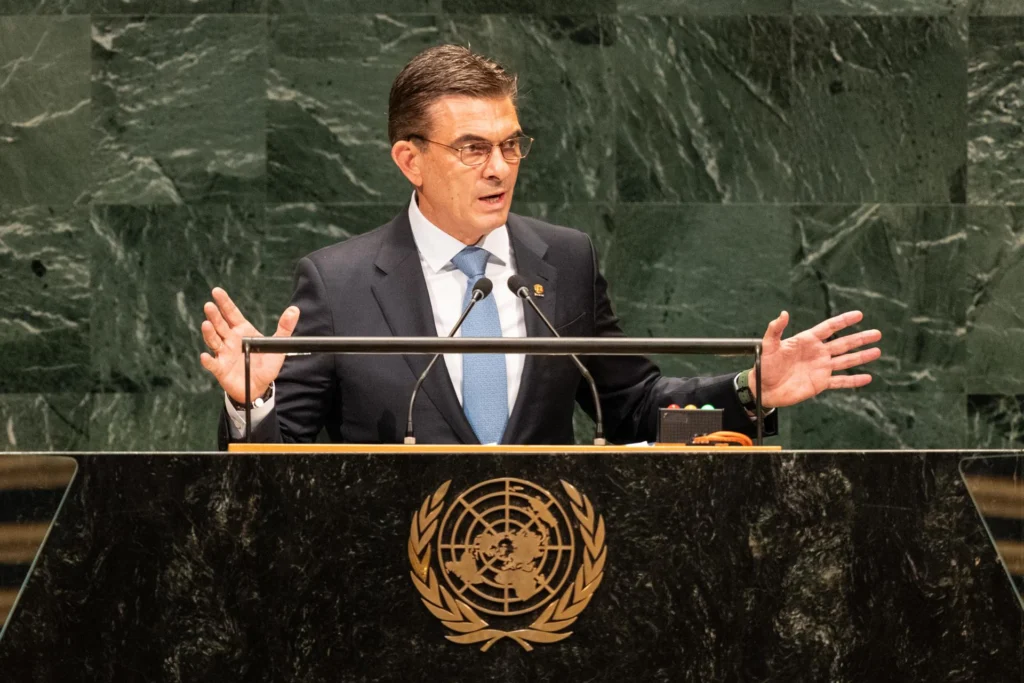
Bolivia’s President blamed the country’s left-wing governments for the nation’s current economic crisis during his address to the 81st session of UNGA on Thursday, while defending capitalism and the market-oriented reforms his administration has pursued since taking office.
President Rodrigo Paz singled out former presidents Evo Morales and Luis Arce, both of the Movement Toward Socialism party (MAS, in Spanish), as responsible for Bolivia’s economic troubles.
“Socialism and ideology don’t put food on the table,” Paz told the United Nations General Assembly of the United Nations (UNGA) without addressing the structural causes behind the crisis or referencing the near two-decade period under leftist governance.
RELATED: Bolivia’s Right-Wing Government Enacts IMF 1.9 Billion Dollars Agreement
The Bolivian head of State argued that his country currently has government and governability, but lacks what he termed “governance,” attributing that deficit to what he described as narco-terrorism, which he blamed for the wave of popular unrest that swept Bolivia between May and June this year. Those protests, which included road blockades lasting 53 days, demanded the resignation of the cabinet, greater responsiveness to popular sectors, an end to the criminalization of social protest, and the repeal of neoliberal economic measures his government has since implemented.
📷 #EnVivo | Sigue la intervención del presidente Rodrigo Paz ante la Asamblea General de la ONU.https://t.co/UcehCSk3Tm
— Cancillería de Bolivia 🇧🇴 (@MRE_Bolivia) September 24, 2026
Paz’s address to the UN plenary made no mention of a series of scandals currently facing his administration, including the case of Argentine far-right political operative Fernando Cerimedo, who is currently imprisoned in Bolivia and facing four separate investigations tied to an attack against his former partner, attorney Nadia Beller. Reports have also raised questions about the extent of Cerimedo’s influence over Paz’s campaign, including in sensitive areas such as national security, which stands in contrast to Paz’s own claim before the assembly that he ran his campaign purely through social media and without hired advisers.
A separate scandal implicating Cerimedo has also drawn in Bolivia’s First Lady, María Elena Urquidi, Paz’s wife, in connection with an alleged illegal fuel trafficking scheme, in a country that, as Paz himself acknowledged before the UN, faces significant fuel shortages and months of public protests over the sale of substandard fuel.
Los presidentes de Panamá, José Raúl Mulino; Israel, Benjamín Netanyahu; Bolivia, Rodrigo Paz; y Paraguay, Santiago Peña, sostuvieron este jueves una reunión conjunta en Nueva York.
El líder israelí expresó su disposición en colaborar con los países de América Latina en materia… pic.twitter.com/O7pS7fFZWe
— Telemetro Reporta (@TReporta) September 24, 2026
Text reads: “The presidents of Panama, José Raúl Mulino; Israel, Benjamin Netanyahu; Bolivia, Rodrigo Paz; and Paraguay, Santiago Peña, held a joint meeting in New York on Thursday. The Israeli PM expressed his willingness to collaborate with Latin American countries on economic, innovation, technology and security…”
Resources and Global Agenda
Elsewhere in his address, Paz noted that Bolivia holds vast natural resources, including strategic reserves of lithium and tin, but said the country does not wish to become merely a raw materials exporter, expressing interest in partnering with other nations to gain technical knowledge and pursue industrialization, an objective that had already been advanced during the MAS governments.
Paz also described the conservation of the Amazon as an international duty, urging countries that share the region to take on greater commitments to prevent its degradation, and called on the UN to accelerate the transfer of resources to developing nations. He further urged warring nations to end their conflicts, arguing they are driving up the cost of energy and basic goods, and called for a new global agenda addressing energy, critical minerals, industrialization, infrastructure, digitalization, water, biodiversity, food security, education, health, gender, science, technology and connectivity.
The Bolivian President also praised the United Nations as a space for consolidating a global strategy against organized crime, and defended his government’s decision to have Bolivia join the Shield of the Americas security initiative, arguing it would provide greater security for Latin American democracies.
From teleSUR English via This RSS Feed.