

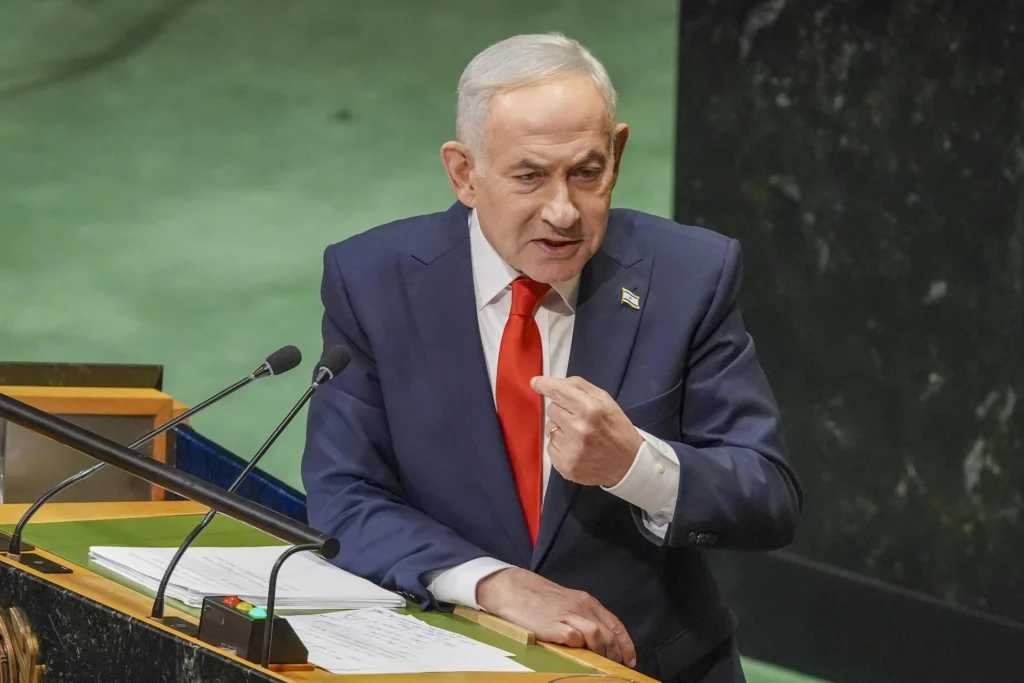
Israeli PM Benjamin Netanyahu delivered a defiant address to the United Nations General Assembly (UNGA) on Thursday, defending his government’s military campaigns in Gaza, Iran and Lebanon before a chamber marked by boos and a mass walkout of international delegations.
Facing a scene of open contempt from delegates, Israeli PM Benjamin Netanyahu opened his remarks by telling those still present that if there were other “moral cowards” who had not yet left the room, they should do so immediately.
Throughout his speech, he sought to justify Israel’s military actions, describing the destruction of Iran’s nuclear facilities as an unavoidable decision to prevent what he called an existential threat to Israel, and accused leaders who had walked out of privately thanking Israel afterward for neutralizing that alleged threat.
RELATED: Benjamin Netanyahu Booed at UN General Assembly Over Gaza Genocide
To deflect accusations of colonialism, Netanyahu returned to the 1967 war, claiming Israel had been surrounded by hostile forces and that the survival of the Jewish state had been threatened by three Arab armies. He wove in a personal anecdote about returning from Pennsylvania and reuniting with his brother Jonathan, then a 21-year-old paratrooper officer, recalling that his brother told him they would win because they had no other option.
That narrative of survival stands in stark contrast to the humanitarian catastrophe Netanyahu’s own government has imposed on the Gaza Strip. Since October 7, 2023, Israel’s military siege has killed 73,922 Palestinians, most of them women and children, wounded 174,995 more, and destroyed 90 percent of Gaza’s infrastructure, with reconstruction costs estimated at roughly 70 billion dollars. An additional 1,402 deaths and 4,881 injuries have been recorded since the fragile October 2025 ceasefire, which Israel has repeatedly violated, according to the figures cited.
Netanyahu boasted of having fought what he described as a seven-front war against the Resistance Movements like Hamas, Hezbollah, the Houthis, Iran and other armed groups, touting the destruction of weapons arsenals and the elimination of regional leaders. Even as he defended this sweeping offensive, he downplayed settler violence in the occupied West Bank, dismissing it as minor incidents involving “juvenile delinquents” and drawing a dishonest comparison to attacks suffered by Israeli settlements.
Attacks On Critics
In the closing portion of his address, Netanyahu turned his rhetoric against a series of governments and international figures, accusing Qatar of funding hostile media outlets and Türkiye of spreading antisemitic falsehoods while occupying territory. He also moved to shield his own record, rejecting genocide accusations outright and claiming, without credible evidence, that his military had taken more precautions to protect civilians than any other army in history.
Netanyahu’s appearance in New York was already shadowed by his public feud with the city’s socialist mayor, Zohran Mamdani, who has called for the enforcement of the International Criminal Court’s arrest warrant against the Israeli premier. The ICC found in 2024 that there were reasonable grounds to prosecute Netanyahu for war crimes linked to Israel’s offensive in Gaza; Netanyahu, without evidence, accused Mamdani of backing Hamas and inciting unrest.
Adding to the tension surrounding the session, Palestinian President Mahmoud Abbas was again barred from attending in person, for the second consecutive year, after Washington denied him a visa. Addressing the assembly by video from Ramallah, Abbas called the U.S. visa denial a flagrant violation of international law and warned that Israeli policy threatens the very existence of the Palestinian people, describing a “genocidal war” destroying hospitals, schools and basic infrastructure.
Condemnation of Israel’s actions echoed throughout the week’s proceedings. Qatar’s Emir, Tamim bin Hamad Al Thani, described the situation in Gaza as “a genocide in every sense of the word” and a stain on humanity’s conscience, while Jordan’s King Abdullah II pointed to overwhelming evidence of systematic abuses and warned of a deliberate strategy of forced displacement. Turkish President Recep Tayyip Erdoğan, for his part, decried the censorship of Abbas and described Gaza as “the field of death” and the world’s largest children’s graveyard.
From teleSUR English via This RSS Feed.