

Two terms of aggressive tariffs demonstrate that the United States is unwilling to respect market decisions.
The shift in U.S.–China relations from strategic partnership to direct economic conflict is driven by changes in global manufacturing and trade. Between 1990 and 2023, the U.S. share of global industrial output fell from nearly 30 percent to 16 percent, while China’s share grew from under 5 percent to over 28 percent.
RELATED:
President Xi Calls for Cooperation with Sincerity and Coexistence In Peace
In response to this growing trade deficit, the first Donald Trump administration abandoned previous U.S. trade policies that favored multilateral agreements and open markets. Instead, Trump turned to unilateral tariffs and executive actions under the framework of economic nationalism.
The explicit goal was to force manufacturing supply chains back to the United States and restrict China’s growth in advanced technology sectors.
However, state-imposed trade barriers have not reversed these broader economic trends. Because global manufacturing remains interconnected, unilateral tariffs raised costs for American consumers and businesses reliant on imported components without restoring domestic manufacturing dominance.
Unilateral Escalation and Structural Realignment
During the first Trump’s administration, Washington transitioned from indirect containment to direct economic confrontation. Under previous American administrations, policy focused on binding regional economies into multilateral trade blocs, such as the Trans-Pacific Partnership.
The Trump administration withdrew from these diplomatic initiatives in 2017, choosing instead to use executive power and unilateral trade sanctions to confront Beijing directly.
The administration launched a series of trade investigations under Section 301 of the Trade Act of 1974. Beginning in 2018, Washington imposed tariffs ranging from 10 percent to 25 percent on roughly 350 billion dollars worth of Chinese imports, targeting industrial equipment, steel, aluminum, and consumer electronics.
In response, China placed retaliatory duties on 110 billion dollars of American goods, focusing heavily on agricultural exports such as soybeans, corn, and pork, as well as automotive products.
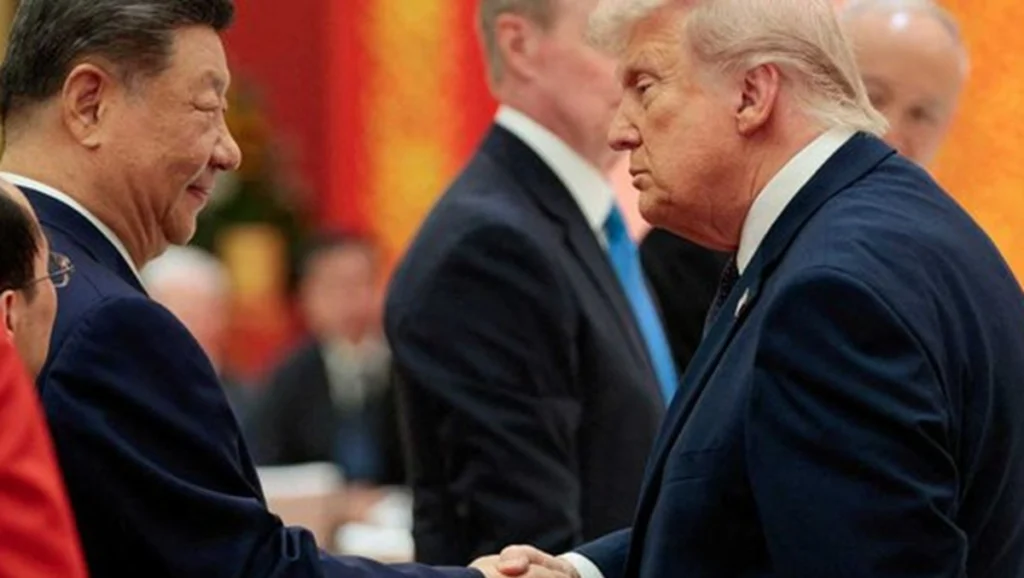
Diplomatic engagements during this period reflected sharp shifts between personal negotiations and institutional escalation. In April 2017, President Trump hosted Chinese President Xi Jinping at the Mar-a-Lago resort in Florida, followed by an official state visit to Beijing in November 2017. Despite these initial high-level meetings, relations deteriorated rapidly as Washington expanded trade restrictions into the technology sector.
The U.S. Department of Commerce added major Chinese technology companies, including Huawei and ZTE, to its Entity List. These restrictions blocked Chinese firms from purchasing advanced American semiconductors, software, and manufacturing equipment.
In January 2020, the two nations signed the Phase One Economic and Trade Agreement. Under the terms of the deal, China agreed to purchase an additional 200 billion dollars in American goods and services over two years, while the United States agreed to modify certain tariff rates. However, economic data showed that the agreement fell short of its targets.
By the end of 2021, China had purchased roughly 58 percent of the targeted goods, as global trade disruptions during the COVID-19 pandemic further complicated compliance.
Economic studies indicated that the first wave of tariffs acted primarily as a tax on domestic consumers and manufacturers reliant on imported intermediate parts.
US slaps steep tariffs on China
The measures will affect $18 billion of imports including steel and aluminum, semiconductors, critical minerals, and solar cellshttps://t.co/XirtYvQskh pic.twitter.com/KkysBpSFHP
— RT (@RT_com) May 15, 2024
Escalation, Reciprocal Leverage, and the 2026 Summit
The return of Donald Trump to the White House in January 2025 initiated a new phase of intense trade confrontation. Citing immigration and fentanyl precursor chemicals, the administration swiftly imposed a 10 percent baseline duty on all Chinese imports in February 2025, quickly doubling it to 20 percent in March.
By April 2025, Washington launched broader “Liberation Day” tariff measures that escalated duties on Chinese goods to a peak of 145 percent. Beijing responded with targeted retaliatory levies and strategic supply-chain countermeasures.
China applied 125 percent tariffs on American products, hitting key agricultural items such as soybeans and beef, alongside energy exports like liquefied natural gas (LNG) and crude oil.
Beyond tariffs, China deployed its dominance in critical minerals. In April 2025, Beijing added seven medium and heavy rare-earth elements, including terbium, dysprosium, and samarium, to its strict export-control list.
In October 2025, China introduced extraterritorial licensing rules for foreign products containing Chinese rare earths, creating significant leverage over defense equipment, electric vehicle motors, and renewable energy technology.
Legal and economic pressures eventually forced both governments toward temporary truces. In February 2026, the U.S. Supreme Court struck down the administration’s initial emergency tariffs, prompting Washington to pivot to statutory tariffs, including a 10 percent global duty under Section 122 of the Trade Act of 1974 and targeted 12.5 percent tariffs in July 2026.
Recognizing the economic damage of escalating duties and mineral embargoes, the two nations agreed to a temporary trade truce in Busan, South Korea, in October 2025, suspending the most extreme export restrictions and rolling back peak tariffs to an average of 20 to 30 percent.
Diplomatic outreach resumed in 2026 with President Trump’s visit to Beijing in May, where both governments established joint Boards of Trade and Investment, and China agreed to purchase 200 Boeing aircraft alongside U.S. agricultural goods.
This culminated in a high-stakes bilateral summit on September 24, 2026, in Washington, where President Trump hosted President Xi Jinping at the White House. The negotiations centered on extending the trade truce past its November 2026 expiration, managing critical mineral export licenses, addressing AI safety governance, and maintaining purchase agreements, including China’s commitment to import 25 million tonnes of U.S. soybeans annually through 2028.
Continuity or Disruption? Assessing the Strategy Across Both Terms
An examination of the two administrations reveals clear structural continuity in the overall approach to China, alongside an evolution in strategic tactics. Both Trump’s terms operated on the foundational premise of economic nationalism, using unilateral tariffs, technological sanctions, and executive actions to challenge China’s growing industrial weight.
The primary evolution between Trump’s terms lies in the shift from unilateral U.S. pressure to a state of mutual, asymmetric leverage. During the first term (2017–2021), Washington acted as the primary aggressor, while Beijing largely relied on defensive tariffs.
By the second term (2025–present), China leveraged its near-monopoly on critical mineral processing, controlling over 70 percent of global rare-earth mining and 85 percent of refining, to create direct counter-leverage against U.S. industrial and defense sectors.
Furthermore, policy continuity extended across political parties.
The intervening administration of Joe Biden maintained the original Section 301 tariffs and expanded restrictions on semiconductor exports to China. This cross-party alignment demonstrates that aggressive economic competition with China reflects a broader, long-term consensus in U.S. foreign policy rather than the strategy of a single presidential administration.
JUST IN: 🇨🇳🇺🇸 Chinese President Xi Jinping with a message for the Americans:
“Ladies and gentlemen, dear friends, achieving the great rejuvenation of the Chinese nation and making America great again can go hand in hand.
Let us meet the people’s expectation and show our… pic.twitter.com/JaKgBZ4dHR
— Megatron (@Megatron_ron) September 24, 2026
Multipolarity, De-Dollarization, and Global South Realignment
The escalation of economic friction between the United States and China has transformed international commerce, accelerating the transition toward a multipolar global order. As Trump turned to unilateral tariffs and technological export controls, developing nations faced mounting pressure from supply chain disruptions, currency volatility, and rising input costs.
A primary structural outcome of this prolonged trade confrontation is the acceleration of global de-dollarization. Intra-BRICS trade grew significantly, rising from 203 billion dollars in 2021 to over 417 billion dollars by 2026. Global South nations increasingly adopted local-currency frameworks.
For instance, Bank Indonesia recorded over 49 billion dollars in local currency trade settlements through mid-2026, driven largely by surging demand for the Chinese yuan in bilateral trade and infrastructure investment.
As direct U.S. imports from China declined toward levels not seen since China’s entry into the World Trade Organization in 2001, trade flows rerouted through proxy processing centers in Vietnam, Malaysia, Indonesia, and Mexico.
China solidified its role as a primary exporter of intermediate components and industrial machinery, supplying the essential machinery required for advanced electronics and hardware assembly across the Association of Southeast Asian Nations (ASEAN) and South America.
This structural shift carries distinct class consequences within the United States and across developing markets. In the United States, protectionist tariffs functioned as a regressive consumption tax, raising consumer prices and increasing input costs for domestic manufacturers dependent on imported components.
Meanwhile, global working populations bore the brunt of trade friction through localized inflation and volatile commodity markets.
XI JINPING JUST ANNOUNCED A NEW 100,000-YOUTH EXCHANGE INITIATIVE.
“The hope of China-US relations lies in our people, and its future lies with the young.”
Xi announced an invitation for 100,000 young Americans to visit China over the next five years for exchanges and study.… pic.twitter.com/FM12XfQjRM
— China pulse 🇨🇳 (@Eng_china5) September 24, 2026
The Limits of Imperial Unilateralism
The trajectory of U.S.–China relations across both Donald Trump administrations illustrates the structural limits of imperial unilateralism. Over nearly a decade of shifting policy, marked by heavy Section 301 duties, high-technology export embargoes, and sweeping protectionist tariffs, Trump attempted to reverse the relative decline of American industrial supremacy and slow Chinese economic development.
Despite these aggressive measures, the underlying material trends of global production remain largely unchanged. Trade policies increased costs for working households while pushing Chinese industries to accelerate technological self-reliance, diversify foreign exports through other markets, and secure strategic dominance over critical raw materials.
Ultimately, the global economy continues its shift toward multipolarity, characterized by broader trade networks, local currency settlements, and a redistributed manufacturing landscape.
Sources: TeleSUR – Al Jazeera – Xinhua – CGTN – RT – Press TV – Página 12 – El Orden Mundial – BBC – CNN – The Guardian – Al Mayadeen
From teleSUR English via This RSS Feed.