

By Misión Verdad — Sep 23, 2026
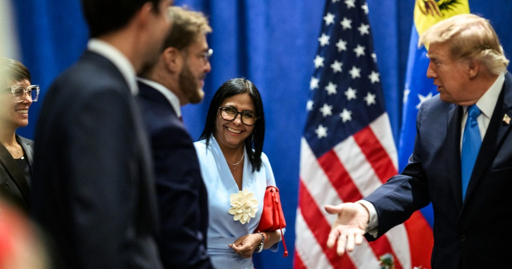
The recent meeting between the president of the US empire, Donald Trump, and Acting President Delcy Rodríguez of Venezuela took place during a gala on the sidelines of the United Nations General Assembly in New York. The event marks a milestone in the geopolitical reconfiguration of the Western Hemisphere. After years of sanctions, diplomatic rupture, and maximum-pressure confrontation, this rapprochement signals a shift from open hostility toward a new phase in relations between the two countries.
The context and the images that arose from it overturn long-standing political traditions, common-sense assumptions, slogans, and ideological totems for each side.
Yet beyond appearances, substance prevails. The meeting between Rodríguez and Trump operates at the midpoint where Washington’s asymmetric coercion and the strategic adaptation deployed by Chavismo converge.
The geometry of entangled interests, the management of narrative dissonance (as this meeting takes place after the events of January 3), back-channel diplomacy, and the inevitability of open interaction between both governments are components of an analysis that leads to a single premise: the rapprochement responds to a need for operational stabilization in which both sides reduce political costs by sacrificing ideological orthodoxy.
From pressure to survival pragmatism
Diplomacy between adversary states rarely emerges from normative alignment; rather, it tends to arise when unilateral strategies of coercion or resistance reach a point of diminishing returns. This was Venezuela’s case.
The bilateral contact between Washington and Caracas at the highest level develops against a marked asymmetry of structural power. Nevertheless, international relations have shown that strict asymmetry does not erase the agency of the quantitatively weaker actor; it alters its tactics, shifting it from open confrontation toward strategic adaptation. That appears to be precisely the Chavista position, especially after the inflection of January 3 when asymmetric coercion escalated into a foreign armed intervention.
In a broader context, for the US empire, the model of absolute isolation and incentives for the internal collapse of Chavismo showed operational limits for achieving regional stability and the returns sought in strategic assets. Burning Venezuela to the ground while also extracting its oil was not an option.
Over time, and with the US drift on Iran, hydrocarbons and their prices became a persistent problem for the Trump regime. This year, that reality pushed them to consolidate their perceived “achievements” in Venezuela as a prized element of North American foreign strategy.
Here enters the US ‘flexible realism.’ It is one of the guiding principles introduced in this Trump era in the National Security Strategy (NSS) and consolidated in the US National Defense Strategy (NDS). This approach marks a sharp turn away from the idealism or liberal internationalism of prior decades, replacing the objective of absolute global dominance and democracy promotion with a highly pragmatic, selective stance strictly centered on national interest. From that perspective, Washington can relate to Caracas regardless of whether the Chavista structure beneath President Nicolás Maduro remains intact. Interests overlaps over values and ideology.
For Chavista leaders in Venezuela, global financial isolation and the partial operational paralysis of the oil industry forced a recalibration of anti-imperialist rhetoric toward a transactional negotiation model. This is evident.
In this geopolitical interstice is where the bilateral meeting sits: a gray zone where economic coercion and operational agreement coexist.
The geometry of interests and transactional dynamics
The first pillar of this analysis rests on the intrinsic complexity of the incentives that guide both actors. Far from pursuing a maximalist vision, the approach responds to a non-zero-sum calculation in highly delimited areas.
Washington’s equation is: access to Venezuelan energy and mineral sources, control of migratory flows, and preserving regional influence through differentiated use of force. Pure and hard hegemonic exercise.
Caracas’s equation is: easing of sanctions, an end to the naval blockade and other measures, operational-diplomatic recognition of the government, return to the international financial system, attraction of investment, economic stabilization, and support for operational resistance and institutional resilience of the state in a complex context.
Given the transactional logic evident in the Trump administration, it is necessary to observe where the Venezuelan government’s logic functions. It demonstrates tactical malleability. Facing structural barriers to commercializing its resources, state leadership offers operational guarantees to foreign energy corporations in exchange for exploitation licenses and direct fiscal revenues.
Moreover, the strategic adaptation preserves the basic architecture of internal political power while ceding space in the management of natural resources to guarantee cash flow and de facto legitimacy. In doing so, it breaks the siege and weakens the inertia of sanctions, which has been one of Chavismo’s most prized objectives in recent years.
For Chavismo, dismantling the inertia of isolationary sanctions has been crucial. The choice is to dismantle it or sink into a perpetual, intergenerational structural loop that causes immense suffering and deep impoverishment of the population. The sizes and characteristics of the Venezuelan population give the blockade devastating power.
After 12 years of sanctions, a Venezuela that failed to associate with BRICS to circumvent Western suffocation, that could not tolerate a prolonged naval blockade in the Caribbean due to its physical characteristics, and that could not overcome the military asymmetry favoring the US empire, was supposedly forced to negotiate within the framework of the possibilities and limits of the moment.
Narrative dissonance and the weight of photos
The image of both presidents together and smiling is a striking portrait of the political moment, not only for Venezuela, but for the region and the contemporary international relations context. It is where certain discourses founder and where ideological compasses stop working.
The murkiest component—often labeled “incomprehensible” from the public opinion perspective—is the mere possibility of coexistence between natural antagonisms through a fluid technical relationship. There, the epithets aimed at Delcy as a ‘submissive puppet’ do not prevail; nor do the labels for Trump as ‘an ally of a tyrannical narco-terrorist.’ What emerges is supposedly realpolitik at high resolution.
From the perspective of both governments, each—albeit differently—deals with political costs. In both Washington’s and Caracas’s domestic politics, the reputational cost of ideological softening is considerable.
For the US empire, visible rapprochement risks being interpreted by sectors of the electorate as a concession to an “authoritarian regime,” which is not a trivial matter in the run-up to midterm elections. Democrats, and even some hawkish Republicans, react angrily. Beyond party logic, some view the meeting as the oxygen Washington supplies to its principal continental adversary, absent a linear regime-change outcome that could go wrong and jeopardize the gains ‘flexible realism’ under Trump has produced in Venezuela.
For Venezuelan leadership, an explicit understanding with the North American power that bombarded Caracas on January 3 and that kidnapped President Maduro severely undermines the historical narrative of anti-imperialist sovereignty that serves as an identity glue for its operational base. Furthermore, Chavismo has effectively been expelled from the club of certain strands of the international left. Various digital media operators, commentators, and influencers on the international left lash out at Chavismo and at Delcy with shallow analysis governed by easy coordinate points such as “betrayal” or “capitulation.” Among those groups, there is zero recognition of politics as the difficult art of navigating the gray zone.
To manage this dilemma and offset political costs, both sides have resorted to back-channel diplomacy. These channels operated in a hermetic space outside media scrutiny, using special envoys, private-sector intermediaries, or low-profile meetings, such as “pull aside meetings” at multilateral summits.
This separation between external rhetoric and private negotiation allowed both parties to minimize internal political losses while advancing substantive concessions. What appears from the outside as dissonance or incoherence is, in strategic analysis, the indispensable condition for diplomacy to be viable. But now the meeting became public, the photos were taken and released, and there is an open exercise of legitimizing the relationship.
There is little to analyze regarding the most radical sectors of the Venezuelan opposition in this context. Their strategic irrelevance and null reach in real power dynamics have excluded them from this equation.
The inevitable point of diplomacy
Finally, any analysis of the meeting between the heads of state must recognize the element of compulsion inherent in international relations. Diplomacy is not a reward offered to allies; it is also the primary tool to manage contradictions with adversaries.
Total isolation as a foreign policy strategy tends to generate a dead end that paralyzes strategic action capacity.
When unilateral pressure exhausts its margins of effectiveness without substantially altering the adversary’s power structure, direct interaction ceases to be optional. This applies to Trump. At that point, diplomacy becomes a geopolitical necessity imposed by geography, natural-resource markets, and hemispheric stability, especially when in the US a gallon of diesel costs seven dollars and Trump needs to signal to his voters that everything is under control.
Venezuela’s Delcy Rodríguez Arrives in New York for UN General Assembly Ahead of Trump Meeting
The meeting does not symbolize a lasting alliance or axiological coincidence, but rather a temporary motive of equilibrium. It marks the establishment of a minimal framework of rules of the game in which asymmetric coercion and strategic adaptation converge to avoid uncontrolled chaos scenarios. The particulars and context that govern the meeting between Venezuela’s and the US empire’s leadership show that contemporary international relations operate in a terrain where ideological labels give way to transactional dynamics.
It is terrain that confirms that diplomacy cannot be indefinitely ignored; faced with the paralysis of maximalist approaches, transactional dialogue emerges as the only channel to manage losses and ensure strategic survival, which applies to Chavista leadership.
In the end, the event reflects a constant of geopolitics: at the intersection of pressure and resistance, material incentives and operational stability will always impose their own diplomacy.
Translation: Orinoco Tribune
OT/JRE/JRE
From Orinoco Tribune via This RSS Feed.