


Nika Bartoo-Smith
Underscore Native News + ICT
Hundreds gathered in Snoqualmie, Washington, last week for the annual Affiliated Tribes of Northwest Indians convention. Over the course of three and a half days, tribal leaders, federal employees and Indigenous serving organizations discussed important issues impacting Indian Country including legislation from both state and federal governments and national priorities as it nears midterm elections.
Some areas of concerns included, the role of artificial intelligence, and data centers impacting Native nations, mail-in voting, data sovereignty, impacts of the Office of Management and Budget proposed rule changes, and proposed changes to section 106 of the National Historic Preservation Act.

A women’s drum group shares an honor song during an honoring lunch at the Affiliated Tribes of Northwest Indians annual convention in Snoqualmie, Washington on September 14, 2026. (Photo by Nika Bartoo-Smith, Underscore Native News / ICT)
Throughout the week, panels also met with focuses on energy, education, philanthropy, climate, food sovereignty, and more.
Founded in 1953, ATNI is made up of 57 Northwest tribal governments from across Oregon, Idaho, Washington, southeast Alaska, Northern California and Western Montana. Its goal is to protect and advance the tribal sovereignty and interests of its member tribes. It originally began as a way to fight back against illegal tax and then a vehicle to fight against termination, according to Josh Gabel, enrolled Snoqualmie Tribe and treasurer for the Snoqualmie Tribe
“Well, 70 some years later, we’re still here fighting some of those same things. But it’s with the knowledge of the elders, it’s with the wisdom of our ancestors, that we may carry on together,” Gabel said, addressing those gathered to vote on resolutions at ATNI on Sept. 17.
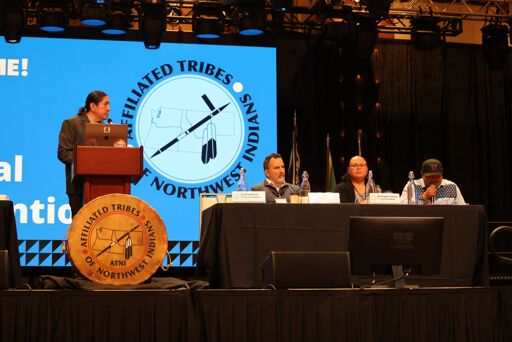
Federal officials address ATNI
On the morning of Sept. 14, newly appointed director of Indian Health Services, Mark Cruz, took the stage and addressed ATNI attendees. Cruz, Klamath Tribes, was nominated by the White House to lead Indian Health Services in June and confirmed this August.

Mark Cruz, Klamath Tribes, director of Indian Health Services speaks during the Affiliated Tribes of Northwest Indians annual convention in Snoqualmie, Washington on September 14, 2026. (Photo by Nika Bartoo-Smith, Underscore Native News / ICT)
Addressing those gathered for ATNI, Cruz outlined his top three priorities as director of Indian Health Services.
First, he plans to fix the 30 percent vacancy rate at Indian Health Services clinics across the country.
Second, he plans to finish a backlog of construction projects, based off of a list from 1993. As of 14 months ago, there were still eight projects on the list with an estimated cost of $8 billion, he said.
“The secretary and I travel around the country and hear about the significant needs that are still across the IHS network, and you know we can’t create a new list because Congress put us in a straitjacket saying you can’t create a new list until you get the 93 list done,” Cruz said.
Third, Cruz outlined his goal to increase Indian Health Services’ budget, requesting an 11 percent increase in 2027 raising the budget from $8.2 million to $9.1 million, he said.
Later in the week, William “Billy” Kirkland, assistant secretary of the Interior, spoke about priorities within the Bureau of Indian Affairs, including a current goal to hire 400 new employees within the Bureau of Indian Affairs.

William “Billy” Kirkland, Navajo, assistant secretary of the Interior, speaks about priorities within the Bureau of Indian Affairs during the Affiliated Tribes of Northwest Indians annual convention in Snoqualmie, Washington on September 16, 2026. (Photo by Nika Bartoo-Smith, Underscore Native News / ICT)
Kirkland, a citizen of Navajo Nation, outlined his commitment to “communication, coordination and customer service.”
“I want to be clear about a number of things. One is that the president, President [Donald] Trump, and Secretary [of the Interior Doug] Burgum don’t view Indian Country as a problem to be managed. They view it as a partner to work with,” Kirkland said. “So while we have a lot of challenges out there, challenges are also opportunities.”
AI and Indian Country
The use of AI and the impacts of AI data centers across the northwest came up during several sessions at ATNI.

A map of data centers in the Columbia River Basin as of September 22, 2026. (Image Courtesy of Elaine Harvey)
As AI data centers continue to pop up across the Pacific northwest, Native nations are often at the frontlines as Native land is being targeted for placement of some of the mega centers, part of an ongoing historical pattern of colonial and capitalistic extractive industry work.
“For me, the goal isn’t for ATNI to decide whether every tribal nation should be for or against data centers,” said Johnny Buck, Yakama Nation, co-chair of ATNI’s Youth Committee, during a panel about AI and data centers. “Different nations are going to make different sovereign decisions. I think the question is whether each nation has the information, technical capacity, time, legal authority, and bargaining power to make that decision before the project becomes inevitable.”
Beyond the need for consultation with Native nations about the AI data center infrastructure by big tech companies, panelists also raised concerns about the environmental impacts.
Elaine Harvey, Yakama Nation, watershed department manager at the Columbia River Inter-Tribal Fish Commission, was also a panelist. She explained that for data centers in the Columbia River Basin, one huge concern among Native fishers is that the water being used to cool the data centers could contribute to warmer river temperatures which is harmful for the salmon and other native fish.

From right, Johnny Buck, Yakama Nation, co-chair of Affiliated Tribes of Northwest Indians’ Youth Committee; Elaine Harvey, Yakama Nation, watershed department manager at the Columbia River Inter-Tribal Fish Commission; and Leonard Forsman, Suquamish Tribe, president of the Affiliated Tribes of Northwest Indians sit on a panel about AI data centers during the Affiliated Tribes of Northwest Indians annual convention in Snoqualmie, Washington on September 15, 2026. (Photo by Nika Bartoo-Smith, Underscore Native News / ICT)
“We have multiple concerns when it comes to water and temperature, water quality, and the impacts to our life, our tribal lifeways, the impacts for us to fish, the impacts to the health of the fish,” Harvey said. “These are big concerns, big issues that we’re trying to stay on top of, to track, and I really think there are no regulations, very little regulations on these data centers at the state level and a county level, and so it’s really important for us as tribes to be engaged with these policymaking decisions.”
There are also concerns about where the wastewater from the data centers is going.
When thinking about AI data centers, panelists highlighted the need to think about impacts to future generations.
“One of the lessons they have been carrying is that their generation already live with infrastructure decisions made before they were born,” Buck said, speaking about conversations he’s had with ATNI Youth Committee members about AI.
“We talked about dams not because a data center is a dam, but because there is a similar familiar pattern where decisions start becoming inevitable long before an infected nation is actually brought into the room,” he continued.

Josh Gabel, Snoqualmie Tribe and treasurer for the Snoqualmie Tribe, addressing those gathered to vote on resolutions at the Affiliated Tribes of Northwest Indians annual convention in Snoqualmie, Washington on September 17, 2026. (Photo by Nika Bartoo-Smith, Underscore Native News / ICT)
Beyond the concerns about AI data centers, ATNI members also raised concerns about the use of AI itself, namely within the child welfare system.
In a committee session about the Indian Child Welfare Act, representatives from the National Indian Child Welfare Association talked about Executive Order 15359 which directs states to expand the use of AI within the child welfare system in order to “increase caregiver recruitment and retention rates, improve caregiver and child matching.”
David Simmons, the director of government affairs and advocacy at NICWA, raised concerns as to how AI does not do a good job of analyzing nuanced information. He said that some studies have found that children and families of color tend to have worse outcomes when AI is used.
“What we’re trying to do here in the ICWA Committee is to get on record a resolution that says to the federal government and to state governments that we don’t want you just opening up AI tools and things to Native families and children without tribal consultation and I would say permission,” Simmons said.
The resolution did pass in both the ICWA committee and general assembly. It will now move on to the National Congress of American Indians, according to Simmons.
Two other resolutions related to AI were brought forward to the general assembly: one supporting the formation of an ATNI task force on AI, and the other calling for responsible governance on how youth use AI chatbots in schools and education. Both passed.
Concerns over proposed federal legislation
On a federal level, a few pieces of proposed changes were top of mind at this year’s ATNI annual convention.
In July, the federal Advisory Council on Historic Preservation released a set of proposed changes to Section 106 of the National Historic Preservation Act that would make tribal consultation optional on culturally significant lands. In August, the National Congress of American Indians urged tribes to advocate against the proposed changes.
There is concern that this will make the job of Tribal Historic Preservation Officer more difficult, attorney Brian Gunn, Confederated Tribes of the Colville Reservation, shared during general assembly on Sept. 14 at ATNI.
“For sacred sites, there’s not a lot of statutory protections for those. 106 has really been it,” Gunn said.
Later in the week, ATNI passed a resolution opposing the proposed changes and calling for “meaningful tribal consultation in the revision of the Section 106 regulations.”
In May, the Office of Management and Budget published a proposed rule to revise the Uniform Guidance, which is a set of regulations that manages federal financial assistance awards and research programs.

An image of the Snoqualmie Tribe’s sign welcomes visitors on September 17, 2026. (Photo by Nika Bartoo-Smith, Underscore Native News / ICT)
Under the proposed rules, the Office of Management and Budget would have expanded authority allowing them to determine if funds, even those already distributed, align with the president’s interests in order to be allocated, according to Craig Jacobson, partner at Hobbs, Straus, Dean & Walker, LLP.
“What the concern is amongst tribal governments that are looking at these proposed rules is that it then politicizes a lot of different funding programs that aren’t politicized,” said Jacobson, addressing those in attendance at ATNI.
He went on to highlight concerns with how the current administration has dismantled diversity, equity and inclusion programs and how sometimes funding for tribal programs is misrepresented as DEI work.
Currently, the Office of Budget and Management rule is on pause until Dec. 11, according to Jacobson, who urged tribal governments to prepare now by mapping out current grants and risks that losing funding could pose.
“One of the safeguards that tribal leaders are seeking to communicate to the [Office of Management and Budget] and through this administration and through your delegations is statements that ideally would come out of any sort of proposed rule that make it clear that tribal classifications, tribal funding is a function of political and not racial terms, and has nothing to do with DEI, because again, that’s been a target of this administration in terms of pulling funding,” Jacobson said.
This story is co-published by Underscore Native News and ICT, a news partnership that covers Indigenous communities in the Pacific Northwest.
The post Tribal leaders talk AI, proposed legislation and national priorities at annual Northwest convention appeared first on ICT.
From ICT via This RSS Feed.