

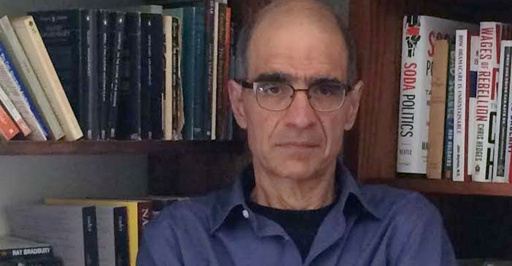
Janine Jackson interviewed Russell Mokhiber, of Capitol Hill Citizen and Corporate Crime Reporter*, about covering corporate crime for the* September 18, 2026, episode of CounterSpin*. This is a lightly edited transcript.*
https://media.blubrry.com/counterspin/content.blubrry.com/counterspin/CounterSpin260918.mp3
Janine Jackson: In some ways, modern media criticism is corporate crime reporting. Major news media are fundamentally corporations; that used to be a controversial thing to say. And some of the things they do in mis- and disinforming us about the world, and ourselves and our political possibilities, constitute, minimally, moral crimes.
It’s very hard to learn about the harmful actions of other corporations—fossil fuels, insurance—without news media that are able and willing to shine that light. And, of course, you can’t get a full understanding of why corporations can do what they do without understanding government’s role.
Our guest’s work has brought those things together for years now. Russell Mokhiber is editor of the Washington, DC–based Corporate Crime Reporter, and editor and writer at the Capitol Hill Citizen. He joins us now by phone from West Virginia. Welcome back to CounterSpin, Russell Mokhiber.
Russell Mokhiber: Thank you for having me, Janine.
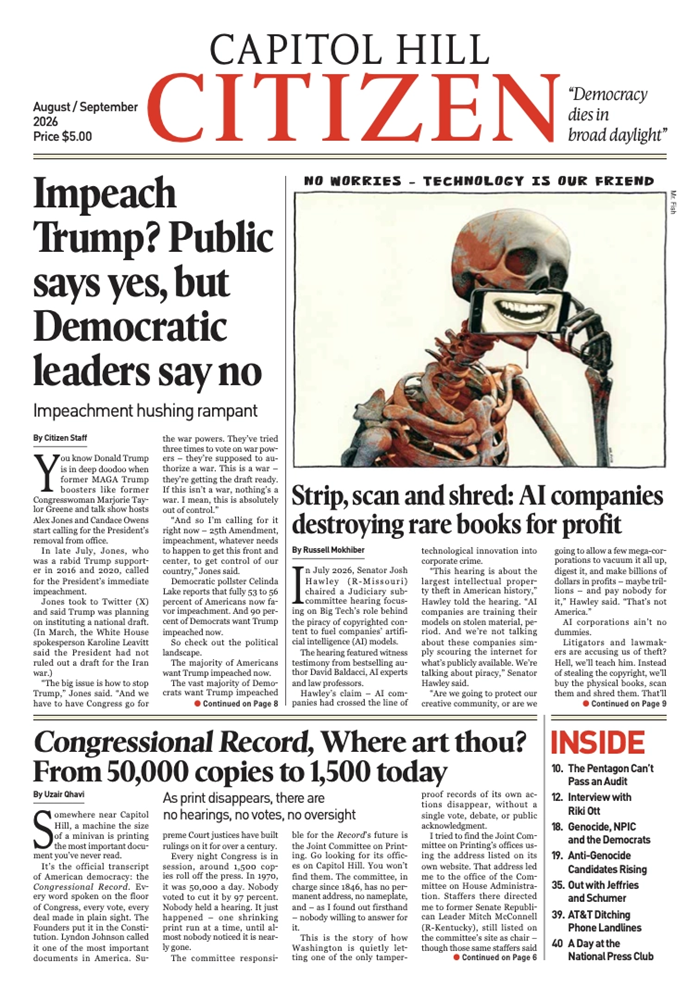
Capitol Hill Citizen (8–9/26)
JJ: Let’s talk first about Capitol Hill Citizen. You can find it online, but it is, importantly, a print paper, and there are reasons for that. Tell us a bit about this project and what it’s trying to do.
RM: The paper was started a couple years ago by Ralph Nader. We publish four times a year now, but we want to go to a monthly and then a weekly, and eventually bring back the idea of a daily paper covering Congress and corporate politics inside the Beltway.
Unlike most newspapers, we don’t take any advertisements. We don’t take corporate advertisements—sometimes we run ads for books that our authors write.
But the idea is to get people off the phones, off the internet, and have people spend a few moments sitting, holding a newspaper, reading a newspaper. And reading a newspaper unlike any other in the United States, unlike any other magazine in the United States, unlike any other printed paper in the United States. And that’s because our point of view is that we have a corrupt corporate duopoly controlling our lives in the country. And both parties are beholden to the corporate powers; we’re very critical of both parties.
There are a couple newspapers that cover Capitol Hill—Politico, The Hill, Roll Call—but they are all heavily influenced by corporate powers. A number of them—and this includes, of course, the New York Times, the Wall Street Journal, the Washington Post, which have congressional correspondents on the Hill—have run seminars on Capitol Hill for members of Congress, for the business community, that are sponsored by these same corporations that control the parties, and that control the political discourse. So Capitol Citizen is different in that respect.
It’s also different in the respect that our readership really likes the paper. We call newsprint “the new underground,” because as people move away from the phone and the internet—and we’re all addicted to it; my wife will tell you I’m the most addicted to it—but people are really showing signs of rebellion.
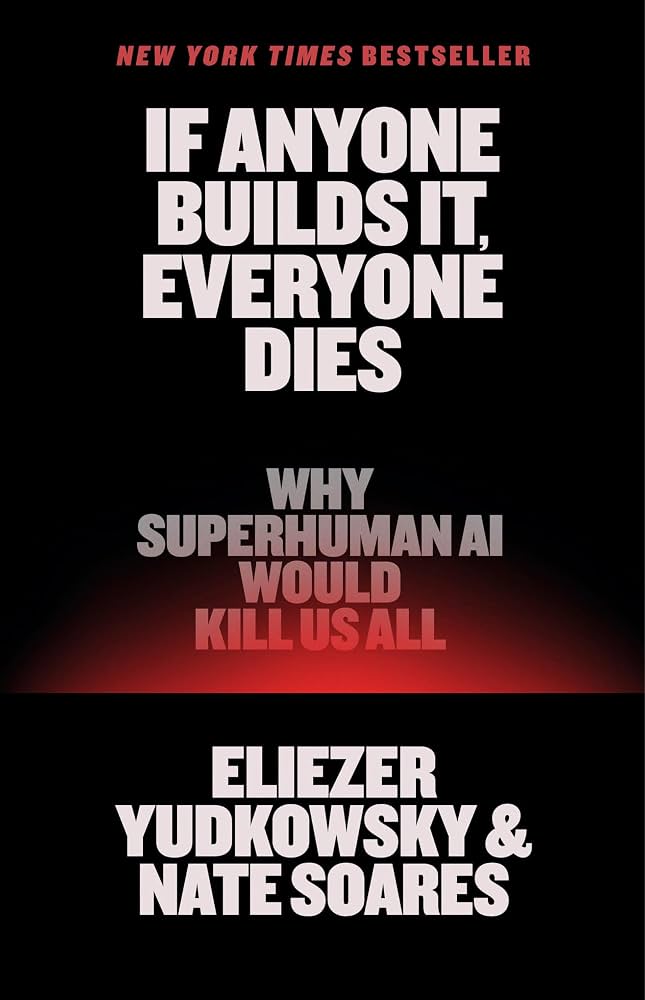
One is the popular movement against data centers.That’s not just because people don’t want data centers in their backyards. It’s because people understand that the whole artificial intelligence movement is a threat to humanity. And increasingly, this is blowing up in the mainstream press, but something we covered early on in our history at Capitol Citizen a number of years ago, we profiled a book by Soares and Yudkowsky titled “If They Build It, We Will All Die,” or something like that. I don’t know the exact title of the book, but basically these were two insiders who say that it’s a runaway technology that threatens humanity.
And we’re not accepting of the corporate Democrats and Republicans talking about inside-the-Beltway regulation. We want to stop this kind of technology, because it does threaten us all.
And unlike some of even the left media who are very pro–Democratic Party, we are not. We call out the Democrats as much as we call out the Republicans. That’s one way we’re different.
The other is, we believe in print. We believe that it’s going to be the new underground. And a lot of younger people are coming around to this, that we’re going to be able to get our information again from the newspaper, as the internet moves more and more towards this threatening technology.
JJ: Right, right. And there’s something different about the slower way you absorb print. And I’m not a Luddite, but there is something mental that happens when you read 57 different stories from 57 different sources in the space of 20 minutes, rather than slowing down with one particular story and thinking about it. It’s just different. And it’s not what was promised, but it’s where we’re at. So I understand that.
RM: And the term “doomscrolling” is real. You get on the internet, and you just flip from one item to another. It sucks you in. It’s very addictive and enticing. It just sucks you in, and you laugh at some things and you cry at others. And then you realize, when you put your phone down, that it’s somehow really dirty. And it’s dirty in a fundamental way, and we believe the newsprint is a lot cleaner that way.
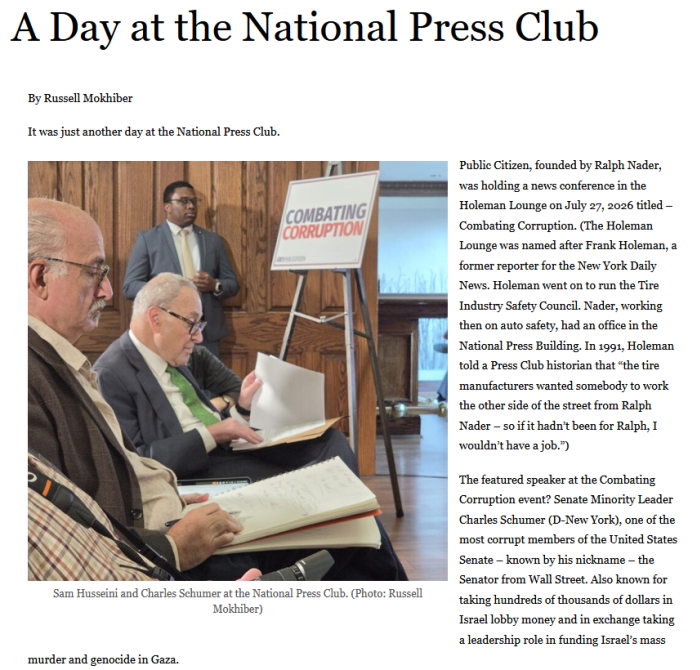
Capitol Hill Citizen (8/19/26)
JJ: You’re talking about things that happen behind the scenes, and who sponsors what, and it might seem like a departure, but it’s not: The National Press Club probably sounds kind of musty to a lot of folks, but it still actually is an institution that has a role to play. And I know that you had a run in with the Press Club recently, and briefly, of course, please tell us what happened, and also, why do you think it should matter to somebody who wasn’t there?
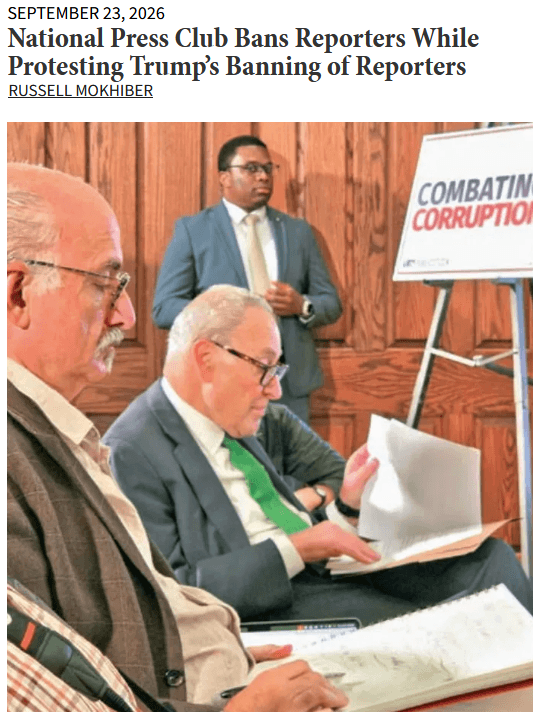
RM: I had heard that Public Citizen, which is a group founded by Ralph Nader, one of the strong public interest groups inside the Beltway, was hosting a press conference on what they called “combating corruption.”
And as a reporter for Corporate Crime Reporter for 40 years, corruption’s been my beat. But I sort of smelled a rat. I said, “combating corruption, Public Citizen…” And I had heard that the Senate Democrats had put out a report on Trump’s corruption, and they were eyeing it for the midterm election, and they wanted publicity on it. So I suspected that’s what it was about.
And so I wrote to them and I said, “Hey, what’s this about?” And they sent me the details, and they were going to basically turn over Public Citizen’s name, and Public Citizen’s going to rent a room at the Press Club and do a press conference.
They printed up these really beautiful signs that said “Combating Corruption.” They put them around the room. Then they brought in three Democratic senators, led by the Senate minority leader, Chuck Schumer, senator from New York, also known as the senator from Wall Street, who was instrumental in the funding of the Israeli genocide in Gaza.
So I wrote to the press person, I said, “Hey, it’s going to be a press conference, right?” She goes, “Well, actually, no, we’ve canceled the Q&A session for Schumer.” “Oh, wow. That’s interesting. Why don’t they want….”
Of course, I knew why they don’t want questions for Schumer, because the question’s going to come up in a press conference on combating corruption: How could you have arguably the most corrupt senator in the US Senate, taking money from AIPAC and the Israeli lobby to fund a genocide, taking money from Wall Street to deregulate Wall Street?
CounterPunch (9/23/26)
So, you know, I wrote my buddies, and Sam Husseini and I were right there in the front row when the press conference started. Schumer started to speak, and Sam stood up and he held up a letter from, I think it was the Center for Constitutional Rights, which was sent to every member of Congress, warning them that if they fund a genocide, they too will be liable for criminal prosecution at the International Criminal Court. If you fund a genocide, you’ll be liable for that. It was sent to them two years ago. So they were on notice that if they funded a genocide, they would be liable for funding a genocide. Sam just stood up and confronted Schumer on this, and security came and dragged him off.
I sat there and I tried to ask these senators questions, Sen. Sheldon Whitehouse from Rhode Island, who’s also taken AIPAC money. I asked Schumer, and he just walked away. I asked Whitehouse, and he just walked away. And Senator Padilla, from California, I asked him, “How can you support the most corrupt senator in the Senate to be your leader?” And he just said, “He is our leader. Next question.”
JJ: Wow.
RM: And then I tried to get Lisa Gilbert—Lisa Gilbert is co-president of Public Citizen—afterwards to answer why she would allow these senators taking AIPAC money to lead this press conference on combating corruption. And she basically said that it’s “not connected”: We support his bill on corruption, and what you’re talking about is not connected.
I believe it is connected. I believe it’s the same dynamic. You take money from Wall Street, you deregulate Wall Street. You take money from AIPAC, you fund a genocide.
JJ: It feels like an old definition, because people are connecting those things. So to say, “We’re smarter and we recognize they’re not connected,” is just a disassociation.

Guardian (9/18/26)
RM: Well, there’s this recent poll that I think 70% of Democrats want Jeffries and Schumer out as the leadership of the Democrats in the Congress. So it’s not just me and you, Janine, it’s 70% of Democrats, for exactly that reason.
So it wasn’t a pretty situation, and Sam was banned from the Press Club. He’s appealing that. I’m a member of the Press Club, I’ve been on and off a member for 40 years, and I was stripped of my privileges. I appealed that, and it was like a two-week suspension, but now they say they’re going to keep it on my record, so I’m appealing that. It reminded me—I don’t know if you saw the news on Macklemore this morning.
JJ: Absolutely.
RM: Where Robert Kraft said, “You can’t play in our stadium.” I think that’s the message the Press Club was sending. It was like, “If you’re going to challenge genocide, don’t do it at the Press Club. Do it someplace else.” And of course it’s the Press Club, which should be about reporters’ freedom to ask tough questions of those in power. That’s what the whole thing should be about. The fact that they’re sending a message, “No, don’t do that in the confines of the Press Club, which is a private club,” is pretty outrageous.
Remarkably, I found out in doing the research for this article in the Capitol Hill Citizen—by the way, if people want a print copy of the Capitol Hill Citizen, you can just go on and for a donation of $5 or more, we’ll send you a copy, at CapitolHillCitizen.com—but what I found out at this event, the room that Public Citizen rented was in the Holeman Lounge. It’s named after Frank Holeman, and he was a reporter for the Daily News, and then he went on to work for the tire industry, for some front group called the Tire Industry Safety Council or something.
There was a Press Club historian who interviewed Frank Holeman, and he said, “Yeah, after I quit the Daily News, Ralph Nader had an office in the press building, and they wanted to hire someone to counter his effort. So if it wasn’t for Ralph Nader, I wouldn’t have a job.” So the place was founded on that kind of corporate power.
JJ: I think it’s such an interesting story, because people often say, “Why don’t people stand up? Why don’t people say something?” And then you have an example of people standing up and saying something, but then once it becomes a particular incident, people can say, “Oh, well, Sam didn’t do it right. Sam Husseini”—who is a former FAIR employee, I should say—“and Russell Mokhiber, they didn’t do it right. They should have done it differently.”
And there’s a disconnect there, between people thinking, abstractly, we should speak truth to power, but then when people speak truth to power, that becomes an incident, and it’s uncomfortable, and people don’t want to be uncomfortable, yeah?
RM: Yeah. And instead of saying, “Why is the senator who funded a genocide being allowed to hold this press conference here,” they turn it on us: “Why are you questioning this?” And it’s also not just about us, obviously; it’s sending a message to other reporters: “Don’t you dare, in these confines, ask these kinds of questions, and don’t you dare ask them in that way, or you’ll be gone.”
Capitol Hill Citizen
JJ: I want to say finally, first of all, I love—by which I mean I hate—the subhead “Democracy Dies in Broad Daylight,” which is from Capitol Hill Citizen. I appreciate it, and it makes me sad.
But I want to bring us back, finally, to: I came to media criticism through an interest in corporate crime. It’s been just a focus of mine since I was a teenager. It’s a keystone issue for me, as obviously for you. And I wonder, in our last couple minutes, could you talk about what drew you to this work, why you’re still invested in it, and I know it has something to do with where you grew up.
RM: Yeah. I grew up in Niagara Falls, New York, home to one of the Seven Wonders of the World, the beautiful falls and the beautiful gorge there. And my dad died young. My mom was an immigrant from Lebanon. So when my dad died, we were 10, 11, 12, myself and my sisters, and she moved us to Lebanon to get us out of Niagara Falls.
We had a wonderful family there, my dad’s family, in Niagara Falls, a wonderful family. I just got back from the Falls. I was there for a couple days for a little bit of a family gathering.
But the reason she moved us out was because she realized that the chemical companies for which my dad worked, Union Carbide, Carborundum, some of the other big—Hooker Chemical there—were destroying the place.
We had the indications. My Aunt Katie’s two kids, age four and six, died of leukemia. They were my age, my sisters’ age also. My cousin Billy, who was star quarterback on Niagara Falls’ high school football team, died in his early 30s. My dad died at 52. So people dying young from cancers and rare illnesses.
Corporate Crime Reporter (9/9/26)
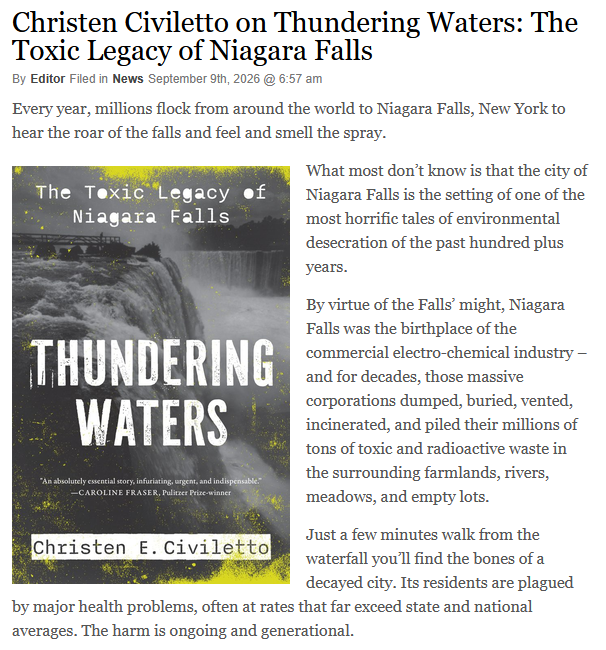
And then last week I interviewed a woman named Christen Civiletto, who’s just out with a book from Princeton University Press called Thundering Waters: The Toxic Legacy of Niagara Falls. I interviewed her, the summary of the interview’s up at CorporateCrimeReporter.com.
Janine, I’ve interviewed like 48 people a year for 40 years for Corporate Crime Reporter, and we run a Q&A format. I had never broken down and cried during an interview, but I did during this. Because she said she grew up in Niagara Falls, went away to law school, worked at a big corporate law firm in Atlanta, and while in Atlanta, her coworkers are telling her, “Why are you always talking about people dying young?” Because she would come home to her 10th high school reunion, and people were dying from cancer and so forth, people were dead from cancer.
And she ended up going back to Niagara Falls for family reasons, and she started litigating these cases and writing about this, and she documents the whole history of how the chemical companies turned it into one huge cancer center. It’s a great book, and it’s a great history of Niagara Falls.
But, yeah, that’s how I got involved, because I said to myself, “What the hell’s going on?” I actually, in preparing for the interview, sent her a picture from the Chicago Tribune with me, 40 years ago, challenging Armand Hammer.
Armand Hammer was the CEO of Occidental Petroleum, which owned Hooker Chemical. President Nixon at the time—revealing my age here—had appointed Armand Hammer to head the President’s Cancer Panel to find a cure for cancer!
I was outraged by this. A guy who had caused cancer in my community, killed off members of my family, friends, people in the community, was head of the President’s Cancer Panel? I stood up and challenged him, and got thrown out. I didn’t know about this photo in the Chicago Tribune until years later, when someone sent it to me.
But yeah, there’s a history of resistance to this kind of corporate crime. What she points out in her book was, in 1901, the first chemical factory was shut down and bankrupted by a group of mothers living in the neighborhood. The first chemical factory was polluting the neighborhood. They basically—unlike us today, us activists today, we litigate, we ask for compromise, we engage in civil settlements—they actually shut the place down; and they did get settlements to their lawsuits.
There was something called the Free Niagara Movement, where Frederick Law Olmsted and a whole bunch of prominent people tried to make Niagara Falls basically like a Yosemite, where the whole place would be protected, and they would put the nascent chemical industry out of business. But they only got to create Niagara Falls State Park, which is just around the falls of the gorge, and the industry flourished around that. There was an opportunity to save it, and unfortunately we didn’t get it done back then, that movement didn’t get it done.
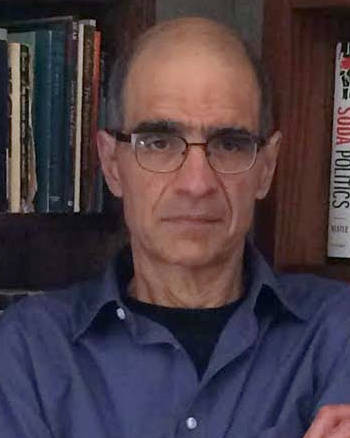
Russell Mokhiber: “We sat around as a message to the future: not to close your eyes, to keep your eyes open, and if you see something, say something and take action.”
So, yeah, that’s how I got started, because I grew up right in the middle of it. I actually returned to the Falls because my cousin Paul, who’s now in his 80s, wanted a roundtable among Mokhiber activists, and it was at my cousin Craig’s house. It was Craig Mokhiber; my cousin Albert, who was with ADC; his daughter Laila; and me and Paul, and we sat around as a message to the future: not to close your eyes, to keep your eyes open, and if you see something, say something and take action. That’s why I was in Niagara Falls. I was in Niagara Falls for that, and to hang out with the family a little bit.
But yeah, it was an eye-opener growing up in the Falls. We didn’t put two and two together. We were young kids. I left there when I was 11, but it always came back, and reading this book really haunted me.
JJ: It’s the same conflicts, and it’s the same questions of “what can I do about it” that folks are facing today. I think your message of, just keep your eyes open and see where you can do something, that’s where we’re at, and that’s powerful.
RM: Well, yeah, I would say, I love this newspaper. I love the Capitol Citizen, and I think your listeners will too. So if you’re listening to this program, go to CapitolHillCitizen.com, make a donation of $5 or more, and we’ll send you the current issue, and spread the word, because we really like it. We think it can be the future underground. Turn off the phone for a few minutes every day, sit with the paper and enjoy it.
JJ: We’ve been speaking with Russell Mokhiber, editor of Corporate Crime Reporter, and editor and writer at the Capitol Hill Citizen, where you can learn how to get a print copy. Thank you so much, Russell Mokhiber, for joining us this week on CounterSpin.
RM: Thank you, Janine.
From FAIR via This RSS Feed.