

Caracas (OrinocoTribune.com)—Venezuelan Acting President Delcy Rodríguez addressed the United Nations General Assembly on Wednesday, September 23, a day after meeting US President Donald Trump in New York. Her speech had originally been scheduled for Thursday but was moved to Wednesday afternoon. The appearance was the first in-person address to the assembly by a Venezuelan head of state since President Nicolás Maduro spoke there in 2018.
Rodríguez called for dialogue and a just peace, invoked the devastation of Venezuela’s June 24 earthquakes, and described the new energy agreement with Washington as important to her country’s economy. She thanked Trump for restoring diplomatic cooperation and announced what she called an orderly, institutional process of institutional strengthening, while demanding the end of the illegal US sanctions. It was a deafening silence her lack of mention of President Nicolas Maduro and First Lady Cilia Flores illegal detention by the US regime.
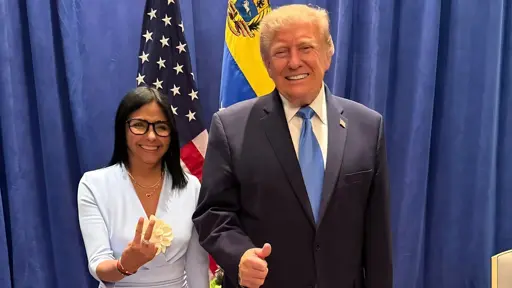
The speech followed a closed-door encounter Tuesday evening at the Lotte New York Palace Hotel, during a reception Trump hosted for foreign leaders attending the 81st General Assembly. Rodríguez called it a “historic meeting” and said the two had discussed energy, mining, security and other areas of cooperation. The image of a Chavista leader seated with the president who ordered a military attack on her country nine months earlier captured the tensions running through Venezuela-US new relationship.
“We held a historic meeting with the President of the United States, Donald Trump, with whom we discussed strengthening the bilateral relationship between our countries and advancing a cooperation agenda in strategic areas such as energy, mining, security and other matters of common interest,” Rodríguez wrote in a post about the meeting.
She thanked Trump and his administration for assistance following the June 24 earthquakes and for supporting Venezuela’s return to multilateral forums. Rodríguez said the historic relationship between the two countries should now be guided by dialogue and concrete benefits for the Venezuelan people.
An encounter under unequal conditionsThe White House account of those present listed Secretary of State Marco Rubio, Treasury Secretary Scott Bessent, White House Chief of Staff Susie Wiles and Deputy Chief of Staff Stephen Miller alongside Trump. Venezuelan Foreign Minister Félix Plasencia and Deputy Foreign Minister Oliver Blanco accompanied Rodríguez. Rubio subsequently called it a short but important meeting focused on economic recovery and “political transition,” according to corporate media.
The encounter was the first between sitting US and Venezuelan leaders since Barack Obama briefly met President Maduro at the 2015 Summit of the Americas in Panama. It followed the January 3 US invasion of Venezuela and the abduction of President Maduro and First Lady and National Assembly Deputy Cilia Flores, who remain held captive by the US regime.
Caracas and Washington agreed on March 5 to restore the diplomatic and consular relations severed in 2019, when Washington backed a failed regime change attempt recognizing former deputy Juan Guaidó as interim president.
Rodríguez had listened on Tuesday as Trump defended the operation against Venezuela from the UN podium and presented access to its oil as a prize of war. “To the victor belong the spoils,” he said. That boast makes the question of who controls Venezuela’s resources unavoidable in any assessment of the talks. However, the fact that the US is forced to deal with a Chavista government to gain its strategic interest is seen by many analysts as a sign of the complexities in the relationship.
The symbolism of the photographIn a photograph circulated by the Venezuelan presidency, Rodríguez raises two fingers in a V for victory while holding her other hand in a clenched fist beside Trump. The gestures recall President Maduro’s V sign after his forced arrival in the United States. Some supporters read the image as a show of resolve by a leader obliged to negotiate with the government holding Venezuela’s president; other observers saw tension in her clenched hand. A photograph cannot establish what Rodríguez intended, but the contrasting interpretations reveal the political weight of the meeting.
Critics on the left have questioned whether agreements negotiated after the invasion concede too much control to Washington. That concern has been sharpened by Trump’s language about Venezuelan oil and US oversight of its revenues. Within Chavismo, National Assembly President Jorge Rodríguez defended acting president’s difficult diplomatic course on Wednesday, portraying her participation at the UN as a victory for Venezuela. The encounter also disappointed far-right opposition politicians—in Venezuela and the US—who had expected the US attack to remove Chavismo from power. None of these competing reactions, on their own, have created a split within Chavismo.
Some Venezuelan politicians have also celebrated a sovereign-risk reading near 6,030 basis points in the context of the New York visit. The date matters: financial reporting recorded 6,037 basis points on September 3, nearly three weeks before the Trump meeting. The figure therefore cannot demonstrate that Tuesday’s encounter caused a sudden fall from 9,000. Even around 6,000 basis points, Venezuela’s borrowing-risk premium remains exceptionally high.
A wider diplomatic agendaRodríguez’s UN visit began Monday with meetings with the heads of the Inter-American Development Bank, International Monetary Fund and World Bank, followed by talks with UN Secretary-General António Guterres. The financial discussions concerned reconstruction, technical cooperation and renewed access to international institutions. They took place as Venezuela confronts the damage from the earthquakes and the continuing effects of US sanctions.
The acting president has also met Trinidad and Tobago Prime Minister Kamla Persad-Bissessar and Dutch Prime Minister Rob Jetten, according to her social media posts. On Tuesday she briefly spoke with Spanish Prime Minister Pedro Sánchez, and both expressed interest in continued contact. Chilean President José Antonio Kast has scheduled a meeting with her at UN headquarters for Thursday afternoon, September 24. These engagements span neighbors and governments with sharply different positions toward Venezuela.
The National Assembly also authorized Rodríguez’s travel on Wednesday. Article 235 of Venezuela’s Constitution requires parliamentary or Delegated Commission authorization when a president’s absence from national territory exceeds five consecutive days. The authorization permits a longer stay; by itself, it does not confirm how long Rodríguez will remain abroad.
Her return to the UN at presidential level brings Venezuela’s case to an international forum while President Maduro and Flores remain imprisoned in the United States. Whether the diplomacy yields reconstruction assistance, relief from coercive measures or progress toward their release remains an open question for many analysts.
Special for Orinoco Tribune by staff
OT/JRE/JRE
From Orinoco Tribune via This RSS Feed.